B2B Sales Benchmarks: Key Metrics, Insights, And Best Practices



You’re at the weekly pipeline review, scrolling through a dashboard that shows great reply rates but a miracle-level win rate someone insisted on hitting, and you realize the team has been using one-size-fits-all benchmarks as quotas and calling it a plan. The hidden problem isn’t effort, it’s mismatched signals: mixing outbound with inbound, treating benchmarks as targets, ignoring AI-driven sequencing and tiny sample sizes that make numbers lie.
Read on and you’ll get clear, usable guidance: what true B2B sales benchmarks are, which funnel and economic metrics matter, how to segment and cohort so comparisons are fair, and how to turn gaps into prioritized experiments and realistic quotas so your next review stops being a guessing game.
What Are B2B Sales Benchmarks?
Benchmarks are objective reference points, built from aggregated performance data, that tell you what "good" looks like for specific sales metrics. They are not goals, they are industry or stage-based expectations you compare your performance against. Use them to diagnose problems, prioritize experiments, and set realistic targets.
They are especially useful for B2B because sales cycles are long, deals are lumpy, and performance is influenced by product-market fit, pricing, and GTM maturity. Benchmarks turn noisy signals into clear signals you can act on.
Which Metrics Define Benchmarks?
Benchmarks typically group into buckets:
- Pipeline and conversion rates, for funnel health.
- Revenue and deal metrics, for outcome quality.
- Efficiency and cost metrics, for resource productivity.
- Time-based metrics, like sales cycle length and ramp time.
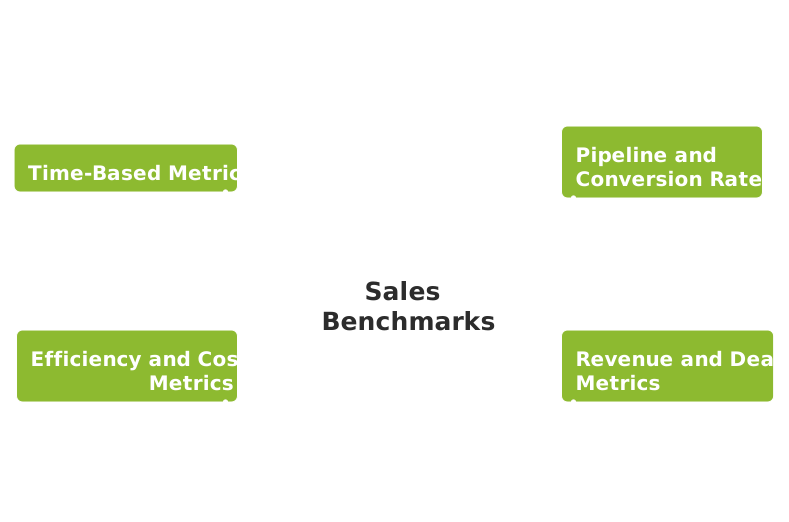
Pick the bucket that answers the question you have. If you want to know whether the problem is lead quality, look at MQL to SQL and SQL to opportunity rates. If you worry about unit economics, look at CAC and LTV.
Remember, outbound is now a marketing motion. Benchmarks must account for marketing-driven outbound performance, AI-assisted sequencing, and automation that replaces traditional SDR tasks. Benchmarks tied to old SDR headcount models will mislead you.
Why Benchmarks Matter For Growth?
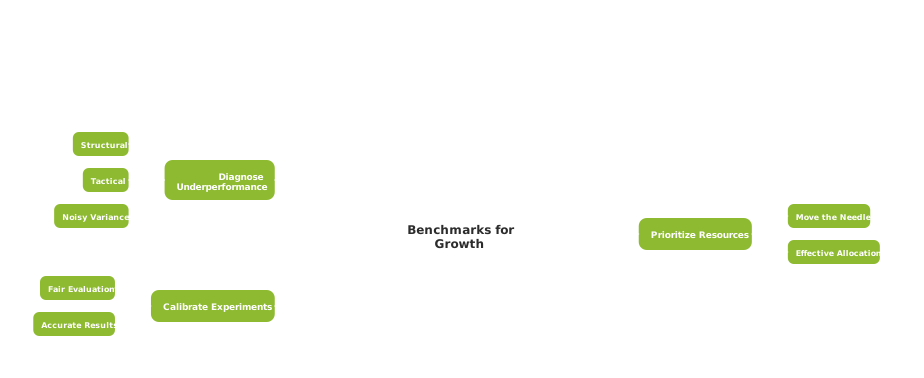
Benchmarks do three things that matter for growth.
- Diagnose. They show whether underperformance is structural, tactical, or just noisy variance.
- Prioritize. You can triage limited engineering, content, or SDR resources where they move the needle.
- Calibrate experiments. Benchmarks create guardrails so A/B tests and new channels get evaluated fairly.
GTM is a system, not a collection of tactics. Benchmarks help align workflows, infrastructure, and feedback loops. They also let marketing and sales speak the same language when outbound is run as a scaled, signal-driven motion.
How Do Benchmarks Differ From Targets?
Benchmarks are external reference points, targets are internal commitments.
- Benchmarks say what is typical or possible in a segment or stage.

- Targets say what you will achieve given strategy, capacity, and objectives.
Use benchmarks to set realistic targets. If your benchmarked win rate is 18 percent, setting a target of 40 percent without a product or pricing change is fantasy. Targets should reflect ambition plus a plan to improve above the benchmark through investment or strategy.
When you push targets above benchmarks, document the assumptions. Are you counting on AI-driven personalization, hiring more reps, or a new pricing model? That helps the organization evaluate progress and course-correct.
Which Metrics Should You Track?
Track the fewest metrics that answer the basic questions: Is the funnel full? Is the funnel converting? Are deals profitable? Which levers to pull next? Focus on conversion rates, deal economics, and efficiency.

Start with pipeline health, then revenue quality, then efficiency. If you run outbound, treat it like a marketing channel and include channel-level metrics: response rate, positive reply rate, meetings per 1,000 prospects, etc. AI makes outbound cheap and scalable, so those channel metrics now matter as early indicators.
Which Pipeline And Conversion Metrics?
Core pipeline metrics:
- Lead volume by source, per period.
- MQL rate and MQLs per rep.
- SQL rate.
- Opportunity creation rate.
- Opportunity-to-win rate, by stage and rep.
- Pipeline coverage ratio, required pipeline vs quota.
Channel-specific metrics for outbound:
- Outreach volume (emails, touches).
- Reply rate and positive reply rate.
- Meetings booked per 1,000 sequences.
- Meeting-to-opportunity conversion.
These show where friction sits. Low reply rates point to targeting or message problems. Low meeting-to-opportunity conversion points to qualification or demo problems.
Which Revenue And Deal Metrics?
Revenue-focused metrics you need:
- Average deal size, ACV, and ARR.
- Win rate, by segment, rep, and channel.
- Revenue by cohort and LTV by cohort.
- Renewal and churn rates for subscription businesses.
- Upsell and expansion rates.
These metrics tell you whether growth is predictable and profitable. For B2B, cohort analysis matters more than raw revenue. Look at the same-cohort retention and expansion to know if you can scale.
Which Efficiency And Cost Metrics?
Efficiency and cost metrics show how scalable the motion is:
- Customer acquisition cost, CAC, and CAC payback period.
- Cost per lead, and cost per opportunity.
- Sales efficiency metrics like sales velocity and revenue per sales full time equivalent.
- Ramp time to quota and quota attainment distribution.
- Marketing originated revenue and pipeline efficiency.
As SDRs get automated, track automation throughput and cost per booked meeting. GTM now requires technical operators, so include platform and tooling costs in CAC when relevant.
How Do You Calculate Each Metric?
Give formulas, use consistent time frames, and segment by source or cohort. Here are the standard calculations.
Pipeline & conversion
- Lead-to-MQL rate = MQLs / Leads.
- MQL-to-SQL rate = SQLs / MQLs.
- SQL-to-opportunity rate = Opportunities / SQLs.
- Opportunity-to-win (win rate) = Closed won / Opportunities.
- Pipeline coverage = (Total pipeline value) / (Quota x expected close rate).
Example: If quota is $1M and expected close rate is 25 percent, required pipeline = $1M / 0.25 = $4M.
Revenue & deal metrics
- Average deal size = Sum deal value / Number of deals.
- ACV = Total contract value / contract years or average annualized value.
- ARR = Sum of annualized recurring revenues.
- Net revenue retention = (Renewal + Expansion - Churn) / Starting ARR for the cohort.
Efficiency & cost metrics
- CAC = Total sales and marketing spend for a period / New customers acquired in that period.
- CAC payback = CAC / Gross margin adjusted monthly recurring revenue added per month.
- Sales velocity = (Number of opportunities x Win rate x Average deal size) / Sales cycle length in days.
That yields revenue per day through the funnel.
- Cost per lead = Marketing spend / Number of leads from that channel.
- Ramp time = Average time from hire to first quota achieving month.
Channel metrics for outbound
- Reply rate = Replies / Outreach attempts.
- Positive reply rate = Positive replies / Outreach attempts.
- Meetings per 1,000 = Meetings booked / Outreach attempts x 1000.
How you bucket time matters. Use cohort windows that match your sales cycle. For example, if your average sales cycle is 90 days, evaluate conversion rates with at least a 90-day window.
If you use tools, enrich and segment consistently. For outreach run as marketing, tracking performance by sequence, persona, and list quality is essential.
Mentioning a tool is relevant here. Clay can enrich and validate prospects, automate activation of sequences, and provide signals you can use to segment outbound lists. Using this link to Clay gives you 3,000 free credits: https://clay.com/?via=salescaptain. Use the enrichment to reduce false leads, improve match rates, and feed accurate channel metrics into your dashboard.
Practical tip, especially for teams using automation: attribute meetings and pipeline to specific sequences and data signals so you can compare manual SDR output to automated outreach fairly.
How Do Benchmarks Vary By Industry And Size?
Benchmarks are not one number. Industry, contract type, price point, and company size shift everything. Benchmarks should be a function of your vertical and your GTM model, not a generic conversion table.
SaaS selling to enterprise buyers will show lower reply rates, longer cycles, and higher ACVs than transactional B2B. Supply chain or manufacturing B2B may have low churn but high procurement friction. Know your buyer's procurement rhythm before you apply a benchmark.
What Benchmarks Look Like By Industry?
Typical patterns:
- Enterprise SaaS: lower lead-to-opportunity rates, win rates around 15 to 25 percent, long sales cycles 6 to 12 months, high ACV.
- Mid-market SaaS: higher conversion rates, shorter cycles, ACV medium, churn moderate.
- Low-touch SaaS or product-led: high volume, lower ACV, fast cycle, heavy reliance on product-qualified leads.
- Services and agencies: higher deal variability, high upfront CAC, strong emphasis on consultative qualification.
- Hardware or manufacturing: long procurement cycles, low churn but long implementation, lower reply rates for cold outreach.
These are patterns, not rules. The arrival of AI and programmatic outbound shifts reply and meeting rates, especially for sectors receptive to rapid personalization. Use vertical benchmarks as starting points, then refine with your own cohort data.
How Do Benchmarks Change By Company Size?
Company size affects benchmarks in two ways: buyer complexity and resource constraints.
- Startups and SMBs selling to SMBs usually have shorter cycles, higher reply rates, and lower ACVs. Expect faster feedback loops and ability to iterate quickly.
- Mid-market sellers face mixed realities, with a need for both scalable outbound and some sales motion. Benchmarks sit between low-touch and enterprise.
- Enterprise sellers face longer approval processes, multiple stakeholders, and often lower win rates but higher deal value.
Operationally, smaller companies may measure velocity and meetings per rep, while larger organizations focus on cohort LTV, net retention, and multi-quarter pipeline health. Benchmarks for efficiency also differ; an SMB might accept higher CAC to grow quickly, an enterprise seller needs predictable CAC payback.
When Should You Use Vertical Benchmarks?
Use vertical benchmarks when:
- You sell into a defined industry with known procurement patterns, because general benchmarks mislead.
- You run targeted outbound sequences where list quality and signal differ by vertical.
- You need to justify resource allocation to leadership, and comparisons must be apples-to-apples.
Avoid vertical benchmarks when:
- Your product spans many industries and your GTM is horizontal, because variance will be large.
- Your company is experimenting with new channels or motions and you need baseline internal benchmarks first.
If you lack vertical benchmarks, start internal. Track cohorts by industry for 2 to 3 sales cycles. Use those cohorts as your working benchmark and compare to external industry data to spot large mismatches.
Practically, many teams accelerate learning by partnering with specialists. Cold outreach agencies can help set realistic expectations and run experiments faster. If you need rapid outbound scale or sequence engineering, consider working with cold outreach agencies that act as GTM accelerators, not just vendors. For teams looking for a cold outreach agency or help with cold email outreach, an experienced partner can shorten the learning curve. If you want to compare vendors or get started, look at options from cold outreach agencies for pilot programs and measurement frameworks: https://www.salescaptain.io/cold-outreach-agencies.
Final note, benchmarks are tools, not mandates. Treat them like hypotheses you test against your cohort data, and iterate your GTM system with engineering, automation, and feedback loops to move the needle.
How Do Sales Models Affect Benchmarks?
Sales model shapes every benchmark you measure, because motion determines volume, signal, and effort per deal. Below are the common contrasts and what they change in practice.
How Do Inside And Field Sales Compare?
Inside sales
- Volume and speed, higher meeting throughput per rep, shorter cycles.
- Benchmarks: higher meeting-to-opportunity conversion, lower ACV, lower CAC per rep but often higher cost per deal when you include automation and tooling.
- Metrics to watch: meetings per rep per week, demos-to-opportunity %, time-to-first-meeting.
Field sales
- Fewer touches, deeper qualification, longer cycles, higher ACV.
- Benchmarks: lower reply and meeting rates from cold outreach, higher opportunity-to-close rates once qualified, longer stage durations (discovery, procurement).
- Metrics to watch: deal velocity across long stages, number of stakeholders engaged, average sales cycle in days.
Operational implications
- Inside motions reward tooling, sequences, and audience hygiene.
- Field motions reward account mapping, executive alignment, and bespoke content.
- Treat outbound as a marketing motion in both cases, run lists and sequences like campaigns, and measure outreach as a channel so inside teams scale predictably.
What Changes With SDR Led Or Product Led Models?
SDR-led
- Predictable pipeline if lists and sequences are clean.
- Benchmarks: meetings per 1,000 touches, positive reply rate, SQL-to-opportunity conversion depend on targeting quality.
- SDR efficiency now combines human and automated tasks, so track automation throughput separately from rep output.
Product-led
- Benchmarks move to activation and PQL conversion: activation-to-paid %, trial-to-paid %, time-to-PQL.
- Lower ACV, higher volume, shorter cycles for self-serve seats, but upsell and expansion drive LTV.
- Measure product engagement signals as early funnel metrics, not just marketing touches.
What shifts when you switch
- KPIs move from manual activity (calls, dials) to signal quality (usage events, intent score).
- SDR roles shift to sequence engineering, qualification by signals, and technical ops. Expect fewer low-skill SDRs and more technical operators who maintain automation and signals pipelines.
How Do Channel And Partner Sales Differ?
Channel and partner sales change attribution, timing, and economics.
- Benchmarks: partner-sourced lead-to-opportunity rates tend to be higher, initial close velocity slower because of co-selling steps, deal sizes often larger due to bundled services or credibility lift.
- Costs: lower direct CAC but shared margins and longer onboarding costs for partner enablement.
- Metrics to track: partner activation rate, time-to-first-deal, partner pipeline velocity, percent of pipeline attributable to partners.
Attribution and governance
- Track lead source, partner ID, and partner-influence flags in CRM.
- Normalize partner deals separately for fair comparison, because the sales play and costs differ from direct motions.
Operational note
- Partners are a lever for scaling reach, not a plug-and-play growth engine. Measure partner enablement and retention the same way you measure customers.
What Are Typical Stage Benchmarks?
Benchmarks vary by motion and segment, but practical ranges help you spot outliers quickly. Use these as starting points, then replace them with your cohort data.

What Are Lead To Opportunity Rates?
Expect wide variance by source and motion:
- Cold outbound: 0.5 to 3 percent lead-to-opportunity.
- Inbound marketing: 5 to 20 percent.
- Product-led or PQL flows: 2 to 10 percent, depending on onboarding quality.
- Partner-sourced: 10 to 30 percent.
How to use the numbers
- Compare like-for-like. Don’t mix cold lists with inbound when calculating a single bench.
- Use medians, not means. A few viral campaigns can skew averages.
What Are Opportunity To Close Rates?
Win rates depend on deal size and buyer complexity:
- Enterprise: 10 to 25 percent.
- Mid-market: 20 to 35 percent.
- SMB / low-touch: 30 to 60 percent.
- Channel-assisted deals: often 25 to 45 percent, variable by partner maturity.
Practice tip
- Break win rate by stage entry point. Opportunities that enter at "qualified after demo" should benchmark differently than "qualification-incomplete" opportunities.
What Is A Normal Stage Duration?
Stage lengths vary by motion, use medians and percentiles:
- Initial contact to meeting: 3 to 14 days in inside motions, longer for enterprise.
- Discovery to proposal: 7 to 30 days for mid-market, 30 to 90 days for enterprise.
- Negotiation to close: 7 to 60 days depending on procurement complexity.
Measure stage duration as an event series, not static fields. Use the timestamp of the stage-change event to avoid bias from manual edits.
What Is A Typical Sales Cycle By Deal Size?
Use ACV bands as a quick rule of thumb:
- $5k to $50k ACV: 1 to 3 months.
- $50k to $250k ACV: 3 to 6 months.
- $250k+ ACV: 6 to 12+ months.
Don’t treat these as laws
- Vertical, procurement cadence, and whether the motion is product-led or sales-led change these dramatically.
- Always cohort by deal size and motion when you report cycle benchmarks.
How To Build Your Own Benchmark Report?
Benchmarks only help if your data is solid, your segments are meaningful, and your distributions reach the right people. Below is a practical playbook to build a repeatable report.
Which Data Should You Pull From CRM?
Pull raw event-level and master-record fields:
- Timestamps for each stage change, lead creation, first contact, meeting booked, opportunity created, and close date.
- Deal fields: deal value, ACV, contract length, product line, ARR.
- Account fields: industry, employee count, region, account tier.
- Contact fields: role, seniority, decision maker flags.
- Source and campaign IDs, sequence or outreach template ID, channel attribution, partner ID if applicable.
- Activity logs: outreach attempts, replies, meetings, demo attendance.
- System fields: owner, team, region, created by, source import flags.
How to use enrichment
- Enrich bad or missing firmographic fields to improve segmentation. Use Clay to append clean company and contact fields, firmographics, and intent signals, this link gives 3,000 free credits: https://clay.com/?via=salescaptain. Enrichment reduces false leads and improves channel-level benchmarks.
How Do You Clean And Normalize Data?
Cleaning is an engineering task, not manual guesswork:
- Deduplicate accounts and contacts using canonical keys, domain matching, and manual review for edge cases.
- Canonicalize company names and normalize currency and fiscal quarters.
- Standardize stage definitions across teams, map legacy stages to a single stage taxonomy, and lock the mapping.
- Remove test, demo, and low-quality imports via flags.
- Backfill missing timestamps using rules, for example use first activity timestamp if stage-change timestamp is missing.
- Winsorize or trim extreme outliers for duration and value calculations, but keep a separate outlier log for investigation.
- Use median and percentiles for timing metrics, arithmetic mean only for sums and totals.
Automation-specific notes
- Tag whether a meeting came from automation, a sequence, or a human SDR. Track automated vs human throughput to avoid skewed productivity benchmarks.
How Should You Segment And Cohort?
Segment before you aggregate:
- Core segments: motion (inside vs field), channel (inbound, outbound, partner, product-led), deal size band, vertical, region.
- Cohorts: by lead creation month or cohort start, and by acquisition channel for at least one full sales cycle.
- Minimal viable segmentation: start with motion + deal size + channel. You can add verticals later.
- Use cohorts sized to yield statistical power, avoid tiny buckets that produce noise.
Practical cohort rules
- Use a cohort window at least as long as your 80th percentile sales cycle.
- Freeze cohorts after a reasonable attribution window to avoid reattributing old leads when evaluating conversion.
How Do You Visualize And Distribute Findings?
Visualize for action, not vanity:
- Essentials: funnel conversion rates by channel, stage duration heatmap, cohort retention and expansion tables, win rate by segment, and pipeline coverage vs quota.
- Use visuals that expose friction: Sankey for funnel leaks, box plots for stage durations, and cumulative win-rate curves by cohort.
- Dashboards: interactive for ops and managers, monthly PDF executive summary for leadership, and weekly alerts for major deltas.
Distribution and cadence
- Weekly operational digest for sales ops and SDR managers with short next-step recommendations.
- Monthly performance review with GTM leaders that includes cohort comparisons and hypothesis-driven experiments.
- Quarterly strategy deck that folds benchmarks into capacity planning and financial forecasts.
Embed benchmarks into workflows
- Put benchmark thresholds into SLAs and alerts so ops gets pinged when conversion or velocity drops.
- Use the report to create experiment backlogs, not just scoreboard updates. Benchmarks should drive specific tests on list quality, sequence changes, pricing, or tooling.
Final note
- Benchmarks are living artifacts. Re-run and re-cohort every quarter, automate the pipelines that produce the report, and treat the results as inputs to your GTM system, not as a scorecard you glance at once a quarter.
Where Can You Find Reliable Data?
Reliable benchmarks come from three places, each with tradeoffs: large third party studies, vendor or community PDFs, and your own CRM and analytics systems. Use third party studies to set expectations, vendor PDFs to understand playbooks and assumptions, and your CRM to validate applicability. Always check sample size, segmentation, time window, and whether outbound is treated as a marketing channel in the methodology. If AI or automation tools are baked into a report, that shifts expected reply and meeting rates upward.
Which Third Party Reports To Use?
Pick sources known for methodology and sample size, not flashy headlines. Useful reports:
- Bridge Group, for SaaS sales compensation and quota data.
- OpenView and SaaStr, for go-to-market patterns and velocity in SaaS.
- Gartner or Forrester, for enterprise buying behavior and vendor comparisons.
- TOPO/CSO Insights, for funnel and process benchmarks.
- Industry-specific research from IDC or vertical associations when you sell into regulated markets.
How to evaluate a report:
- Check sample size and cohort breakdowns by ACV, motion, and vertical.
- Prefer medians and percentile bands over single averages.
- Note the data window, because AI-driven outbound changed reply and meeting rates quickly.
- Avoid vendor marketing studies that lack raw counts or that present selective cohorts.
Use third party reports to set conservative guardrails, then test those guardrails against your cohorts.
How To Use PDFs Like Ebsta Or Pavilion?
Vendor and community PDFs are practical but require skepticism. Treat them as hypothesis sources, not gospel. Actions that add value:
- Read the methodology section first. If they omit sample size or cohort definitions, devalue the numbers.
- Extract tables into CSV for comparison. Tools like Tabula, pandas read_pdf, or simple copy-and-paste into spreadsheets work. Save the original PDF link with notes on sample size and time period.
- Normalize the metrics to your definitions, for example convert "reply rate" definitions to match your outbound taxonomy.
- Audit for bias, especially if the vendor sells a solution that inflates a metric they report on.
- Use community reports to learn playbooks and sequence examples, then run A/B tests before adopting their KPIs as targets.
PDFs are idea generators. Use them to design experiments, not to set quotas without validation.
Which CRM And Analytics Tools Help?
Your CRM and analytics stack should be the primary source for benchmarks because it reflects reality. Prioritize tools that capture event-level data, sequence IDs, and source attribution. Recommended categories:
- Enrichment and list hygiene: Clay, ZoomInfo, Clearbit.
- CRMs that support event-level stage changes: Salesforce, HubSpot, Pipedrive.
- Conversation and meeting analytics: Gong, Chorus.
- BI and analytics: Looker, Mode, Metabase, or a data warehouse + SQL layer.
- Sequence and outbound platforms: Outreach, SalesLoft, and any automation that tags sequence and template IDs.
Start with a clean single source of truth in a data warehouse. Push canonical CRM events there and run your cohort calculations from that layer so dashboards are reproducible.
How to use Clay for enrichment and segmentation
- Why Clay first, then other tools: Clay is lightweight for app-native enrichment and automation, and it can fill firmographic and contact gaps quickly. Using this link gives you 3,000 free credits: https://clay.com/?via=salescaptain.
- Practical steps: batch-enrich your CRM exports to fill missing firmographics, append intent or technographic signals where available, and output a segmentation key you can join to opportunity records.
- Output hygiene: write back only canonical fields, tag records you changed, and keep an enrichment timestamp so you can audit cohort stability.
- Use Clay to build high-signal lists for experiments, then attribute sequence performance back to the list-level field you created.
If you use other tools, make sure sequence and template IDs, automation vs human flags, and inbound source tags are captured at creation time. That makes benchmarking fair and repeatable.
How To Use Benchmarks To Set Quotas?
Benchmarks should inform quota setting, not replace judgement. Translate external and internal benchmarks into achievable quotas by combining expected pipeline conversion, average deal size, ramp profiles, and capacity. Always document the assumptions that lift a quota above the benchmark, like AI-assisted personalization or new product pricing.
How To Translate Metrics Into Quotas?
Turn funnel math into a quota plan:
- Start with target revenue per rep for the period.
- Divide target revenue by expected ACV to get required closed deals.
- Inflate required deals by inverse win rate to get needed opportunities.
- Inflate opportunities by inverse opportunity creation rate to get required SQLs and MQLs.
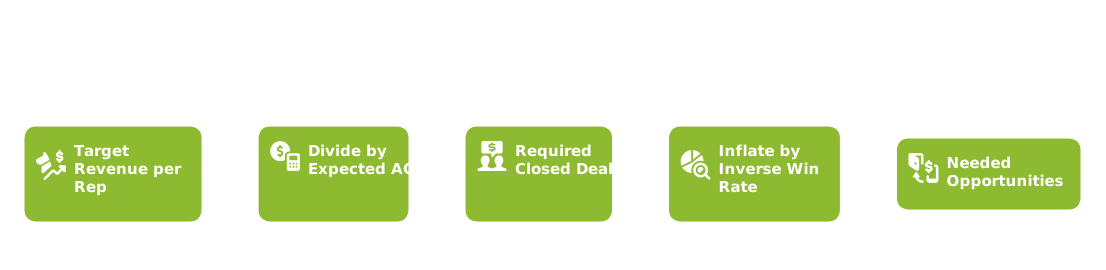
Example: $1M quota, $50k ACV, 25 percent win rate means 20 closed deals, 80 opportunities, and if opportunity creation from SQL is 40 percent you need 200 SQLs.
Key checks:
- Use median conversion rates from your cohort, not industry means.
- Add buffer for pipeline coverage, typically 3x to 5x depending on win-rate variability.
- Translate required upstream volume into list size and outreach capacity, accounting for reply and meeting rates when outbound is a channel.
Document each conversion factor and its source so you can revise quotas when the assumptions change.
How To Adjust For Ramp And Territories?
Quotas must reflect ramp and territory realities:
- Ramp: use a time-weighted quota for new hires, for example 25 percent month 1, 50 percent month 2, 75 percent month 3, then 100 percent by month 4. Align ramp to your median time-to-first-close, not an arbitrary calendar.
- Territories: normalize quotas for TAM and historical win rates by territory. If a rep covers a smaller TAM but higher win rates, set a proportional quota tied to addressable market.
- Partial-year hires: prorate quotas and adjust expectations for activity conversions, since shorter exposure reduces deal pipeline buildup.
Operationally, bake ramp and territory logic into quota spreadsheets and your compensation engine so payroll and forecasts match the quota model.
How To Build Forecasts From Benchmarks?
Build forecasts from the funnel backwards and validate forwards:
- Use cohort-based conversion rates to convert pipeline by stage into expected closed revenue. Apply stage-specific close probabilities derived from your own data.
- Create scenario layers: baseline using median rates, conservative using lower quartile, and stretch using upper quartile or planned improvements.
- Include timing by using stage duration percentiles to estimate conversion timing, not just probability.
- Adjust for pipeline quality signals like intent score, sequence origin, or enrichment confidence.
- Run a forward-looking sensitivity test: change a single lever like reply rate or win rate by 10 percent to quantify revenue impact.
Forecast cadence matters. Run weekly operational checks on lead inflow and stage movement, and monthly reforecast that updates stage probabilities with new cohort performance.
What Is A Practical Improvement Playbook?
An improvement playbook turns benchmark gaps into experiments, not directives. The playbook below is tactical and prioritized. It treats outbound as a marketing motion, uses automation for scale, and expects GTM to operate as a system with feedback loops.
Step 1: Diagnose Performance Gaps
Find the weakest link with data, not anecdotes:
- Compare your funnel to benchmark bands by channel and motion to find outliers.
- Break anomaly down to owner, list, sequence, persona, and deal size. For example low meeting-to-opportunity might be a bad demo script or poor qualification.
- Look for signal mismatches, such as high reply rate but low qualified meeting rate, which points to targeting or messaging misalignment.
- Validate with samples: pull recent lost/opportunity records and listen to calls or review sequences for root causes.
Keep diagnostics short and hypothesis-driven, then move to experiments.
Step 2: Prioritize High Leverage Metrics
Pick metrics that move revenue fastest:
- Prioritize conversion steps nearest to close, like win rate and opportunity conversion, when pipeline is thin.
- Prioritize top-of-funnel metrics like reply and meeting rates when you lack volume.
- Use ROI scoring: expected revenue impact divided by implementation cost and time to learn.
- Favor experiments that improve signal quality, since better signal compounds across later funnel stages.
Create a 90-day backlog ranked by leverage, and commit one high-impact experiment per cadence.
Step 3: Design Experiments And Plays
Build experiments like engineers, not wishful thinkers:
- Define hypothesis, primary and secondary metrics, required sample size, and success criteria upfront.
- Randomize where possible, for example A/B test sequences across matched lists or run parallel pricing on similar cohorts.
- Make changes atomic, change one variable at a time: subject line, persona, call-to-action, pricing tier.
- For outreach tests, control for list quality using enrichment and segmentation so you compare apples to apples.
- Capture qualitative learnings, like objection themes from sales conversations, alongside quantitative metrics.
Run short learning cycles, 2 to 6 weeks for outreach tests, longer for pricing or playbook changes.
Step 4: Measure, Iterate, And Scale
Turn wins into standard operating procedures:
- If an experiment meets success criteria, document the play, create templates, and operationalize it into sequences, training, and launch checklists.
- Measure performance decay. Some wins fade as lists saturate or competitors copy the play, so monitor decay curves and refresh plays.
- Scale with guardrails, for example only expand a sequence once it maintains lift across 3 different lists and two reps.
- Archive failed experiments with clear reasons and next steps. Failures teach what not to scale.
- Feed results into capacity and quota planning so forecast assumptions reflect the new baseline.
Improvement is iterative. Use benchmarks to pick the next test, then repeat the cycle until the metric meets your target.
Which Mistakes Should You Avoid?
Why You Must Not Compare Apples To Oranges
Benchmarks only work when the underlying signals are comparable. Don’t mix motions, ACV bands, or channels when you benchmark a metric, because cold outbound, inbound, and product-led flows behave differently. Normalize by motion, deal-size band, and cohort window before you compare. Map your CRM stages and definitions to the external report’s definitions, then discard any rows that don’t match. If you ignore this, you’ll chase the wrong fixes and penalize the channels that actually perform for your GTM system.
Why Small Samples Mislead
Small samples create wild variance and false confidence. A sequence that books three meetings from 100 touches looks great until it runs on a second list and collapses. Use practical minimums: for outreach metrics, aim for hundreds of sequences or at least 500 to 1,000 touches per test; for win rates, use 50 to 100 closed opportunities before treating the rate as stable. If you can’t reach those sizes, run randomized lifts across matched lists or extend the test window rather than locking decisions on a tiny sample. Always report percentile bands, not just a single average.
Why Ignoring Seasonality Harms Decisions
Buyer behavior ebbs and flows by quarter, industry budget cycles, and holidays. Comparing a November campaign to a March baseline will mislead you, especially for enterprise deals near fiscal year ends. Use same-quarter year over year comparisons, rolling 12-month baselines, or seasonally adjusted views that match your sales cycle length. Annotate major events, product launches, or macro shocks so you can separate durable trend from calendar noise. If you don’t, you’ll tweak playbooks for a temporary lull and break real momentum.
Why Overemphasizing A Single Metric Fails
Focusing on one metric creates perverse incentives. High reply rates that produce no qualified meetings mean you optimized for noise, not revenue. Always pair upstream metrics with downstream outcomes, for example reply rate plus meeting-to-opportunity conversion and win rate. Track unit economics alongside activity metrics, so a lift in meetings also improves CAC and CAC payback. Treat your GTM as a system, run experiments that measure multiple linked metrics, and refuse to scale a lead driver until it proves value across the funnel.
How Have Benchmarks Changed Since 2021?
What Major Shifts Occurred Since 2021?
Three big shifts reshaped benchmarks. First, AI and automation made outbound cheaper and more scalable, lifting reply and meeting rates for teams that use signal-driven personalization. Second, list and sequence hygiene became a competitive advantage, because small differences in match quality compound across automated touches. Third, SDR roles shifted toward technical operators who manage sequences and data pipelines, so human output and automation throughput must be benchmarked separately. These shifts raised ceiling rates for some metrics but also increased variance across teams.
What Did Ebsta And Pavilion Find?
Vendor and community reports like those from Ebsta and Pavilion tend to converge on a few practical themes. They underscore the value of clean data and proper segmentation, show higher early-funnel activity when teams adopt personalization, and caution that averages hide wide percentile gaps. Their recommendations typically favor rigorous measurement, cohort-based comparisons, and playbooks tied to channel-level performance. Read their methodology sections first, then use their findings as hypothesis starters rather than hard quotas.
How To Interpret Year Over Year Variance?
Don’t treat YoY changes as a single verdict. Break the variance into drivers: changes in motion, list quality, product or pricing, macro effects, and tool adoption like automation or AI. Use cohort-based YoY comparisons that match cohort start dates and sales-cycle lengths. Quantify how much each driver explains the delta, for example run a simple attribution where you hold list quality constant and measure the incremental lift from new sequences. If a metric moves and the cause is unclear, design a targeted experiment to validate causality before you change quota, compensation, or headcount.
What Templates And Checklists Help?
Benchmark Report Template To Use
A practical report includes three panes: context, channel breakdown, and action. Context covers cohort definitions, sample sizes, and methodology notes. Channel breakdown lists funnel conversion rates, stage durations, and efficiency metrics by motion, deal-size band, and vertical. Action rows map anomalies to owners, hypotheses, and next-step experiments. Keep the executive page to two charts and three prioritized actions, the ops page as the full data table, and a reproducible SQL or notebook tied to the report so you can rerun it each quarter.
Monthly Sales Benchmark Review Checklist
Use a short checklist to keep reviews focused:
- Confirm cohort windows match sales cycle length.
- Verify sample sizes for each segment meet minimum thresholds.
- Compare channel-level conversion funnels to prior quarter and same quarter last year.
- Flag any metric outside the 10th or 90th percentile band and assign an owner.
- Validate recent experimentation changes and their impacts.
- Decide one operational change and one experiment to run this month.
Keep the review under 60 minutes, with a one-paragraph decision log for leadership.
Data Collection And Segmentation Template
Capture a minimal set of canonical fields for every record:
- Timestamps: lead created, first contact, meeting booked, opportunity created, close date.
- Deal fields: ACV, contract length, product line.
- Account and contact: industry, company size band, region, buyer role.
- Attribution: channel, sequence ID, list ID, automation flag.
Create a segmentation key that concatenates motion + ACV band + vertical + channel. Store the segmentation key on every opportunity and snapshot it at creation time. That lets you compare apples to apples and rerun cohort analyses reliably without reprocessing historical records.
FAQs


RELATED ARTICLES
Lorem ipsum dolor sit amet, consectetuer adipiscing elit, sed diam nonummy nibh euismod tincidunt ut laoreet dolore magna aliquam erat volutpat.
.png)
.png)