

Launching a product is hard. Most teams get stuck somewhere between building and selling. They know what they’ve built is valuable, but they don’t know how to position it, pitch it, or get it in front of the right people.
That’s where GTM agencies come in. The good ones don’t just “help with marketing.” They guide your offer, messaging, targeting, and channels, from strategy to execution, so your product actually lands and starts selling.
In this article, we’ve listed the top go-to-market agencies that are doing real work for real companies. We looked at how they approach strategy, how deep they go into positioning, and how fast they move. These aren’t just creative agencies with fancy decks. They’re hands-on partners who know how to launch.
If you’re planning to launch something serious in 2026, this list will help you find the team to back it up.

Let’s keep it simple. A GTM agency helps you bring a product or service to market the right way, with a clear plan, strong positioning, and an execution strategy that actually makes sense for your audience.
It’s not just about marketing. It’s about timing, messaging, and knowing where and how to show up.
A GTM agency works with your team to figure out what you're selling, who it's for, and how to get it in front of them. That might sound obvious, but most companies launch with vague positioning, broad targeting, and channels that don’t convert.
Without a solid go-to-market strategy, even great products fall flat. GTM agencies help you avoid that by building a real plan around your offer, one that’s shaped by data, tested frameworks, and repeatable systems.
Here’s what a typical GTM agency brings to the table:
Good GTM agencies don’t leave you with a deck and a deadline. They help you build the machine and get it running.
Benefits of Hiring a GTM Agency
You could figure it out yourself. Spend weeks researching your ICP, writing landing pages, testing cold messages, running ads, fixing your positioning, and hoping it works.
Or you could bring in a team that does this every day and skip the guesswork.
Here’s why smart teams bring in a GTM agency:
Bottom line: if you're serious about going to market in 2026, hiring the right agency will save you time, money, and a whole lot of frustration.
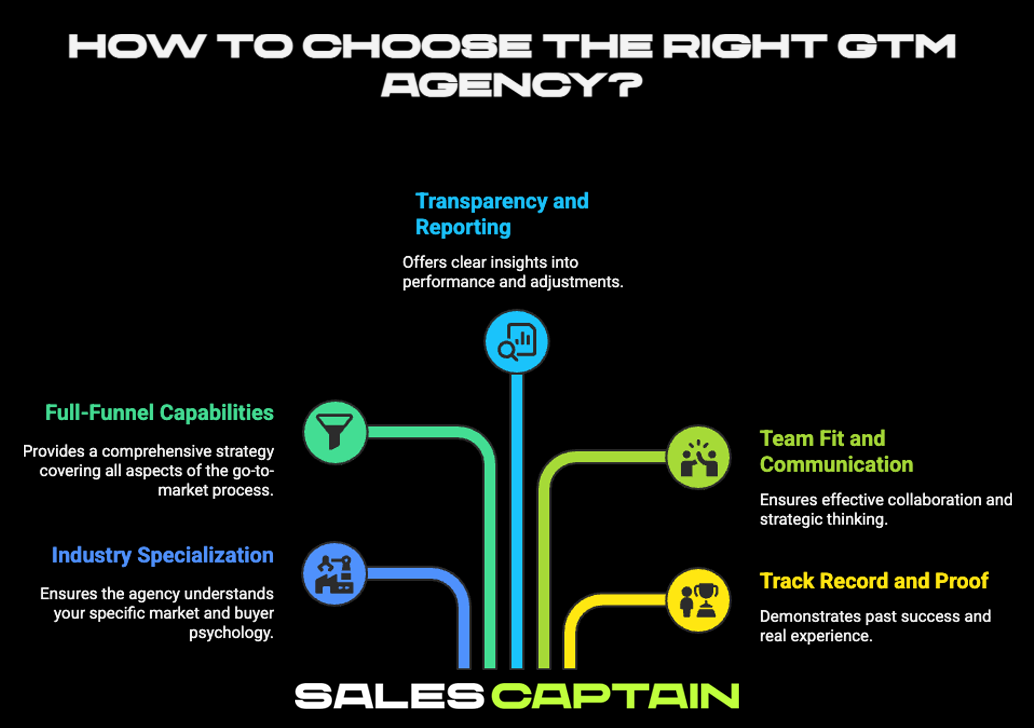
Not all GTM agencies are built the same. Some focus purely on messaging. Others lean into paid media or outbound. The best ones take a full-funnel approach and shape their work around your business model, stage, and goals.
Here’s how to spot a good fit before you sign anything.
Start with alignment. Does the agency understand your space? B2B SaaS and consumer products need completely different go-to-market playbooks. An agency that specializes in your industry will already know the language, buyer psychology, and common failure points.
A proper GTM strategy includes more than messaging. You need positioning, offer testing, acquisition channel planning, sales enablement, and a feedback loop between marketing and sales. Look for agencies that can own more than one piece of the puzzle.
Ask how they measure success. A good GTM agency will show you what’s working, what isn’t, and what they’re adjusting next. No hiding behind buzzwords or pretty dashboards.
You’ll be working closely, so communication matters. Can they challenge your assumptions without being rigid? Do they move fast? Are they proactive? You want strategic thinkers who can also get things done.
You don’t need to see logos. But you do need signs that they’ve done this before. Ask for examples of launches they’ve worked on. Look for specifics that only come from real experience.
Here’s the list. These are the agencies that are actually helping companies go to market with clarity, speed, and traction. Each one brings something unique to the table, but they all share one thing, they get results.
Best for: B2B SaaS companies, agencies, and revenue teams that want a GTM agency to help them build pipeline, sharpen positioning, improve outbound, and turn growth strategy into measurable revenue.
SalesCaptain is a full-funnel GTM and outbound agency built to generate the same pipeline as traditional outbound using 3x fewer contacts.
Instead of treating go-to-market as a mix of disconnected campaigns, SalesCaptain helps companies connect strategy, messaging, outbound, sales execution, and feedback loops into one clear GTM motion.
The agency works across the full revenue funnel, helping companies identify the right accounts, define the right buying signals, create stronger messaging, launch targeted campaigns, and improve conversion from first touch to booked meeting.
SalesCaptain’s GTM system is built around three core motions:
TOFU: Creates demand with the right accounts before they are actively searching.
MOFU: Captures demand from companies already showing buying intent or market signals.
BOFU: Recovers demand from warm prospects who engaged before but did not convert.
This helps B2B companies avoid the common mistake of using one generic message for every buyer. A cold account, an intent-driven account, and a warm lead should not receive the same campaign, CTA, or offer.
SalesCaptain handles the full GTM execution process, including ICP strategy, lead sourcing, data enrichment, campaign messaging, outbound execution, inbox infrastructure, AI-assisted workflows, and performance tracking.
1. Full-Funnel GTM, Not Generic Cold Outreach
Most agencies focus on one channel, one campaign, or one part of the funnel.
SalesCaptain builds GTM systems across the full revenue journey. The team runs different motions for cold accounts, active buyers, and warm prospects, so each segment gets the right message, CTA, and offer based on where they are in the buying journey.
2. Marketing-First GTM Team
SalesCaptain comes from a marketing background, so GTM is treated like a campaign engine, not a static sales plan.
The team tests fast, reads the data, scales what works, and cuts what does not. This makes campaigns more adaptable when markets, offers, or buyer behavior shift.
3. Deep GTM Tooling Expertise
SalesCaptain is a Clay Enterprise Partner, Salesforge expert, and Lemlist expert.
That gives the team strong experience across the core systems needed for modern GTM execution, including data enrichment, lead sourcing, email infrastructure, campaign sequencing, personalization, and workflow automation.
4. Hybrid AI GTM Execution
SalesCaptain combines human strategy with AI-supported execution.
AI supports research, personalization, response handling, segmentation, and workflow speed, while humans still control strategy, messaging, positioning, and campaign direction.
5. Custom-Built AI BDR
SalesCaptain has a custom AI BDR built in-house.
It can automate email responses, support follow-ups, qualify conversations, and book meetings directly for your AEs. This helps reduce manual work while keeping the GTM motion active.
6. Sales Feedback Loop
SalesCaptain does not treat GTM performance as just open rates, reply rates, and booked calls.
The team uses sales call recordings, email replies, buyer objections, and campaign data to improve messaging, sharpen positioning, and help sales teams handle the objections that show up most often.
7. Industry-Specific Playbooks
Campaigns are adapted by business model, industry, and sales motion.
SalesCaptain works across B2B SaaS, B2B products, B2B services, and enterprise sales motions, so the strategy is not copied from one market and forced onto another.
8. Localized Global Campaigns
For companies expanding into new markets, SalesCaptain localizes campaign copy based on the region, market, and buyer context.
The agency has worked with clients across North America, Europe, Asia, the GCC, Australia, New Zealand, and beyond.
9. Recognized GTM and Outbound Performance
SalesCaptain has been awarded #1 Top Outbound Agency for the last 3 years consecutively and has also won an award from Tekpon.
This adds credibility, but the real difference is the operating model: SalesCaptain does not compete by doing more random activity. It competes by knowing who to target, when to contact them, what message to use, and which GTM motion they belong in.
SalesCaptain has also proven this system across different industries, markets, and sales motions.
Examples:
1. Curated Media: 391 Positive Replies and $60K in New ARR
SalesCaptain helped Curated Media build a repeatable outbound engine for programmatic media. After refining the ICP, improving messaging, adding LinkedIn outreach, and running weekly optimization loops, the campaign generated 391 positive replies, 156 booked appointments, 12 closed clients, and $60K in new ARR.
2. Global Recruitment Service: $394K ARR in 10 Months
For a global recruitment service, SalesCaptain built a scalable outbound engine, sharpened the ICP, improved messaging, and reactivated cold leads through structured follow-ups. The campaign generated 501 booked appointments in 10 months, 715 positive replies, 57 new clients closed, and $394K in new ARR.
3. Riskwell: 5 to 10 SQLs Per Week
SalesCaptain helped Riskwell, a risk management SaaS company, generate 5 to 10 sales-qualified leads per week through targeted outbound. The campaign produced 32 booked appointments in 4 months and a 35% booked meetings ratio.
These case studies show why SalesCaptain’s model is not just about sending more emails. The agency has used outbound to create pipeline across SaaS, recruitment, programmatic media, risk management, healthcare, cybersecurity, and other B2B markets.
Check out more case studies of SalesCaptain
Check out more reviews of SalesCaptain on Clutch

inBeat is known for its performance-focused approach to GTM, especially for DTC and B2C brands. They tap into a vast micro-influencer network to help new products get traction quickly through social proof and fast-moving creative. While they lean heavy on influencer marketing, their GTM work includes landing page optimization, user-generated content strategy, and launch planning.
Best for: Consumer brands launching physical or digital products
Key services: Influencer-driven GTM, UGC content, paid social launch campaigns

Ironpaper focuses on B2B companies that need marketing and sales alignment from day one. Their GTM approach includes everything from messaging and buyer journey design to lead generation and sales enablement. They’re especially strong with companies selling complex products where the sales cycle is longer and more consultative.
Best for: B2B tech and service companies with complex offerings
Key services: GTM planning, content strategy, lead gen, sales enablement
Ziggy helps startups and scaleups figure out their positioning fast. Their GTM process is built around messaging clarity, sharp differentiation, and early traction. They’re a good fit for teams that need to refine their offer before investing in growth channels. Ziggy keeps things lean, but strategic, especially when you're still searching for product-market fit.
Best for: Early-stage startups testing positioning and market entry
Key services: Messaging strategy, customer research, GTM planning

Deviate Labs is the agency you call when you want unconventional growth strategies. Their GTM work often combines creative experiments, viral mechanics, and performance marketing, ideal for companies that want to stand out fast. They’ve worked with everything from funded startups to Fortune 500s, but their sweet spot is fast-moving challengers.
Best for: Bold brands that want creative GTM strategies
Key services: GTM launch strategy, creative growth tactics, marketing automation

Refine Labs made its name in B2B demand generation, but their GTM capabilities go much deeper. They focus on building demand engines that align with how modern buyers actually make decisions. That means fixing your messaging, optimizing conversion paths, and driving awareness in the right channels, not just stuffing your funnel with leads that never close.
Best for: Mid-market and enterprise B2B companies focused on long-term pipeline
Key services: GTM research and planning, demand gen strategy, paid media execution

Six & Flow blends GTM strategy with HubSpot implementation, making them a strong fit for companies already using or moving to the HubSpot ecosystem. They don’t just build funnels, they make sure your CRM, automation, and sales workflows support the launch plan. Their process includes GTM workshops, sales and marketing alignment, and campaign execution.
Best for: B2B teams using HubSpot who need GTM and RevOps together
Key services: GTM strategy, HubSpot setup, sales and marketing ops

Single Grain focuses on growth-focused GTM launches, especially for SaaS and education platforms. They’re a full-service digital agency, but their go-to-market offering zeroes in on paid media, SEO, funnel strategy, and offer development. If you need traction through search and ads right out of the gate, they can help build that engine.
Best for: SaaS and digital platforms that want performance-led GTM
Key services: Paid media strategy, SEO, GTM funnel design
Boil works with SaaS companies to refine positioning and create messaging that resonates. Their GTM work is rooted in deep customer research and founder interviews. They focus more on the front-end strategy than execution, which makes them ideal for founders who want to nail the story before launching.
Best for: SaaS founders who want sharper positioning before scaling
Key services: GTM research, brand messaging, positioning workshops
Arise GTM is a boutique agency focused entirely on go-to-market strategy. They’re often brought in when a company is prepping for a big launch or pivot and needs external perspective on their messaging, segmentation, and buyer journey. Their strength is in aligning marketing, product, and sales before execution begins.
Best for: Pre-launch companies that want full GTM clarity
Key services: Positioning, ICP definition, offer strategy, messaging

Kalungi offers full-service GTM support for B2B SaaS companies, especially those in early growth stages. Their team plugs in as an outsourced marketing department, handling everything from strategy to execution. They’re particularly good at building marketing foundations for technical founders who need help with storytelling, funnel design, and lead generation.
Best for: B2B SaaS startups that want a plug-and-play marketing team
Key services: GTM strategy, content creation, demand generation, fractional CMO
Growth Shop combines GTM strategy with rapid testing and conversion optimization. They’re ideal for ecommerce and DTC brands looking to validate offers, improve funnels, and grow revenue quickly. Their approach is agile, data-backed, and built for companies that want to scale fast without getting bogged down in process.
Best for: Ecommerce and consumer brands focused on fast growth
Key services: GTM launch support, CRO, offer testing, growth strategy
Most product launches fail quietly. Not because the product is bad, but because the go-to-market was weak.
Wrong message. Wrong audience. Wrong execution.
A good GTM agency helps you avoid all of that. They make sure you’re targeting the right people, saying the right things, and using the right channels. No fluff. Just focused strategy and consistent execution.
So whether you're launching your first product or scaling an existing one, picking the right GTM partner is a key part of getting results.
Want help running a go-to-market strategy that actually delivers? Talk to SalesCaptain.
Looking for agencies in your region?
Below, you’ll find a list of GTM agencies organized by country and city, so you can explore top partners near you.
You should hire a GTM agency when you have a product or service ready to sell, but your team is unclear on positioning, ICP, messaging, channels, or execution. It also makes sense when growth has slowed and you need a stronger system for reaching the right buyers.
A GTM agency focuses on bringing a product, service, or new offer to market with clear positioning, targeting, messaging, and sales execution. A growth agency usually focuses more on scaling acquisition channels after the core market strategy is already clear.
A demand generation agency focuses on creating awareness, interest, and pipeline through marketing channels. A GTM agency looks at the wider market entry system, including ICP, offer strategy, messaging, channel selection, launch planning, and sales alignment.
A RevOps agency focuses on systems, CRM, reporting, automation, and revenue operations. A GTM agency focuses more on market strategy, positioning, campaigns, and execution. Some companies need both if they want strategy and infrastructure working together.
Yes, but the work usually looks different. Before product-market fit, a GTM agency may focus more on customer research, positioning tests, ICP validation, offer refinement, and early traction rather than aggressive scaling.
Yes. A GTM agency can help improve messaging, test new channels, refine audience segments, improve sales enablement, and build stronger feedback loops between marketing and sales after launch.
A strong GTM strategy should include ICP definition, positioning, messaging, offer clarity, market research, competitor analysis, channel planning, sales enablement, campaign execution, reporting, and a process for learning from buyer feedback.
The best metrics depend on your stage, but common ones include qualified pipeline, booked meetings, sales opportunities, conversion rates, reply quality, CAC, sales cycle length, and revenue influenced by GTM campaigns.
Early signals can appear within a few weeks, especially from outbound or campaign testing. Stronger pipeline and revenue results usually take longer because the agency needs time to test messaging, refine targeting, and improve conversion.
A GTM agency usually needs access to your product information, customer data, sales calls, existing messaging, CRM data, past campaign results, competitor insights, and a clear view of your revenue goals.
Common mistakes include hiring based only on brand name, choosing an agency with no experience in your market, expecting instant results, not sharing enough internal data, and treating GTM as a one-time launch instead of an ongoing revenue system.
Startups often hire a GTM agency when they need speed, outside expertise, and execution without building a full team. An in-house team makes more sense when the company already has a proven GTM motion and wants to scale it internally.
Yes. A GTM agency can help adapt positioning, messaging, channels, and campaign execution for different regions. This is especially useful when buyer behavior, language, market maturity, and sales expectations vary by country.
GTM agencies may work across outbound sales, paid ads, SEO, content, partnerships, email, LinkedIn, webinars, communities, and sales enablement. The right channel mix depends on the audience, offer, price point, and sales cycle.
A good fit should understand your market, ask sharp questions, explain how they measure success, show clear execution ability, and connect strategy to pipeline. Avoid agencies that only talk about vague awareness, generic campaigns, or one-size-fits-all playbooks.


.svg)


.svg)

.svg)


.svg)


