GTM For Early Stage Startups: Founder-Led Strategies To Accelerate Growth


You’re on the laptop at 10pm after a long day, sending another round of personalized outreach because a promising demo just came from one of your emails, and it feels like proof that founder-led selling is the growth engine. The snag is you’re treating those wins like magic instead of a repeatable system, so replies live in inboxes, pricing tweaks never get tracked, and the founder becomes the bottleneck or burns out. Read on to get clear about what founder-led GTM really is, when it’s the right play, how to run outbound as a marketing motion with automation and signal capture, what metrics to trust, and how to codify a 30–90 day playbook so learning scales beyond the founder’s calendar.
What Is A Founder-Led GTM?
How Founder-Led GTM Works
Founder-led GTM means the founders run demand, sales, and early customer success themselves. They own outbound, demos, pricing conversations, and product feedback. That combination accelerates learning, because the people who decide product direction hear buyer objections firsthand. Outbound is treated as a marketing motion, founders run targeted outreach to shape positioning and measure response. GTM is a system, not a person, so founders still need workflows, tracking, and feedback loops to capture what they learn. AI makes outbound cheap and signal-driven, so founder outreach can be high-volume and data-rich without hiring an army of SDRs. That said, modern founder sales require technical operator skills, tooling, and basic automation to stay repeatable.

Why It Suits Early Startups
Founder-led GTM is the fastest way to discover who will buy and why. Founders can iterate offers and pricing in single conversations. It saves cash, avoids premature hires, and builds credibility when early buyers want to speak with decision makers. It also tightens the product feedback loop, so roadmap decisions reflect real buying criteria. Treating outbound like marketing lets you target high-value niches and measure signal quality, not vanity metrics.
When Founder-Led Fails
Founder-led GTM fails when the role becomes the bottleneck. If customer volume grows, the founder cannot scale one-to-many without losing message consistency. It fails when deals require complex procurement or enterprise-level processes that founders can’t replicate at scale. It also collapses if the team never codifies the playbook, so every hire repeats the same mistakes. Burnout is a common failure mode, and over-reliance on founder charisma prevents repeatability. Finally, if you lack workflows, automation, and metrics, founder feedback never turns into company-level learning.
When Should You Use Founder-Led GTM?
Signals You Need Founder Sales
Use founder-led GTM when you still need raw learning and rapid iteration. Common signals:
- You can’t consistently predict who buys and why.
- Demo outcomes vary widely, meaning messaging needs tuning.
- Deal sizes are small to mid and require persuasion over procurement.
- Early customer conversations directly change product priorities.
- You have little to no pipeline but a clear hypothesis to test.
If you need help scaling outreach efficiently, start with tools that let founders run repeatable prospecting. For example, Clay (https://clay.com/?via=salescaptain) helps build and enrich prospect lists at scale, and using that link gives you 3,000 free credits. How to use Clay for prospecting: build a targeted list, enrich technographics, push contacts into sequences, and capture reply signals to feed product hypotheses.
How Market Type Changes The Approach
Different markets demand different founder tactics. In existing markets, buyers know the category, so founders focus on differentiation and fast replication of what works. In re-segmented markets, founder messaging must reframe value, so outbound and content need heavy education. In new markets, founders become evangelists, hunting niche anchors where the problem is acute and references are possible. The more novel the market, the longer founders will need to own GTM to create demand and refine the narrative.
How To Transition Off Founder Sales

Transition when your win rates, CAC, and sales cycle stabilize and you can predict pipelines. Steps to transition:
- Codify the playbook, record calls, and capture objection handling.
- Hire a technical operator, someone who understands automation and data, not just cold calling.
- Run overlap periods where founders ride along on calls and coach new reps.
- Automate repeatable parts of outbound and hand over the systems, not just lists.
- Use an outbound agency as an accelerator if you need speed, for example a cold outreach or demand generation agency. Agencies can buy time, but only if the playbook is documented.
Trigger metrics for handoff include repeatable close rates, predictable CAC, and stable deal velocity. Move slowly, measure each handoff, and keep founders in strategic customer conversations until the model proves repeatable.
How To Define Your Ideal Customer?
Build An ICP Template
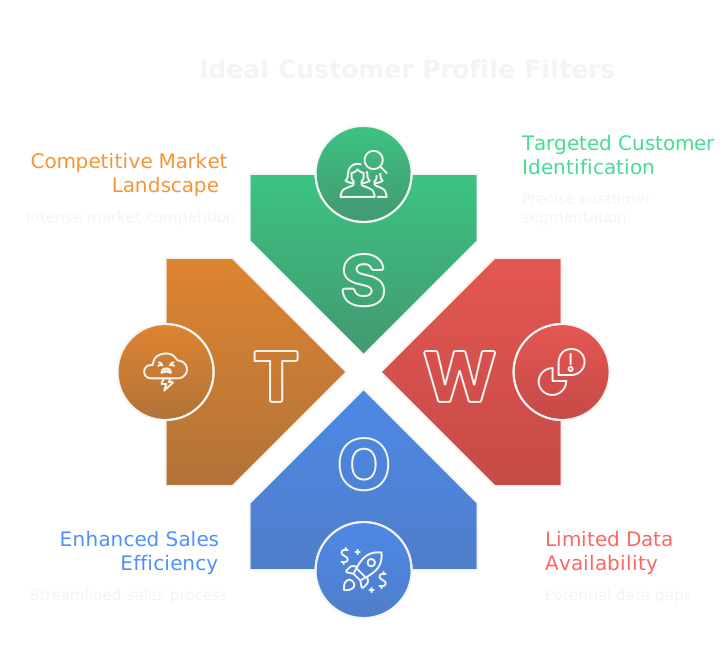
Create a one-page ICP with fields that force specificity. Include:
- Firmographic filters, like industry, company size, and ARR thresholds.
- Technographic signals, current stack, and integrations that matter.
- Buying role and typical titles in the decision unit.
- Primary pain, operational trigger, and worst alternative they tolerate.
- Expected deal size and target time to close.
- Value metrics used by buyers, such as time saved, cost reduction, or revenue uplift.
- Channels where they are reachable and reference companies you can use.
Keep thresholds numeric where possible. Vague ICPs kill repeatability.
Run Rapid Qual Interviews
Aim for 10 to 15 structured interviews in two weeks. Prep three core questions:
- What process are you using today, and what breaks in that process?
- How do you decide on tools, and who signs off?
- What would make you switch in 90 days?
Record answers, pull verbatim quotes, and tag responses to ICP fields. Prioritize listening over pitching. Use the interviews to verify assumptions about pain, budget, and buying timelines. Convert insights into testable hypotheses for pricing, channels, and messaging.
Prioritize Segments For Traction
Score segments by five factors: ease of access, speed to value, lifetime value, defensibility, and reference potential. Run small pilots against top-scoring segments and measure conversion, CAC, and churn after the first 90 days. Double down on the segment that shows predictable conversion and strong referenceability. If multiple segments look promising, choose the one with the fastest closed-loop learning, because traction in one niche creates the signals you need to scale.
How To Validate Product Market Fit Fast?
Design High-Tempo Experiments
Stop slow. Run multiple short experiments in parallel, each targeted at a single hypothesis: who the buyer is, what they value, or what price they’ll pay. Examples you can spin up in days, not weeks:
- Landing page with a clear CTA to book a demo or a paid pilot.
- Two outbound sequences with different value props.
- A paid ad test focused on a single use case.
- Concierge MVP or one-off manual delivery to prove willingness to pay.
Treat outbound as a marketing motion, not a side hustle. Use automation and AI to scale outreach volume and capture reply signals cheaply, then funnel those signals into your experiment board. Operate the GTM like a system, with templates, tracking, and a weekly cadence for learnings. Keep cycles tight, stop losers fast, and double down on winners.
Measure Qualitative And Quantitative Signals
Quantitative signals you need to watch:
- Conversion rates at each funnel step, demo to qualified lead, demo to paid.
- Activation and retention rates at day 7 and day 30.
- Trial to paid conversion and average revenue per account.
Qualitative signals to record every time:
- Exact phrases buyers use to describe the problem.
- Objections and the alternatives they tolerate.
- Buying triggers and timeline language.
Score signals together instead of worshipping any single metric. A modest conversion rate plus strong qualitative intent beats high vanity traffic with zero buyer language. Capture quotes, tag them to ICP fields, and surface them in your weekly review so product and GTM iterate from the same data.
Decide With Clear Go No-Go Criteria
Define decision gates before you run tests. Examples:
- Go if you sign 5 customers from the target ICP within 90 days and CAC is below X.
- Go if demo-to-paid conversion exceeds Y percent on repeatable outreach.
- No-go if activation drops below Z or if no one will pay in test conditions.
Use simple thresholds and sample sizes that are realistic for an early team. Have a fallback plan for each no-go: pivot the target persona, change pricing, or kill the experiment. When you decide to scale, codify the winning playbook immediately so repeats aren’t founder-dependent. A clear rule set removes emotion from the pivot decision.
How To Craft Messaging That Converts?
Use Jobs To Be Done
Frame messaging around what customers are trying to accomplish, not your features. Find the struggle, the desired outcome, and the forces that prevent change. Convert that into language your buyers use:
- Identify the job, the unwanted outcome, and the metric they care about.
- Lead with outcome in opening lines, then explain your approach.
JTBD gives you repeatable hooks for landing pages, outbound openers, and demo intros. It forces specificity, which beats vague product-speak every time.
Test Value Propositions Rapidly
Create crisp hypotheses: “For X, our product does Y so they avoid Z.” Then test variants fast:
- A/B landing pages with different headlines and proof points.
- Two outbound sequences, one price-focused, one time-saved-focused.
- Short paid experiments that route clickers to different CTAs.
Use minimum samples and fixed timelines, then measure the same activation metric across variants. AI can generate copy variants quickly, but the point is speed, not perfection. If one message consistently outperforms, bake it into all touchpoints.
Create A One-Page Positioning Statement
Make a single page that answers five questions:
- Who is the target customer, in one sentence?
- What job are they hiring the product to do?
- What is the unique value promise?
- How do you prove it quickly?
- What’s the primary call to action?
Template:
- Target: [specific ICP]
- Job: [what they need to get done]
- Promise: [quantified outcome]
- Why we’re different: [unique mechanism]
- Proof: [early metric or customer quote]
Keep it visible. Use it for web copy, outbound scripts, sales training, and investor conversations. One page means it gets read and used.
How To Choose Initial Distribution Channels?
Compare Product Led Versus Sales Led
Choose based on friction and deal complexity. Product led works when users can discover value without a salesperson, and viral or self-serve flows drive adoption. Sales led works when the sale requires persuasion, custom pricing, or integration conversations.
Remember modern nuances:
- Outbound has become cheap and signal-driven, so a sales-led start no longer demands expensive SDR teams.
- SDRs are being replaced by automation and technical operators who can run repeatable outreach sequences and instrument feedback loops.
Think of the choice as spectrum, not binary. Many startups start founder-led outbound to learn, then layer in self-serve funnels as product usability improves.
When To Run ABM Or Partnerships
Pick ABM when addressable accounts are few, deal sizes are large, and personalization materially raises win rates. Run a small ABM pilot against 10 to 20 accounts, personalize content and outreach, and measure pipeline creation per account.
Choose partnerships when you can leverage someone else’s distribution for quick credibility, or when integrations materially lower buyer friction. Test partnership pilots with one or two partners, define referral mechanics, and instrument attribution.
If you need acceleration, consider an outbound agency as a growth lever. An agency like SalesCaptain can act as an accelerator to run high-personalization outreach or jumpstart ABM, but only after you’ve documented the playbook it should execute. Agencies buy time, they don’t replace your responsibility to learn.
How To Run Channel Mix Tests
Run channel mix tests like experiments, not bets. Steps:
- Allocate a small fixed budget across 3 to 4 channels you can measure separately.
- Define one primary KPI per channel, for example demo rate, trial starts, or paid conversions.
- Instrument tracking, UTMs, and pipeline tags so every lead’s origin is visible.
- Run tests for a fixed window, compare CAC, conversion velocity, and early retention by channel.
- Iterate by shifting budget to channels with better leading indicators.
Keep tests isolated, change one variable at a time, and analyze cohorts, not raw totals. Mix tests are most useful when you have tracking that ties first-touch to downstream value.
How to use Clay for channel mix tests:
- Build and enrich targeted contact lists for specific channels, using filters like technographics and role.
- Export segments into your outreach sequences, or push audiences into ad platforms for coordinated tests.
- Capture reply and engagement signals back into your experiment tracker to compare channels on the same metrics.
Using the Clay link gives you 3,000 free credits, which is handy for running several small target lists and enrichment passes during early channel experiments.
How To Build A 30-90 Day GTM Playbook?
Follow This Founder-Led Framework
Start with three objectives, time-boxed: learn, convert, and codify. Learn means run outbound and demos to validate ICP, messages, and pricing. Convert means close a repeatable set of customers, even if small. Codify means capture the playbook so someone else can run it.
Structure the playbook around a simple loop: target, outreach, qualification, demo, pilot, close, onboarding, feedback. For each stage list entry criteria, exit criteria, owner, and exact artifacts to produce, for example a one-line qualification template or a demo checklist. Treat outbound like marketing, not an afterthought, and instrument replies as signal for product and pricing changes. Design the loop so AI and automation capture signals automatically, for example reply tags, objection flags, and funnel timestamps.
Make the playbook prescriptive, not aspirational. Include exact subject lines, demo scripts, offer templates, pilot scope, and metrics you’ll accept for a win. A 30-90 day plan is nothing if it’s not measurable.
Week-By-Week Activities For Founders

Finalize ICP, build two target lists, design 2 value props to test, and set up tracking. Schedule 20 outreach sends per founder per day and 8 discovery calls to aim for.
Week 2, run outreach and qualify. Launch sequences, score replies, and do 10 to 15 demos. Log verbatim objections and update the objection playbook. Start 2 paid or paid-pilot conversations.
Week 3, refine demo and pricing. Iterate demo flow based on questions you heard, run a quick price check with 5 prospects, and spin up a one-off pilot offer. Capture conversion rates demo-to-pilot.
Week 4, codify wins and failures. Record winning scripts, create a one-page playbook, and decide the core KPI for the next 30 days, for example demo-to-paid > X%.
Days 31–60, scale outreach and run pricing experiments. Double-down on the better value prop, increase outreach volume with automated sequences, and run a pricing split test with 2 price points or billing models. Begin onboarding two pilot customers and instrument activation metrics at day 7.
Days 61–90, prove repeatability. Hit your defined go/no-go gates: a minimum number of customers from ICP, acceptable CAC, and predictable activation. Hire or contract the first GTM operator if the numbers look good. Create a living dashboard that ties first-touch to revenue and a feedback loop to product.
Keep a weekly ritual: review top-line funnel metrics, top 10 verbatim buyer quotes, open objections, and one prioritized experiment to run next week.
Sales Scripts, Demo Flow, Objections
Scripts should be templates, not lines to memorize. Openers must be outcome-focused and short. Example starter: "We help [title] at [company-type] reduce [bad metric] by [specific outcome]. Curious if you’re seeing this?" Follow immediately with a question that surfaces the trigger.
Demo flow, 8–12 minutes to the point:
- One-sentence positioning, then 30 seconds on why you’re talking to them.
- Ask the three demo questions that reveal status quo, pain, and success metric.
- Show the single path that delivers the outcome you promised, using live data or a quick recorded flow.
- Validate fit with an explicit buy/switch question, for example "If this cut your [time/cost] by X, what would change internally?"
- Next steps and a limited, time-boxed offer for pilots or discounts.
Objection handling is a living doc. Capture phrasing, escalation path, and a short rebuttal. Common objections and concise responses:
- "Too expensive" — Ask what they’d pay today to solve the pain, compare ROI, or offer a small pilot with clear success metrics.
- "We already use X" — Ask who owns the pain X doesn’t solve, show a side-by-side outcome comparison, or propose a short A/B pilot.
- "No budget" — Shift to a paid pilot or outcome-based pricing, or agree on a later review date and keep the relationship warm with targeted content.
Record every call. Tag examples of successful rebuttals and failed ones. Use those clips to train future hires and tune product positioning.
Minimum Toolstack And Ops Setup
You don’t need a thousand apps, you need five capabilities: list building and enrichment, outreach automation, calendaring, call recording and notes, and a simple CRM or spreadsheet that links first-touch to revenue. Make sure your stack automates signal capture, so replies, demo outcomes, and activation events feed one spot.
Operational rules:
- Templates and sequences live in versioned files, not founders’ heads.
- All demos recorded, transcribed, and tagged for objections, use cases, and closing language.
- A single dashboard ties campaign, cohort, and revenue metrics.
- Weekly playbook update, with one owner responsible for rolling changes out.
Technical operators matter more than traditional SDRs right now. You want someone who can wire tools together, own data hygiene, and run automated experiments that scale outreach without losing nuance. If you must choose one integration day, automate reply capture and CRM tagging first. That simple wiring multiplies learning.
Who Should Be Your First GTM Hire?
Define The Founding GTM Role
Your first GTM hire is a hybrid, not a pure closer. They must be a technical operator who can run and iterate outbound, qualify leads, own demos, and codify learnings into playbooks. Priorities: scale what founders proved, maintain message fidelity, and instrument feedback loops into product.
Profile:
- Comfortable with sequence logic and automation.
- Can run honest qualification conversations, not just pitch.
- Data-oriented, can read funnel signals and act.
- Comfortable documenting processes and training others.
This person replaces founder bandwidth without losing the learning loop. They are a multiplier, not a quota machine.
Use An Interview Scorecard
Score candidates across five buckets, each 1–5:
- Outreach craft, includes subject lines, personalization, and sequence design.
- Demo and objection handling, shows live role play performance.
- Technical ops, ability to set up sequences, integrations, and dashboards.
- Data fluency, reading funnel metrics and proposing experiments.
- Cultural fit and coachability, especially willingness to record and iterate.
Interview structure: 30 minutes on background, 30 minutes role play (outbound opener and a demo snippet), 30 minutes on ops test (set an automation or sketch a simple funnel), and 15 minutes for references focused on speed of learning and documentation.
Use the scorecard to make objective calls. Hire for potential and systems mindset, not just previous quota numbers from a different category.
When To Hire Versus Contract
Hire when the role owns repeatable revenue motion and knowledge needs to be retained. If the position will run dozens of experiments, coach others, and become the foundation for a scalable team, hire.
Contract when you need speed, specific skills, or short-term capacity: list building, a targeted ABM pilot, or rapid content personalization. Contractors and agencies buy time while you codify the playbook. But be strict about handoff artifacts: documented sequences, recorded calls, playbooks, and raw data exports.
Rules to decide:
- Critical mass rule, hire if you need the role > 20 hours/week for 3+ months.
- Continuity rule, hire if institutional knowledge must live in-house.
- Experiment rule, contract for burst work where outcomes are tightly scoped and easily exportable.
Always require contractors to deliver exportable assets and a 2-week transition plan so knowledge doesn’t evaporate when the contract ends.
How To Price For Early Traction?
Run Pricing Experiments
Treat pricing as an experiment set. Start with two simple contrasts: price level and billing unit. Examples:
- Flat monthly fee vs usage-based pricing.
- Pilot fee with success-based conversion vs free pilot then paid.
- Per-seat vs per-active-user vs per-outcome.
Run micro-tests in the wild, not surveys. Offer different prices to similar ICP slices or present two offers in parallel outreach. Measure willingness to pay, conversion to pilot, and churn within 30 days. Track elasticity, not just closers. If a modest price increase doesn’t dent conversion but materially raises ACV, raise it.
Use short, clear pilot agreements that define success metrics and conversion terms. A pilot that proves value is the fastest path to a higher price.
Measure these KPIs per price variant: conversion rate, average deal size, time-to-close, early retention, and NPS-like satisfaction at day 30.
Use Value Based Steps
Stop pricing by cost or competitor. Price by the value delivered and make that value explicit.
- Identify the primary value metric buyers care about, for example hours saved, revenue retained, or lead conversion delta.
- Translate that into an ROI statement: "If we cut X by Y%, here’s the monthly value per seat."
- Create price tiers that map to increments of that value, not arbitrary feature lists.
Anchor with a clear reference price, then offer a lower entry point with clear limits and an upgrade path tied to the value metric. Consider outcome-linked pricing for high-trust customers, for example a lower base plus a success fee. Early on, that can accelerate adoption and align incentives.
Don’t invent complicated math. Buyers must see the arithmetic quickly and decide.
Package And Communicate Pricing
Packaging should reduce friction. Three-tier max, labeled by outcome or company size, not by feature. Each tier must answer who it’s for, what it delivers in plain language, and a simple ROI line.
Communicate price as a function of value:
- Put the expected outcome first, price second.
- Offer a calculator or one-line ROI example on the proposal.
- Use time-boxed pilot offers to remove procurement friction: "4-week pilot, $X, success = Y metric."
Train founders and new GTM hires on the exact phrases to handle price pushback. Example: "Our pilots are designed to demonstrate a [X] return in 30 days. If we miss that, we’ll discount the first month." That removes negotiations and shifts the conversation to proof.
Make billing transparent. Simple invoices, clear renewal terms, and predictable upgrade paths reduce churn. Capture objection data around price and feature scarcity and feed it back to product and pricing experiments.
Keep pricing flexible during early traction, but never sloppy. Tight packaging, clear value metrics, and short time-boxed pilots win more deals and produce cleaner data for scaling.
What Metrics Should You Track?
Pick A North Star Metric
Choose one metric that captures the value your product delivers and ties directly to revenue. Examples:
- SaaS product with activation, choose "paid accounts retained after 30 days."
- Marketplace, choose "net take rate times active transactions per week."
- Sales-led, choose "qualified opportunities created per target account per quarter."
Your North Star should be simple, measurable, and invariant across channels. It becomes the single KPI that guides experiments, hiring, and budget. If you track too many North Stars, you have none.
Set a short-term target and a rhythm. For an early startup, a 90-day improvement goal is useful, for example increase demo-to-paid by 50 percent or sign 5 ICP customers in 90 days. Make that target visible on the weekly dashboard everyone uses.
Leading Indicators To Monitor
Leading indicators give you early warning before revenue moves. Track a small set tied to your funnel stages:
- Prospecting signal quality, for example replies with buyer language per 1,000 outreach sends.
- Demo velocity, meaning demos booked per week per founder or operator.
- Demo qualification rate, percent of demos that meet your documented close criteria.
- Pilot conversion, percent of pilots that convert to paid within 30 days.
- Activation behavior, key action completed by day 7 and day 30.
Instrument qualitative signals too, not just counts. Capture top 10 verbatim buyer phrases weekly, and tag new objections. Treat reply signals from outbound as a measurable input, not noise. Leading indicators should trigger specific actions, for example pause a sequence, change messaging, or run a pricing micro-test.
Metrics Investors Expect To See
Investors want to see repeatability and unit economics, even early on. Provide:
- CAC and CAC payback period based on current channels, or a realistic near-term forecast.
- LTV or an LTV proxy, for example NRR or month-6 retention multiplied by ARPA.
- Conversion funnel: MQL to SQL, SQL to demo, demo to paid with sample sizes and time windows.
- Growth rate and cohort retention, at least day 30 and month 3 retention for SaaS.
- Payoff signals from experiments, like a validated price with at least five paying customers.
Show variability and your plan to improve it. Don’t hide small sample sizes, just be explicit: sample size, time period, and what you’re doing next. Investors prefer clear, honest metrics with a repeatable plan over polished but opaque claims.
What Mistakes Should You Avoid?
Common Early GTM Pitfalls
Avoid these predictable traps:
- Chasing vanity metrics, for example raw traffic or number of outbound sends, without measuring buyer intent.
- Failure to codify the playbook, leaving all knowledge in founders’ heads.
- Hiring salespeople before the playbook is proven, which amplifies mistakes.
- Treating outbound as ad hoc instead of a marketing motion with sequences, testing, and feedback loops.
- Over-optimizing for short-term signups that don’t activate or retain.
Each pitfall has an obvious remedy: instrument your funnel, record calls, and force one owner to maintain the playbook. Prefer systemization over heroics.
How To Recover From Bad Bets
If an experiment or hire goes sideways, follow a short playbook:
- Stop spend or activity immediately and isolate the variable that failed.
- Triage impact, quantify loss, and document root causes in one page.
- Run a counter experiment that tests the simplest alternative, for example a different value prop or price point.
- Reallocate resources to the highest-signal channels or pilots that previously worked.
- Codify the lesson into the playbook and apply a 30-day check that the fix worked.
Bad bets should produce learning. Treat each failure as a forced simple A/B test with clear takeaways. Avoid blame culture, focus on rapid, evidence-based corrections.
How To Avoid Premature Scaling
Premature scaling looks like hiring a quota-carrying team before you can predict repeatable unit economics. Watch for these false signals:
- High lead volume with poor demo-to-paid conversion.
- Short-term spikes from a single channel, not broad-based demand.
- Pressure to hire because outreach volume rose, not because win rates are stable.
Rules to avoid scaling too soon:
- Require repeatability gates, for example three consistent months of target win rates and CAC within planned bounds before hiring a quota-bearing rep.
- Keep the first GTM hire as a technical operator focused on automation and playbook codification, not pure closing.
- Automate and test scaling levers first, such as sequence variation, pricing splits, and targeted ad spends, then hire to absorb proven velocity.
Scale when your math works predictably, not when your inbox looks busy.
How To Create A GTM Deck Template?
Slide By Slide Breakdown
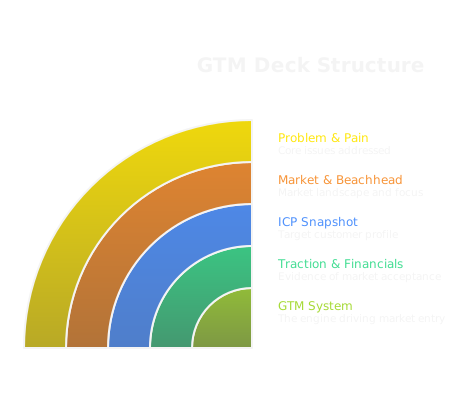
Build a concise deck that tells the story an investor or partner needs to act. Keep it 10 to 12 slides:
- Title and one-line positioning, plus a single traction callout.
- Problem, with buyer language and a clear scale of pain.
- Market size and specific beachhead segment.
- ICP snapshot, including firmographic and technographic filters.
- Unique value proposition and mechanism of change.
- Product demo visuals or workflow, one slide max.
- GTM system, list channels, workflows, and feedback loops.
- Early traction and leading indicators, show cohort charts.
- Unit economics and pricing experiments, with assumptions called out.
- Team and first GTM hires, roles and evidence of execution.
- Risks and mitigation plans, honest and specific.
- Ask, use of funds, and milestones you will hit with that capital.
Each slide should include one headline takeaway and 3 supporting bullets or a single chart. Decks are for decisions, not storytelling marathons.
One-Page GTM Summary Example
Create a one-page summary that can be shared quickly. Structure it into four boxes:
- Target, one-line ICP and why they buy.
- Offer, the core product plus a single quantified outcome.
- System, channels and the key workflow that converts a target into a paying customer.
- Traction and ask, three metrics and the specific support or budget you need.
Example content:
- Target: Series B+ fintech ops teams, 50 to 500 employees, using X payments stack.
- Offer: Automates reconciliation, saves 20 hours per week per operator.
- System: Founder-run outbound to 200 accounts/month, 10 demos, 2 pilots, 1 paid customer.
- Traction and ask: 4 paying pilots signed, demo-to-paid 25 percent, asking for $150k to hire a technical operator and double outreach.
One page forces clarity. Use it in sales calls, partner intros, and investor follow-ups.
What Metrics And Asks To Include
Your deck should include only the metrics that drive decisions and the asks that enable the next milestone. Include:
- Leading metrics: replies with buyer intent per 1,000 sends, demos per week, pilot-to-paid conversion.
- Financials: current CAC, ARPA, and a 12-month forecast under conservative assumptions.
- Retention: day 30 and month 3 activation or retention rates.
- Experiment results: clear winners and losers with sample sizes.
For asks, be explicit:
- Cash amount, use of funds broken into 3 line items, and expected outcomes for each.
- Non-dilutive asks such as partnerships or pilot commitments, with the timeline and mutual deliverables.
- Hiring asks: role, ramp time, and target metrics that hire should hit in 90 days.
End the deck with a single next step, for example "commit to 8 introductions to target accounts" or "approve $150k for outreach and one technical hire." Decision-makers act when you make the next step obvious.
What GTM Examples Work Today?
Founder-Led B2B SaaS Example
A founder runs targeted outbound, owns demos, and negotiates the first pilots. They treat outreach as marketing, not a sales side project. Setup:
- Build narrow ICP lists, run two value-prop sequences, and capture reply language as raw product insight.
- Use automation to send, tag replies, and push qualified prospects into calendar flows.
- Run 4-week paid pilots with clear success metrics, then convert winners to recurring contracts.
Why it works: founders learn fast, iterate pricing in real conversations, and codify the playbook for scale. The trap is founder bottleneck. Solve it by recording calls, documenting objections, and hiring a technical operator to own automation and playbook fidelity once metrics look repeatable.
Key signals to scale: consistent demo-to-paid conversion across cohorts, predictable CAC, and repeatable onboarding success at day 7.
Product-Led Growth Example
A PLG GTM lowers friction so users discover value before any salesperson is involved. Tactics:
- Self-serve signup with immediate key action that proves value within 7 days.
- In-app onboarding nudges and contextual CTAs that prompt paid upgrades.
- Instrumented funnels that tie first-touch to long-term retention.
Use sales-assisted PLG for higher-ticket buyers, surface accounts that hit upgrade signals, and route them to a technical rep. The modern nuance, outbound still matters for PLG. Signal-driven outreach converts accounts that show intent but need help unlocking enterprise value. Technical ops automate the bridge between product signals and human follow-up.
Metrics that matter: activation at day 7, trial-to-paid within 30 days, and expansion velocity per account.
Marketplace And Platform Example
Marketplaces must solve liquidity before scale. Choose which side to subsidize first, then lock the unit economics:
- Seed supply in a tight vertical where onboarding can be automated or heavily templated.
- Run paid demand tests in a single city or account cluster to prove matching economics.
- Create incentives that align early users with the platform, for example reduced fees or exclusive access.
Operational priorities differ from SaaS. Focus on GMV growth, take-rate proof points, and time-to-first-transaction for new users. Treat marketplace GTM as systems work, automate onboarding flows, and instrument two-sided retention. Early hires should be product operations and partnerships people who can run scripted onboarding and integrate with partners that accelerate density.
How GTM Changed Since 2022
GTM priorities shifted from brute outreach and big ad spends to signal-driven, automated systems. Main changes:
- Outbound became cheap and precise, thanks to AI and automation, so small teams can run high-volume, personalized sequences.
- SDR headcount models gave way to technical operators who wire tools, build workflows, and own data hygiene.
- Agencies now function as accelerators, not permanent substitutes. They jumpstart volume or ABM pilots, but you still need the playbook in-house.
- Privacy and channel fragmentation made first-party signals and direct conversations more valuable than broad intent data.
- Success moved from single-channel bets to operating a GTM system, with feedback loops between outreach, product, and pricing.
The implication is simple, evolve GTM from people-based heroics to system-based operations, instrument everything, and hire for technical repeatability rather than purely for volume.
FAQs

.png)

RELATED ARTICLES
Lorem ipsum dolor sit amet, consectetuer adipiscing elit, sed diam nonummy nibh euismod tincidunt ut laoreet dolore magna aliquam erat volutpat.