Outbound Tech Stack in 2026


There is a pattern most outbound teams do not notice until it is too late.
As their stack grows, performance slows down.
At first, adding tools feels like progress. You bring in better data, improve deliverability, layer in intent signals, and upgrade your sequencing tool. Each decision is logical on its own. Each tool solves a real problem.
But over time, something breaks.
Signals arrive too late to act on. Data sits in one tool while sequences run in another. Deliverability becomes unpredictable. Personalization turns into a manual effort instead of a system.
The stack looks sophisticated, but execution feels heavy.
And despite having six or more tools in place, outbound still underperforms.
This is not because teams chose bad tools. Most of them are genuinely strong products. The issue is structural. The tools are not designed to work together as one system, and no single layer is responsible for connecting timing, messaging, and execution.
In 2026, the best outbound teams are not the ones with the most tools. They are the ones with the cleanest architecture.
The real problem with most outbound stacks
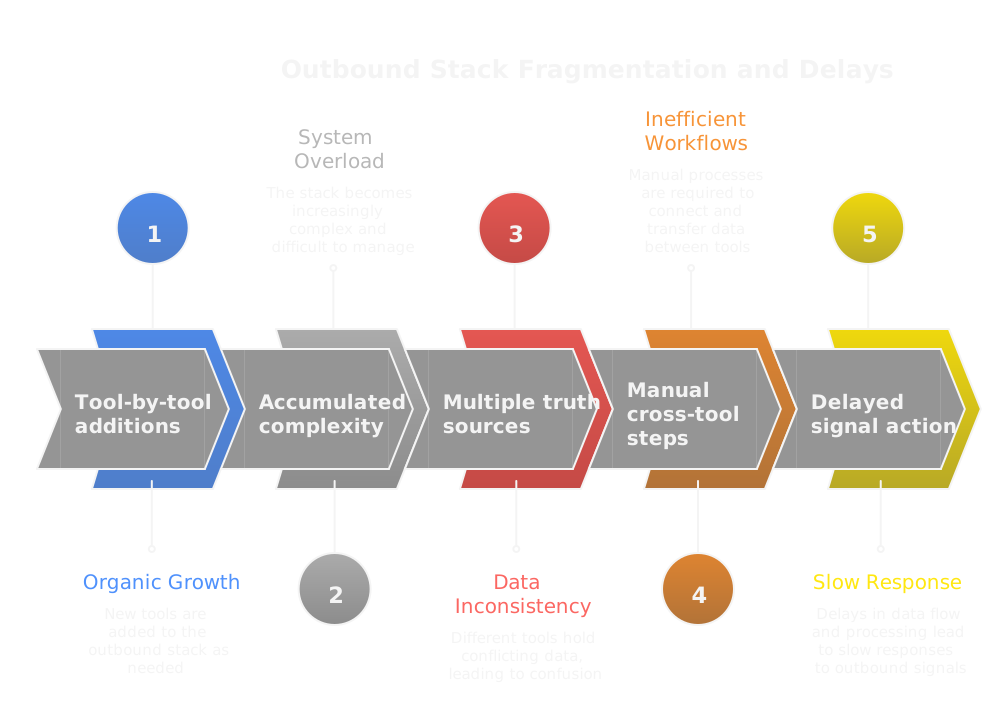
Most stacks are not designed. They are accumulated.
A team starts with a sequencing tool, then adds a data provider. When deliverability becomes an issue, they add a warmup tool. When they want better targeting, they subscribe to an intent platform. Then comes scheduling, enrichment, and a few more tools on top.
Each addition solves a local problem, but the system as a whole becomes fragmented.
You end up with multiple sources of truth, manual workflows between tools, delays between signal and action, and inconsistent personalization across channels.
At that point, outbound stops behaving like a system. It becomes a chain of disconnected steps.
The deeper issue is that there is no central layer where everything comes together. Signals live in one place, execution happens in another, and the connection between the two is fragile or delayed.
That gap is where most outbound performance is lost.
Category breakdown: what each layer actually does
To fix the problem, you need to understand what each category in the stack is responsible for, and just as importantly, where it falls short.
Data and prospecting
Every outbound motion starts here.
Tools like Clay, lemlist, Apollo, and Lusha are used to identify and enrich contacts. They help you define your market, build lists, and get access to email addresses and company data.
This layer is essential, but it has a clear limitation. Data is static.
Even when it is accurate, it does not tell you whether now is the right time to reach out. A contact can perfectly match your ideal customer profile and still have no active need for your product.
This is why list quality alone does not guarantee performance. Data gives you reach, but it does not give you timing.
Most teams try to compensate by adding more data sources, which increases coverage but also increases cost and complexity. The underlying limitation remains the same.
Email infrastructure and deliverability
Once you have contacts, the next challenge is making sure your emails actually land in the inbox.
Tools like lemwarm, Mailreach, and Instantly focus on warming up inboxes, maintaining sender reputation, and protecting deliverability.
This layer is often treated as purely technical, but it has a direct impact on results. If your emails are not seen, nothing else matters.
The mistake many teams make is isolating deliverability from the rest of their stack. They warm up domains in one tool and send campaigns from another, without connecting this to targeting quality or timing.
In reality, deliverability is deeply tied to relevance. When you send messages triggered by real signals, engagement increases, and inbox placement improves naturally.
This is why integrating deliverability directly into your outreach layer is becoming more important. When warmup, sending, and targeting live in separate systems, consistency is hard to maintain.
Intent and signals
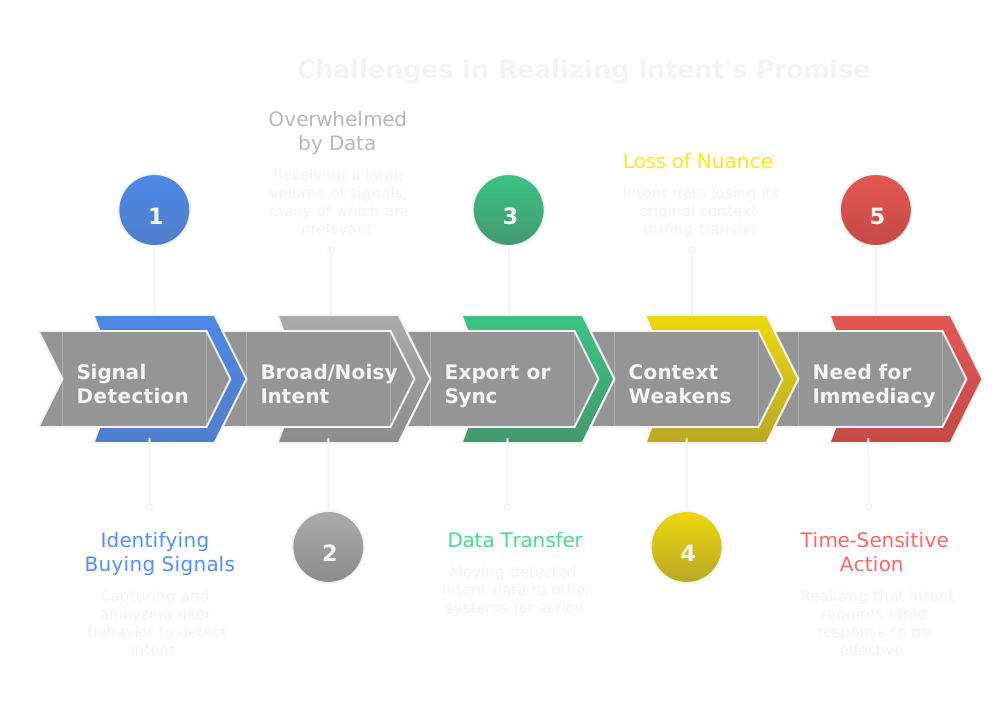
This is the layer that has generated the most excitement and the most confusion.
Tools like Bombora, lemlist and Clearbit attempt to surface buying signals by tracking behavior such as content consumption, website visits, or third-party data patterns.
The promise is compelling. Instead of guessing who to contact, you focus on accounts that are showing signs of interest.
The problem is in execution.
Intent data is often too broad to act on directly. Knowing that a company is researching a topic does not always translate into a clear, actionable message.
More importantly, intent is usually disconnected from execution. Teams detect signals in one platform, export or sync the data, and then trigger campaigns somewhere else. By the time outreach happens, the context is weaker.
This is where most stacks start to break.
The real value of intent is not visibility. It is immediacy. The ability to move from signal to outreach without delay, and to shape the message around that exact moment.
When signals and execution are separated, that advantage disappears.
Sales engagement platforms (SEP)
This is the core of the outbound stack, whether teams realize it or not.
The SEP is where strategy turns into action. It is where messages are created, sequences are launched, and conversations begin.
Traditional platforms were designed for linear execution. You build a sequence, add contacts, and let it run. Personalization is limited, and timing is rarely dynamic.
That model is no longer sufficient.
A modern SEP needs to act as an orchestration layer. It should handle multi-channel outreach, support deep personalization, and most importantly, react to signals in real time.
This is where the structure of the stack starts to change.
Instead of treating signals, deliverability, personalization, and sequencing as separate layers, they begin to converge inside the SEP.
This is how platforms like lemlist position themselves in a modern stack.
Rather than operating as a standalone sending tool, lemlist connects intent signals, multi-channel sequencing, and personalization in one place. Campaigns can be triggered by real events, messaging can reflect the context behind those events, and execution happens immediately across email, LinkedIn, and other channels.
The result is not just better-looking campaigns. It is a shorter path from insight to action, which is where most outbound performance gains actually come from.
CRM
The CRM remains the system of record.
Tools like HubSpot and Salesforce track deals, store account data, and provide visibility into pipeline and revenue.
They are essential for reporting and coordination, but they are not built for outbound execution.
Trying to run sequences directly from a CRM usually leads to rigid workflows and limited flexibility. The role of the CRM is to capture outcomes, not to manage the logic of outreach.
Keeping this separation clear helps maintain a cleaner and more scalable system.
Scheduling
Scheduling is often treated as a small detail, but it plays a critical role in conversion.
Tools like Calendly simplify the process by allowing prospects to book meetings instantly. This removes friction and speeds up the transition from interest to conversation.
In more advanced setups, scheduling is no longer a separate layer. It is embedded directly into the outreach flow.
When a prospect engages, they can move seamlessly from reply to booked meeting without leaving the experience. This reduces drop-off and increases conversion rates.
This is the direction the stack is moving toward, where even the final step of the funnel is integrated into the same system that initiated the outreach.
Lean stack vs full stack
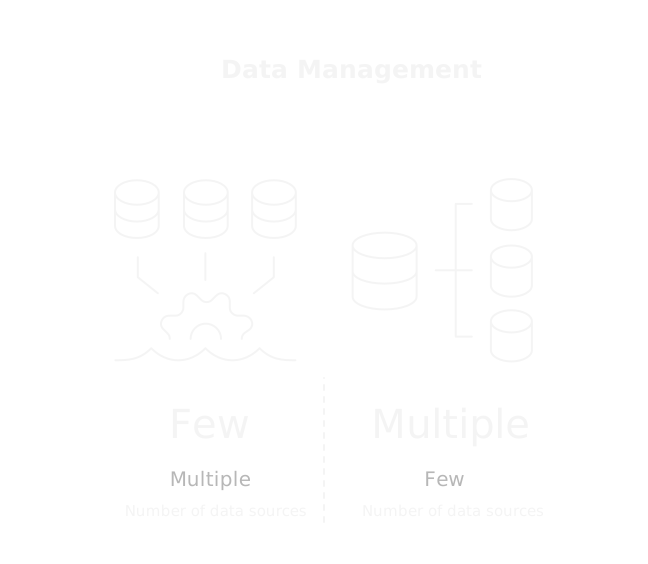
One of the clearest ways to evaluate your setup is to compare a full stack with a lean stack.
A full stack typically looks like this:
- Multiple data providers
- A standalone intent platform
- A sequencing tool
- A separate warmup tool
- A scheduling tool
- A CRM
This setup can work, but it requires constant coordination. Data needs to sync, signals need to be transferred, and workflows need to be maintained across tools.
A lean stack takes a different approach. It reduces the number of moving parts by consolidating key functions into fewer platforms.
Here’s how it compares to a full stack:
Data
Full stack: Multiple providers
Lean stack: 1 to 2 strong sources
Intent
Full stack: Separate tool
Lean stack: Built directly into the sales engagement platform
Sequencing
Full stack: Standalone tool
Lean stack: Managed inside a central platform
Deliverability
Full stack: External tool
Lean stack: Built into the platform
Scheduling
Full stack: Separate tool
Lean stack: Fully integrated
CRM
Full stack: External
Lean stack: External
The difference is not just about cost. It is about speed and reliability. A lean stack allows teams to react faster, reduce manual work, and maintain consistency across their outbound efforts.
Where most teams go wrong
The most common mistake is assuming that more tools will lead to better results.
In practice, every additional tool introduces friction. There are more integrations to manage, more data to synchronize, and more opportunities for things to break.
Over time, this slows down execution and creates blind spots.
Signals might exist but never trigger action. Personalization data might be available but not used effectively. Deliverability issues might go unnoticed until performance drops.
The stack becomes powerful in theory but inefficient in practice.
Why the best stacks are built around a strong core
The highest-performing outbound teams structure their stack around a central platform.
This platform is responsible for sequencing, personalization, signal-based triggers, and deliverability. Everything else connects to it.
In this model, the SEP becomes more than a sending tool. It becomes the orchestration layer.
This is where platforms like lemlist naturally sit.
By combining intent signals, multi-channel sequencing, native deliverability through lemwarm, and integrated scheduling through lemcal, it brings together layers that are traditionally spread across multiple tools.
The benefit is not just consolidation. It is alignment.
Signals trigger action instantly. Messaging reflects real context. Deliverability supports engagement rather than fighting against it. Scheduling happens without friction.
The stack starts to behave as a single system instead of a collection of parts.
Building your stack in 2026
If you are building or auditing your outbound stack today, the goal should not be to find the best tool in every category.
It should be to design a system that works coherently.
Start by identifying your central execution layer. This is where sequencing, signals, and personalization should live.
Then evaluate which tools are truly necessary around it. Data and CRM will remain external, but many other layers can be consolidated.
Finally, optimize for speed. The faster you can move from signal to outreach, the more effective your outbound will be.
Conclusion
If your current stack feels heavy, fragmented, or difficult to operate, it is probably not a tooling problem. It is an architecture problem.
lemlist is built for a more integrated approach, where intent signals, multi-channel sequencing, personalization, deliverability, and scheduling operate in the same environment.
Instead of adding another tool, it allows you to simplify your stack while improving execution.
You can try lemlist or book a demo to see how a more unified outbound system performs in practice.
.png)
RELATED ARTICLES
Lorem ipsum dolor sit amet, consectetuer adipiscing elit, sed diam nonummy nibh euismod tincidunt ut laoreet dolore magna aliquam erat volutpat.
.png)