Revenue Model Optimization Strategies For Sustainable Growth


You’re staring at the growth chart before a board call, ARR ticking up but CAC and discounting creeping higher, so you double down on promotions and assume yield will follow. The hidden problem is that those tactics treat symptoms; you’re running revenue management, not redesigning how you actually capture value, so small price moves and more outbound feel like a war on metrics instead of a system fix. Read on and you’ll learn how to tell short-term yield from strategic revenue model optimization, which four levers to pull—price, packaging, channels, lifecycle monetization—and the practical experiments, metrics, and governance that let you raise realized revenue per buyer without eroding margin, plus when AI-driven outbound and technical operators matter so your next change is a measured win, not a costly guess.
What Is Revenue Model Optimization?
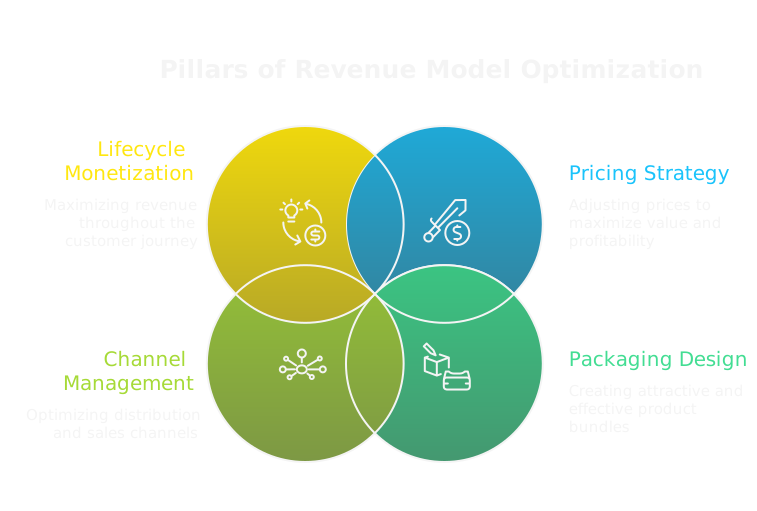
Revenue model optimization is the deliberate reshaping of how you make money. It covers pricing, packaging, sales channels, and the motions that convert prospects into customers and customers into repeat buyers. The goal is simple, measurable: get more sustainable revenue per buyer while protecting or improving margins.
How Does It Differ From Revenue Management?
Revenue management is tactical, often focused on short-term yield, inventory, or seat utilization. Revenue model optimization is strategic; it questions the underlying assumptions about who pays, what they pay for, and how you go to market. One cares about weekly yield and discounts, the other questions pricing tier logic, bundle structure, and channel mix.
Which Revenue Levers Does It Target?
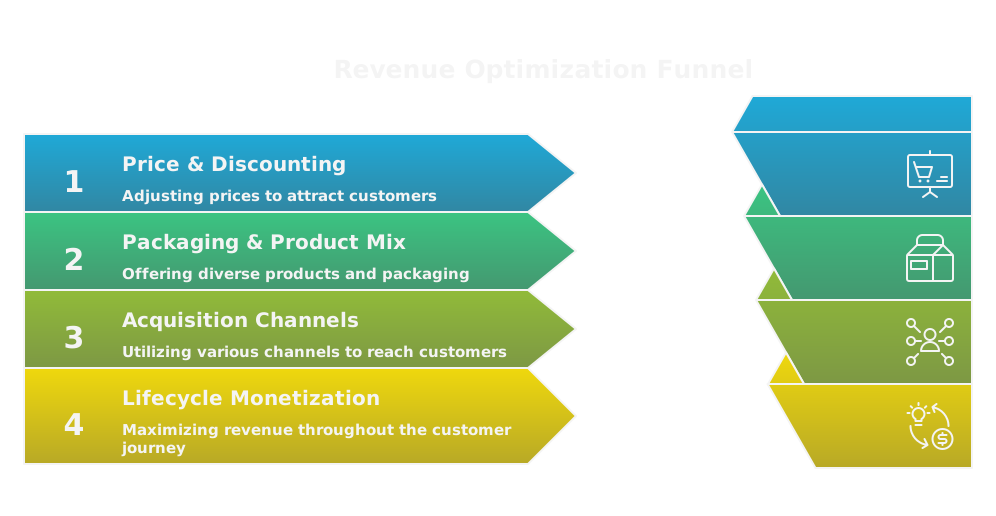
It targets four tight levers:
- Price and discounting, including list price, promotional cadence, and price floors.
- Packaging and product mix, like feature bundles, add-ons, and entry tiers.
- Acquisition channels and motions, paid, organic, and increasingly, outbound as a marketing motion.
- Monetization across the customer lifecycle, conversion, upsell, cross-sell, churn reduction.
Note, AI has made outbound cheap, scalable, and signal-driven. That shifts channel economics and creates new levers because automated outreach can change CAC and conversion across cohorts. GTM is a system; you only get the full benefit if pricing, packaging, and your channel automation are wired together.
When Should You Start Optimizing?
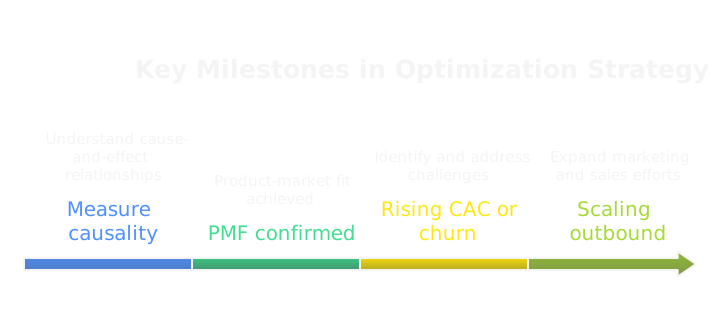
Start now, but with priorities. Begin once you can measure causality, meaning you have basic cohorting, conversion funnels, and a repeatable acquisition channel. Trigger moments to accelerate optimization:
- Product market fit confirmed, and growth is constrained by pricing or margins.
- CAC rising, payback lengthening, or churn creeping up.
- You're scaling outbound and need price or packaging that matches higher-volume GTM.
Optimization is continuous. As AI and automation replace manual SDR work, your team needs technical operators to run experiments and feed results into the GTM system.
If you need help executing outbound tests quickly, agencies like SalesCaptain can accelerate those experiments as a demand generation partner.
Why Improve Your Revenue Model?
Improving your revenue model reduces guesswork in how you capture value. It aligns pricing to willingness to pay, shifts mix toward higher margin products, and turns acquisition into a predictable input, not a wild card.
How Does Optimization Boost Profitability?
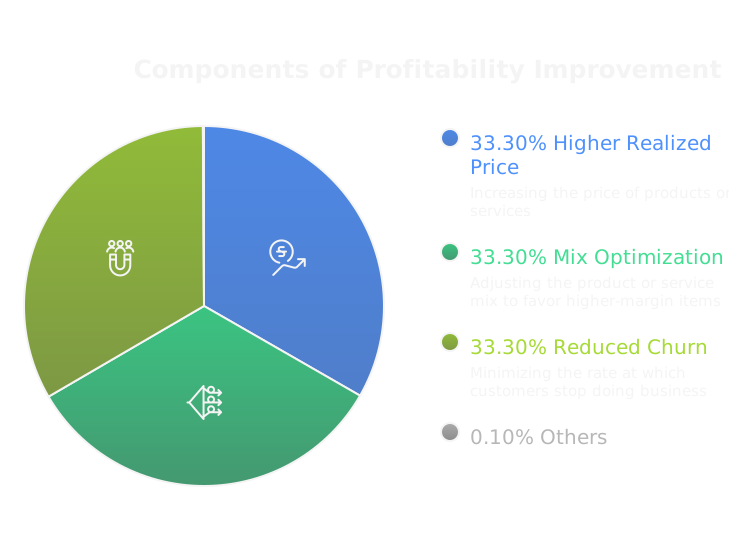
There are three direct paths:
- Higher realized price per transaction without proportionally increasing costs, driven by better positioning and reduced unnecessary discounting.
- Mix optimization, where you sell more high-margin bundles or promote services that have better gross profit.
- Reduced churn and better retention, which cuts acquisition waste and increases net revenue retention.
Small percentage improvements compound quickly. A 5 percent ARPA lift plus lower churn often improves profitability more than equivalent cuts to headcount.
How Does It Increase Customer Lifetime Value?
Optimization increases LTV by increasing revenue per customer and stretching the revenue duration. Tactics include tiered packaging that encourages expansion, usage-based pricing that captures growth, and targeted onboarding to reduce time to value. AI-enabled outbound and automation make it easier to surface expansion signals and run scaled personalization, so LTV growth becomes operational, not accidental.
Which Business Outcomes Improve First?
You’ll usually see three outcomes first:
- Conversion rates on pricing experiments and packaging tweaks.
- Average revenue per account or per user after price or packaging changes.
- Speed of the funnel, shorter sales cycles when pricing matches buyer expectations.
Profitability and NRR follow once those are steady. If you want to move faster on outbound-driven experiments, an outbound agency or GTM accelerator can help run repeatable tests.
Which Metrics Should You Track?
Pick metrics that connect cause to outcome. Every metric should be tied to a hypothesis you can test and iterate on.
Which Customer Revenue Metrics Matter?
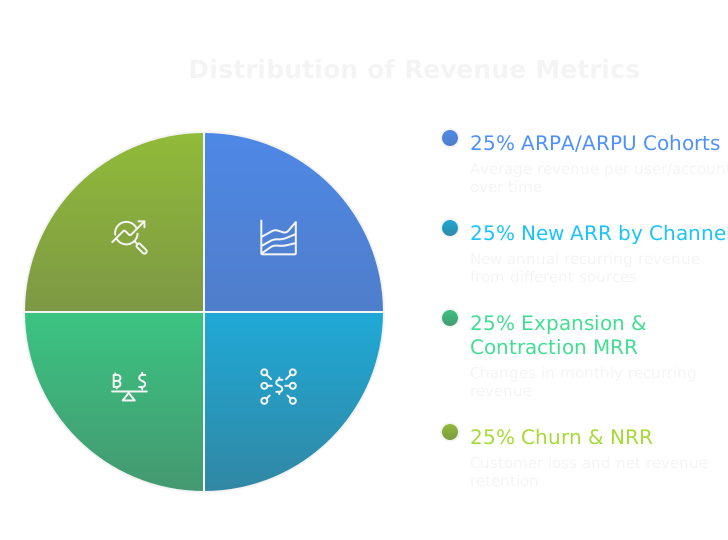
Core metrics to watch:
- ARPA or ARPU, tracked by cohort and segment.
- New ARR or MRR, broken down by channel and package.
- Expansion MRR and contraction MRR, to see net movement inside accounts.
- Churn rate, both logo and revenue churn, cohort-based.
- Net revenue retention, because it captures expansion and churn together.
Segment all of these by acquisition channel, package, industry, and cohort age. Outbound as a marketing motion needs separate attribution because automated outreach behaves differently from paid or organic channels.
How to use Clay for customer revenue metrics: Use Clay to enrich account and contact data, build granular cohorts, and automate exports to your analytics stack. Clay can power signal-driven segmentation for outbound experiments, and using this link gives you 3,000 free credits to get started.
How Do You Measure Price Elasticity?
Practical ways to measure it:
- Run randomized price tests, A/B or multi-variant, with clean holdout groups.
- Use quasi-experimental methods, like difference-in-differences, when full randomization is impossible.
- Track conversion, ARPA, and churn across tested cohorts, not just one-time purchases.
Price elasticity is context-specific. Measure by segment, not company-wide because enterprise buyers behave differently than SMBs. Combine experiments with demand signals from AI-driven outbound to discover pockets of higher willingness to pay.
Which Efficiency Metrics Show Health?
Efficiency metrics indicate if your model scales:
- LTV to CAC ratio, with clear cohort windows for payback.
- CAC payback period in months.
- Sales efficiency, like pipeline created per SDR or per marketing dollar.
- Time to value, measured as days to first meaningful outcome for the customer.
As SDRs are replaced by automation, track pipeline per automation flow and the technical resources needed to maintain them. GTM performance requires monitoring the workflows, infrastructure, and feedback loops that produce pipeline.
How Should You Monitor Margin And Costs?
Monitor margin at the product and customer segment level:
- Gross margin by product or SKU, excluding variable acquisition costs.
- Contribution margin per customer or deal type, including support and onboarding costs.
- Unit economics for usage-based models, like margin per seat or per API call.
Use rolling windows, not single-month snapshots. Look for leading indicators, like rising support hours per account or increasing onboarding time; they erode margin before finance flags problems.
If you use automated outbound or enrichment, tie the operational costs into your CAC model, and treat the cost of automation and AI credits as a repeatable input. That closes the loop between GTM spend and margin.
How Do You Diagnose Revenue Leaks?
Diagnosing revenue leaks is about finding where expected value falls out of the system, then quantifying the hole. You need signal, not surmise: cohort-level funnels, instrumented touchpoints, and a hypothesis-first approach.
How Do You Map The Revenue Funnel?
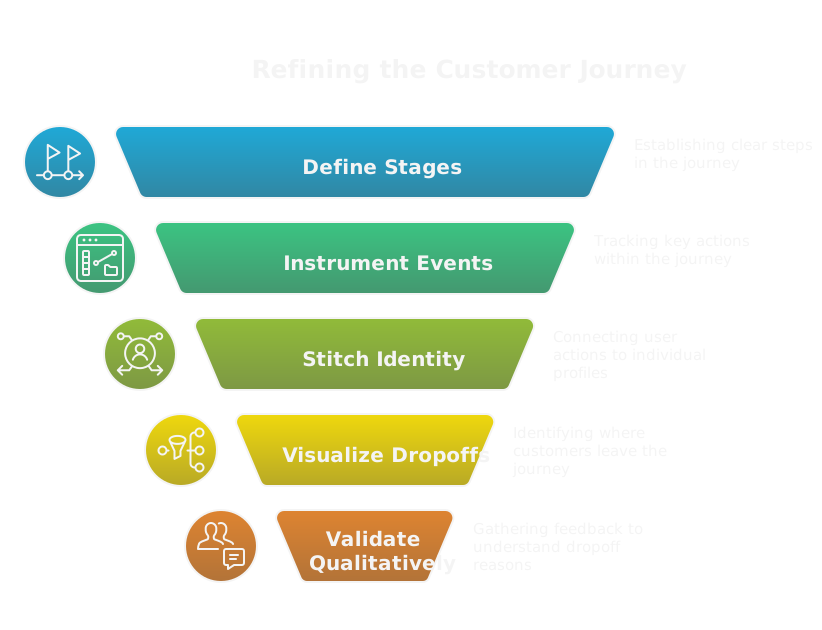
Map every stage a buyer crosses from first touch to repeat purchase, and do it by cohort and channel.
- Define stages precisely, for example, lead, MQL, SQL, opportunity, closed won, onboarding complete, expansion qualified. One precise definition beats many fuzzy ones.
- Instrument events at each stage, including micro-conversions like product activation, first value event, and renewal intent signals.
- Stitch identity across systems, so you know which marketing touch and which automation flow produced a customer.
- Visualize flow rates and time-in-stage by cohort, channel, and package. Look for abrupt dropoffs and long tails.
- Validate with qualitative checks, call recordings, and customer interviews when metrics aren’t telling the full story.
A clean funnel shows where revenue should appear. If it doesn’t, you’ve found a leak.
How Do You Run Cohort And Conversion Analysis?
Cohorts expose what changes over time and by channel.
- Build cohorts by acquisition month, campaign, package, and vertical. Track conversion, ARPA, churn, and expansion for each cohort.
- Compare conversion curves, not single snapshots. Are newer cohorts converting faster or slower? Where do they diverge?
- Use cohort-level LTV curves to detect hidden erosion, like customers who buy but never expand.
- Pair quantitative cohorts with qualitative segmentation. If a cohort underperforms, grab a sample, do root cause interviews, or replay sessions.
- When you suspect pricing sensitivity, run price-stratified cohorts, not global averages.
Cohorts convert numbers into narratives you can act on.
How Do You Identify Pricing And Packaging Breakpoints?
Breakpoints reveal where small changes cause big behavior shifts.
- Plot conversion and churn against price bands and package features. Look for nonlinearity, steep inflection points where willingness to pay collapses or spikes.
- Test threshold effects, for example, adding a single high-value feature to the next tier, or moving a feature from free to paid.
- Use anchoring and decoy tests to expose perceived value without changing product. A well-placed high-priced option can raise mid-tier conversion.
- Measure both acquisition and downstream metrics. A price that increases conversion but kills expansion or raises churn isn’t a win.
- Layer segmentation. Breakpoints differ by industry, buyer seniority, and channel. What works for an SMB outbound list may fail in enterprise bundles.
Don’t guess breakpoints, observe them. Then design experiments around them.
Which Strategies Drive Revenue Growth?
Revenue growth comes from coordinated moves across pricing, packaging, motions, and channels. You can raise price, shift mix, increase conversion, or unlock new monetization paths. The best plans combine several.
How Do You Optimize Pricing Strategies?
Pricing optimization is a mix of data, psychology, and guardrails.
- Start with value mapping. List buyer jobs, quantify outcomes, then price to capture a fraction of the value delivered.
- Use tiered pricing to segment willingness to pay. Keep tiers distinct, with clear job-to-be-done alignment.
- Consider hybrid models, like base subscription plus usage, to capture scale while lowering entry friction.
- Protect margin with disciplined discounting rules, approval workflows, and monitored floors.
- Run randomized price tests where possible, and quasi-experimental approaches when not.
- Track leading signals, like trial-to-paid conversion and first-month churn, to detect price-driven friction early.
AI and automated outbound let you surface buyer signals at scale. Use that signal to segment pricing experiments toward high-propensity cohorts.
How Do You Design Packaging And Bundles?
Packaging steers behavior. Design it to guide customers toward high-value, high-margin outcomes.
- Pack features into coherent jobs, not arbitrary lists. Each bundle should answer a buyer question like, what problem does this tier solve?
- Use anchor and decoy tactics sparingly to nudge choices. The mid-tier should feel like the smart buy.
- Offer unbundled add-ons for high-margin optional services, keep core value in tiers to protect upgrades.
- Test entry-level offers to lower friction, then measure upgrade velocity to ensure they’re not just cheap seats.
- Consider feature gating and consumption tiers for usage growth, while keeping predictable revenue with base fees.
Packaging is a conversation with buyers. Make choices obvious, and make expansion the easy next step.
How Do You Execute Upsell And Cross-Sell?
Upsell and cross-sell are operational problems, not just messaging.
- Define expansion triggers, like usage thresholds, seat counts, or business events. Automate detection and routing.
- Create playbooks for digital and human paths. Use automated outbound for high-volume signals, handoffs to sellers for complex expansions.
- Prioritize offers that increase gross margin, not just ARR. Upsells that require heavy support can be net negative.
- Test frictionless upgrades, like one-click seat increases or in-app add-ons, alongside consultative offers.
- Measure pipeline contribution from expansion separately from new business. Track time from trigger to close, and churn after upgrade.
As SDR roles become automated, ensure technical operators manage the automation and feedback loops that feed these plays.
How Do You Monetize New Channels And Features?
New channels and features are experiments that reveal new buyer value.
- Treat channel economics like a product. Measure CAC by channel, then compare to channel-specific LTV.
- For features, start with gated beta pricing or an add-on fee, then iterate pricing as value becomes clear.
- Use partner and reseller models where channel margins make sense, and structure incentives to drive desired customer outcomes.
- API and usage monetization require clear metering, rate limits, and transparent billing. Start with a simple tiered usage model before adding complexity.
- Run short pilot programs with clear success metrics, then scale incrementally if unit economics hold.
Channels matter. Automated outbound can convert different segments at lower CAC, so test channel-specific pricing and packaging.
How Do You Build An Optimization Framework?
A repeatable framework turns random wins into sustainable revenue improvement. The framework combines audit, prioritization, rigorous experimentation, and disciplined rollout.
How Do You Audit And Benchmark Performance?
Start with a focused audit that surfaces leverageable metrics.
- Inventory revenue streams, pricing tiers, packages, and channel costs. Map revenue by product, segment, and channel.
- Benchmark internally across cohorts and externally against public comps or category peers.
- Identify signal gaps, for example missing activation events or untracked add-ons, and instrument them immediately.
- Build a one-page health dashboard that highlights conversion, ARPA, churn, and experiment velocity.
- Create a short list of 3 to 5 hypotheses that could move the needle. Audits without hypotheses are reports that sit on a shelf.
Benchmarks tell you how far you can push before hitting limits.
How Do You Segment And Prioritize Opportunities?
Not all opportunities are equal. Prioritize by impact, confidence, and effort.
- Score opportunities with an ICE-style model, focusing on revenue impact, ease of implementation, and data confidence.
- Favor fixes that improve both conversion and downstream unit economics, like removing churn drivers or fixing onboarding dropoff.
- Target high-leverage segments first. If AI-driven outbound surfaces a niche that converts at higher price, prioritize experiments there.
- Keep a balanced backlog, mixing quick wins with longer strategic bets.
Prioritization keeps the team executing, not dreaming.
How Do You Design And Run Experiments?
Experimentation is where hypotheses become evidence.
- Define hypothesis, primary metric, cohorts, sample size, and test duration up front. No ambiguities.
- Use randomized tests when possible. When you can’t, use clean matched controls and difference-in-differences.
- Instrument everything, capture secondary metrics like churn and support load, and pre-specify decision rules and rollbacks.
- Run experiments continuously, but limit concurrent tests that affect the same metric or cohort to avoid interference.
- Document outcomes, store learnings in a central playbook, and circulate quick postmortems that include why something failed.
Speed matters, but not at the expense of inferential clarity.
How Do You Implement, Scale, And Govern Changes?
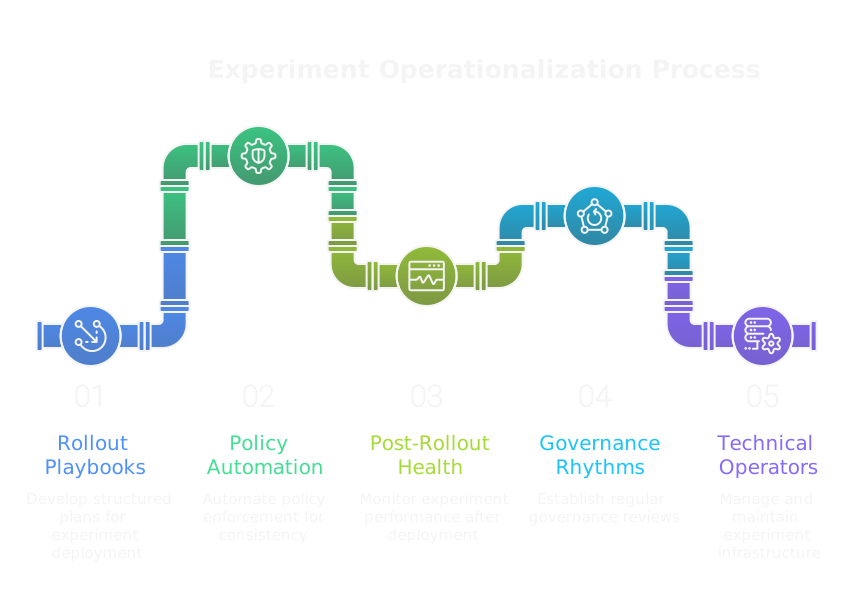
Winning experiments must be operationalized with controls.
- Create rollout playbooks that include pricing updates, UI changes, billing migrations, and customer communications.
- Automate policy enforcement for discounts, billing floors, and approval chains to prevent revenue dilution.
- Measure post-rollout health over long windows, watching for regression in churn or support costs.
- Build governance rhythms, like monthly pricing reviews and a steering committee that includes product, finance, GTM ops, and engineering.
- Treat GTM as a system, with workflows, infrastructure, and feedback loops. As you automate more outbound and replace SDRs, invest in technical operators who can maintain and iterate those loops.
Governance keeps experiments from becoming revenue noise. Scale what works, and make the system relentless about learning.
How Do You Use Data And Technology?
Data and technology are the nervous system of revenue optimization. They collect signals, run experiments, automate offers, and close feedback loops so decisions stop being guesses and become repeatable moves.
Which Tools Support Pricing And Testing?
Start with a layered stack, from enrichment and experimentation to billing and analytics:
- Clay, for enrichment and signal-driven segmentation, linkable to your stack so you can trigger cohort-specific pricing tests. Using the Clay link in this article gives you 3,000 free credits to accelerate tests.
- Analytics and warehousing, like BigQuery, Snowflake, Looker, or Mode, for cohorting, elasticity analysis, and attribution.
- Experimentation and feature flags, like Optimizely, Split, or LaunchDarkly, to run controlled pricing and packaging tests without risky rollouts.
- Product analytics, like Amplitude or Mixpanel, to tie first-value events to paid conversion.
- Billing and metering, like Stripe Billing, Recurly, or Chargebee, to support multiple pricing models and clean migrations.
- Pricing and revenue platforms, like ProfitWell or Vendavo, for benchmarking and visibility into churn by price band.
- Customer data platforms and reverse ETL, to sync experiment cohorts and signals back into CRMs and automation engines.
- ML toolchains, for modeling elasticity or propensity to expand, and a lightweight feature store to serve predictions in real time.
How to use Clay for pricing and testing: use Clay to enrich account attributes, build signal-rich cohorts (industry, employee count, activity signals), then export those lists to your experiment flagging system or automation flow. Clay can seed targeted price variants for outbound lists, reducing setup time for segmented tests.
How Can Machine Learning Improve Revenue?
ML turns historical patterns into actionable predictions, but it must be applied with guardrails.
- Elasticity and segmentation models, predict price sensitivity by cohort so you can target higher willingness to pay without testing every bucket.
- Propensity-to-expand and churn models, prioritize accounts for upsell campaigns and detect at-risk customers before revenue decays.
- Uplift modeling, show incremental revenue from an intervention, useful when automation replaces SDR outreach so you only spend on interventions that move the needle.
- Real-time personalization, adjust offers or packaging in-app based on live signals, for example showing a usage-based option when consumption spikes.
- Reinforcement learning for dynamic offers, where the system experiments in production and learns which prices maximize long-run revenue subject to churn constraints.
Operational cautions: validate causal effects, monitor downstream metrics like churn and support load, and encode business rules to prevent harmful pricing decisions. As SDRs shift to automation, technical operators should own model deployment and the feedback loops that retrain models.
How Do You Integrate Revenue Systems?
Integration is about identity, timing, and governance, not point-to-point copies.
- Stitch identity across marketing, product, billing, and support so experiments have a single source of truth for cohorts and outcomes.
- Use an events-first architecture, streaming key events to a warehouse, then serving those enriched cohorts back to CRMs and experimentation tools via reverse ETL.
- Automate decisioning layers, for example a price-variant service that responds to an account’s cohort and serves the right UI and billing rule.
- Preserve auditability, store experiment assignments and exposure timestamps, and log billing outcomes for post-rollout analysis.
- Orchestrate workflows, not just data. Integrate experiment flags with GTM automation, so an outbound flow sends the right pitch and billing enforces the chosen price.
- Govern with approvals, rollback paths, and feature flags to limit blast radius when models or integrations misbehave.
Integration makes GTM a system: workflows, infrastructure, and feedback loops working together. That system needs technical operators who can maintain automation and the data plumbing that powers signal-driven outbound.
Which Templates And Checklists Help?
Templates reduce ambiguity, speed experiments, and ensure rollouts don’t create hidden revenue drains. Below are lean, battle-tested blueprints.
What Should A Pricing Experiment Plan Include?
A pricing experiment plan must be explicit and measurable:
- Hypothesis, succinctly stating expected direction and rationale.
- Primary metric and guardrail metrics, for example paid conversion as primary, churn and support tickets as guardrails.
- Cohort definition and segmentation rules, including exclusions and regional/legal constraints.
- Variant definitions, exact UI text, and billing behavior for each arm.
- Sample size estimate and test duration with statistical power notes.
- Assignment method and exposure logging details.
- Pre-specified decision rules for rollout, rollback, and partial rollouts.
- Dependencies and owners, including analytics, product, billing, and legal.
- Communication plan for customers and internal teams, and migration steps for future billing normalization.
Keep the plan short, instrumented, and owned by a single technical operator responsible for data quality.
What Does A Packaging Template Look Like?
A packaging template frames choices so buyers see the job-to-be-done mapping:
- Package name and target persona, one line each.
- Core job solved and success criteria the customer achieves.
- Included features, listed as outcome statements, not bullet tech specs.
- Add-ons and how they are billed, with margins and operational impact noted.
- Anchor and decoy positions, and suggested price points or ranges.
- Upgrade path and common expansion triggers.
- Expected conversion funnel: entry offer, activation metric, time to first value.
- Support level and onboarding commitments tied to each tier.
- Monitoring plan: metrics to watch post-launch and churn triggers.
A good template makes packaging decisions defensible and testable.
What Belongs In A Revenue Optimization Checklist?
A checklist prevents rollout shocks and keeps governance tight:
- Data readiness: cohorts, event instrumentation, and attribution verified.
- Legal and tax check for new pricing or bundles.
- Billing test plan: sandbox invoices, migrations, proration rules.
- UI and copy freeze for experiment arms, reviewed by product and comms.
- Experiment flags and rollback switches in place.
- Analytics dashboard and alerting configured for primary and guardrail metrics.
- Support playbook and FAQ for likely customer questions.
- Discount policy enforcement and approval paths validated.
- Post-rollout monitoring schedule and ownership assigned for 30, 60, 90 days.
Run this checklist before any price or packaging change touches customers.
How Have Companies Optimized Revenue?
Real examples compress learning into replicable moves. Below are anonymized, realistic outcomes to show what works across models.
What SaaS Examples Demonstrate Success?
- Tier simplification for faster selection: A mid-market SaaS collapsed five legacy tiers into three, aligned each to a clear job, added an anchored enterprise plan, and increased ARPA by 12 percent while reducing support requests related to incorrect plan selection.
- Usage hybrid capture: An API provider added a small base fee plus usage, which reduced trial friction and captured scale from heavy users, improving gross margin per account as usage rose.
- Signal-driven outbound pricing: A company used automated outbound to surface high-intent accounts, then presented a premium pilot package only to those accounts. Conversion and expansion rates rose, because pricing matched demonstrated urgency rather than a broad average.
Each win depended on instrumentation, segmented experiments, and operational playbooks to scale.
What Retail And Marketplace Examples Show?
- Dynamic markdowns with inventory signals: A retailer tied discounts to excess inventory and elastic demand signals, reducing clearance time while protecting margin on full-price cohorts.
- Take-rate optimization for marketplaces: A two-sided marketplace moved from a flat commission to a blended model, charging lower fees to demand-side customers and premium placement fees to power sellers. Net take-rate increased, and churn on the seller side fell because incentives aligned with volume.
- Bundled incentives for repeat purchase: A vertical marketplace introduced timed bundles, which increased repeat purchase frequency and lifted LTV by creating predictable reorder behavior.
Retail and marketplace optimization is often about matching price to scarcity, urgency, and lifecycle stage, based on insights from retail analytics tools.
How Has Healthcare Applied These Tactics?
- Bundled care pricing: A clinic moved from per-visit billing to bundled care paths for chronic conditions, improving predictability for patients and increasing per-patient revenue while lowering readmission rates.
- Risk-based contracts with clear triggers: Providers negotiated outcome-linked contracts, instrumenting EHR and claims data to prove value and justify higher per-member fees.
- Patient segmentation and financial counseling: Systems used propensity models to segment patients for payment plans and targeted outreach, reducing bad debt and increasing collection rates.
Healthcare changes require compliance and careful communication, but the core mechanics are the same: align price to value and instrument outcomes so revenue follows improved care.
How Do You Compare Revenue Models?
Comparing models is about fit, mechanics, and operating cost. Don’t pick a model because it’s trendy. Match the buyer’s purchase pattern, the product’s value delivery cadence, and your ability to meter and bill cleanly.
When Is Subscription Better Than Usage?
Subscription works when value is steady, predictable, and tied to ongoing access or outcomes.
- Signals that favor subscription: customers need continuous access, onboarding and support are significant, and the product delivers repeated utility each month.
- Business benefits: predictable ARR, easier forecasting, simpler billing, and lower churn if onboarding drives value quickly.
- Risks: low initial friction may hide underused seats, and flat fees can undercapture heavy users. Monitor first-value timing, cohort retention, and activation rates.
- GTM implications: subscription simplifies outbound offers, since you can present clear packages. As outbound becomes automated and signal-driven, you can segment lists by propensity to commit to recurring spend.
When Should You Use Transactional Pricing?
Transactional pricing fits when purchases are discrete events or tightly tied to inventory or one-off services.
- Use it when: customers buy on occasion, value is per-event, or you want low commitment to maximize trial behavior.
- Strengths: low entry friction, easy to A/B test price points, and clear revenue per unit for marketplaces or retail.
- Drawbacks: unpredictable revenue, higher CAC to LTV pressure, and more complex customer lifetime tracking. Track frequency per buyer, repeat-purchase rates, and margin per transaction.
- GTM implications: transactional models require acquisition velocity. Cheap, AI-enabled outbound can seed repeat buyers cheaply, but you must instrument reactivation plays and retention flows.
How Do You Design A Hybrid Model?
Hybrid models capture scale while preserving entry simplicity. Design them deliberately, not piecemeal.
- Start with the buyer journey. Define what deserves a base, predictable fee and what should scale with usage. Base fees should cover fixed onboarding and support costs. Usage tiers capture variable value.
- Keep billing simple. Offer a clear base tier plus metered bands or overage rules. Avoid dozens of micro-meters that confuse customers and ops.
- Set guardrails. Define caps, minimum commitments, and billing floors to avoid margin leakage. Simulate scenarios, like a small number of power users driving disproportionate costs.
- Instrument everything. Meter usage events, link them to invoices, and show customers consumption in-product to reduce disputes. Track contribution margin by cohort to ensure usage monetization improves, not hurts, profitability.
- Migration plan. For existing customers, run pilots with opt-ins, measure churn and expansion, then offer phased migrations. Communicate benefits plainly.
- GTM playbook. Use automated, signal-driven outbound to identify accounts likely to scale and offer tailored hybrid pilots. Ensure the automation flow triggers the correct billing rules and handoffs to account teams.
How Should You Organize Teams And Roles?
Structure must match the complexity of your model and your experiment velocity. Organization is as much about decision rights as it is about headcount.
Who Owns Pricing, RevOps, And CRO Functions?
Clear ownership reduces political leakage and speeds decisions.
- Pricing: a central pricing lead or small pricing team should set list prices, guardrails, experiments, and discount policy. They coordinate feature-to-tier mapping and approve price rollouts.
- RevOps: owns the GTM plumbing, experiment flags, attribution, and billing integrations. They are the technical operators who make the system run. RevOps should log experiment exposures and maintain rollback paths.
- CRO: owns go-to-market strategy and targets, including channel mix and outbound motion. They set commercial priorities and resource allocation, not micro-price edits.
- Governance: create a pricing committee with pricing lead, RevOps, product, finance, and CRO reps. Grant the pricing lead execution authority within committee rules and a fast approval path for tactical experiments.
What Skills Should You Hire For?
Hire for measurement, automation, and commercial empathy.
- Technical operators, people who can build and maintain automation flows, flagging, and billing integrations. As SDR work automates, these roles grow in importance.
- Data analysts and experiment designers, skilled in cohorting, power calculations, and causal inference. They keep tests clean and interpretable.
- Product pricing managers, who translate jobs-to-be-done into packages and guard feature creep.
- Revenue operations engineers, who own event pipelines, reverse ETL, and identity stitching.
- Commercial specialists, like value engineers or customer success sellers, who can close complex expansions and validate perceived value.
- Legal/tax operability for international models and regulatory constraints. Hire lean, cross-functional people who can move fast.
How Do You Align Sales, Product, And Finance?
Alignment is ritualized, metric-driven, and automated.
- Shared metrics. Use a small set of shared KPIs, for example cohort ARPA, expansion velocity, and contribution margin by package. Make these visible in real time.
- Regular cadences. Weekly experiment syncs, monthly pricing reviews, and quarterly strategy sessions. Include data evidence and decision logs.
- SLAs and handoffs. Define explicit triggers and who acts on them, for example when usage crosses the upsell threshold, the automation flow opens a seat increase or routes to an AE.
- Single source of truth. Stitch data across product, billing, and CRM so there’s no debate about experiment exposure or revenue outcomes. RevOps should own this plumbing.
- Autonomy with guardrails. Let product and sales run targeted experiments within pre-approved rules from pricing and finance to avoid uncontrolled discounting or margin erosion.
What Common Mistakes Should You Avoid?
Avoid predictable traps that kill discipline, margin, and learning velocity. Each mistake looks small until it compounds.
Why Is Overreliance On Discounts Harmful?
Discounts are a blunt instrument that erode price signals.
- Short-term wins mask long-term damage. Frequent discounts reset customer expectations and compress realized price.
- They hide product-market mismatches. If you need to discount to close, the problem may be packaging or positioning, not price alone.
- Operational cost. Discounting without controls creates revenue leakage and approval bottlenecks.
- Fix it: codify discount bands, require experiment plans for non-standard deals, and measure net price by cohort, not list price. Use targeted offers via automated outbound to reduce blanket discounting.
Why Should You Not Ignore Cost Variability?
Ignoring variable costs makes usage models dangerous.
- Heavy users can destroy margins. A usage-based surge without proper pricing or caps can turn a good account into a money loser.
- Hidden operational load. Support, onboarding, and uptime costs scale differently across customers. If you don’t track them, you’ll misprice.
- Measure contribution margin per account and per unit of consumption. Model tail scenarios and set overage rates or throttles. Tie billing to actual operational cost drivers so price captures true economics.
Why Does Skipping Tests Cause Failures?
Skipping tests turns decisions into opinions.
- Small changes can have large downstream effects on churn, support, and expansion. Without tests, you’ll only notice damage after it’s baked in.
- Lack of inference leads to political fights and duplicated work. Tests create a common evidence base.
- Run focused, measurable experiments. Pre-specify metrics and guardrails, limit concurrent changes on the same cohort, and capture exposure. If you can’t randomize, use clean controls and report confidence transparently.
- Culture matters. Reward documented failures and store learnings. The faster you test, the quicker you find scalable moves and the less you rely on costly manual outreach to compensate for wrong pricing.
FAQs
RELATED ARTICLES
Check out more articles on our blog!


RELATED ARTICLES
Lorem ipsum dolor sit amet, consectetuer adipiscing elit, sed diam nonummy nibh euismod tincidunt ut laoreet dolore magna aliquam erat volutpat.
.png)