Top 7 Sales Commission Software for Easy Sales Comp Automation



Manually managing sales commissions is the operational equivalent of pulling teeth. It involves complex spreadsheets, constant shadow accounting from reps, and a high probability of errors that damage trust. As organizations look to scale in 2026 and beyond, automation isn't just a luxury; it's a necessity.
This guide reviews the top 7 sales commission software solutions to help you move away from manual calculations and embrace easy sales compensation automation.
TL;DR: Executive Summary
If you are short on time, here is the quick breakdown:
- For Fast Scaling Mid-Market and Enterprise: Visdum
- For Comprehensive Sales Performance Management: Performio.
- For Small Businesses/Simpler Plans: Commissionly.
- For Legacy Systems/Traditional Industries: QCommission.
- For European/Global Teams focused on transparency: Qobra.
Why Automate Sales Commissions?
Operating sales comp via Excel is unsustainable once you have more than five to ten sales reps.
Here is why automation is critical:
- Eradicate Errors: Manual data entry causes payout errors in up to 80% of spreadsheets. Automation eliminates this risk.
- Save Time for Finance/Ops: Instead of spending days reconciling data at month-end, automation reduces the process to hours.
- Boost Rep Morale & Trust: Provide reps with real-time visibility into their earnings, eliminating "shadow accounting."
- Strategic Agility: Design, model, and roll out new comp plans instantly to respond to market changes, without needing to rebuild complex formulas from scratch.
Key Features to Look For in Sales Commission Software
When evaluating tools, ensure they excel in these core areas:
- Robust CRM/ERP Integration: The tool must seamlessly pull data from Salesforce, HubSpot, or your ERP without manual CSV uploads.
- No-Code Plan Designer: Sales leaders or Finance should be able to create complex logic (accelerators, split commissions, clawbacks) without needing an engineering degree.
- Real-Time Rep Dashboards: Reps need to see how much they have earned and what they will earn by closing current deals.
- Workflow & Dispute Management: A system for reps to raise questions about statements and for managers to approve them digitally.
- Audit Trails & ASC 606 Compliance: Essential for public companies or those seeking funding, ensuring revenue recognition is accurate.
Top 7 Sales Commission Software in 2026
Here is our curated list of the best solutions available for sales comp automation, tailored to different needs and company sizes.
1. Visdum
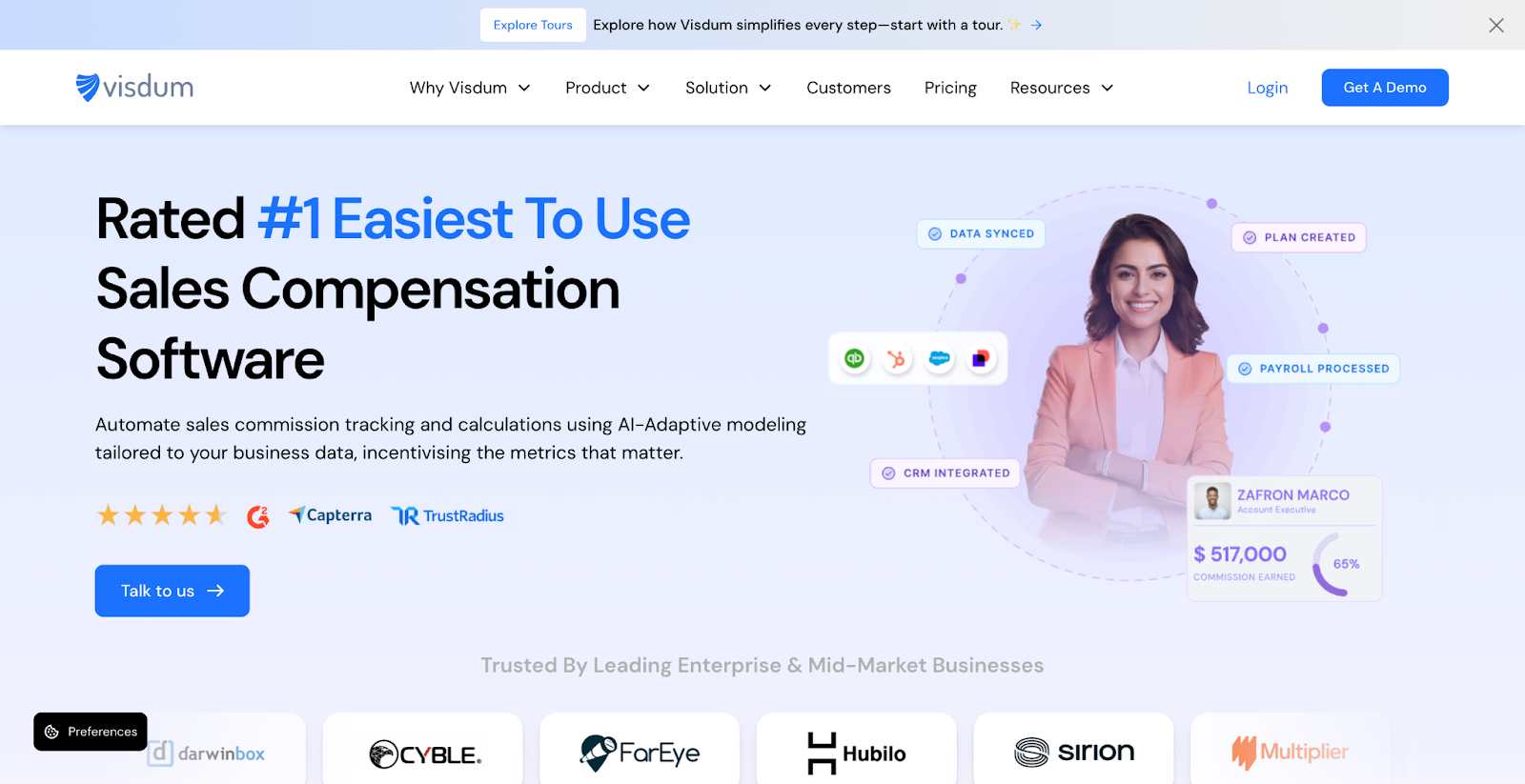
Visdum is a modern sales commission platform built specifically to address the complex needs of businesses that need easy but advanced sales comp automation that needs no in-house resources to maintain.
It emphasizes a no-code experience for designing plans, allowing finance and RevOps teams to build even the most intricate commission structures (including multi-year deals, uplifts, and renewals) with ease. Visdum also promises dedicated support in each plan to extend the ease of use. They heavily focus on reducing implementation time, getting companies live much faster than legacy providers.
Key Features and Capabilities:
- Native, bi-directional integrations with major CRMs (Salesforce, HubSpot, Microsoft Dynamics).
- Visual, drag-and-drop comp plan designer (no coding or complex Excel syntax).
- Real-time visibility for reps through personalized, mobile-friendly dashboards.
- Comprehensive ASC 606 and ASC 340 compliance reporting.
- Automated dispute resolution workflow and approvals.
Best Suited For: Mid-market to enterprise SaaS scaling organizations with sales comp models that require a flexible, scalable, and easy-to-implement solution.
- Pros:
- Exceptionally fast implementation and ease of setup.
- Highly intuitive user interface for both reps and administrators.
- Strong focus on SaaS-specific nuances like renewals, multi-year tiers, and ARR.
- Cons:
- Mobile app doesn’t have full web-app functionality.
- Some users report lack of enough customization to support complex proprietary enterprise needs.
2. Incentivate
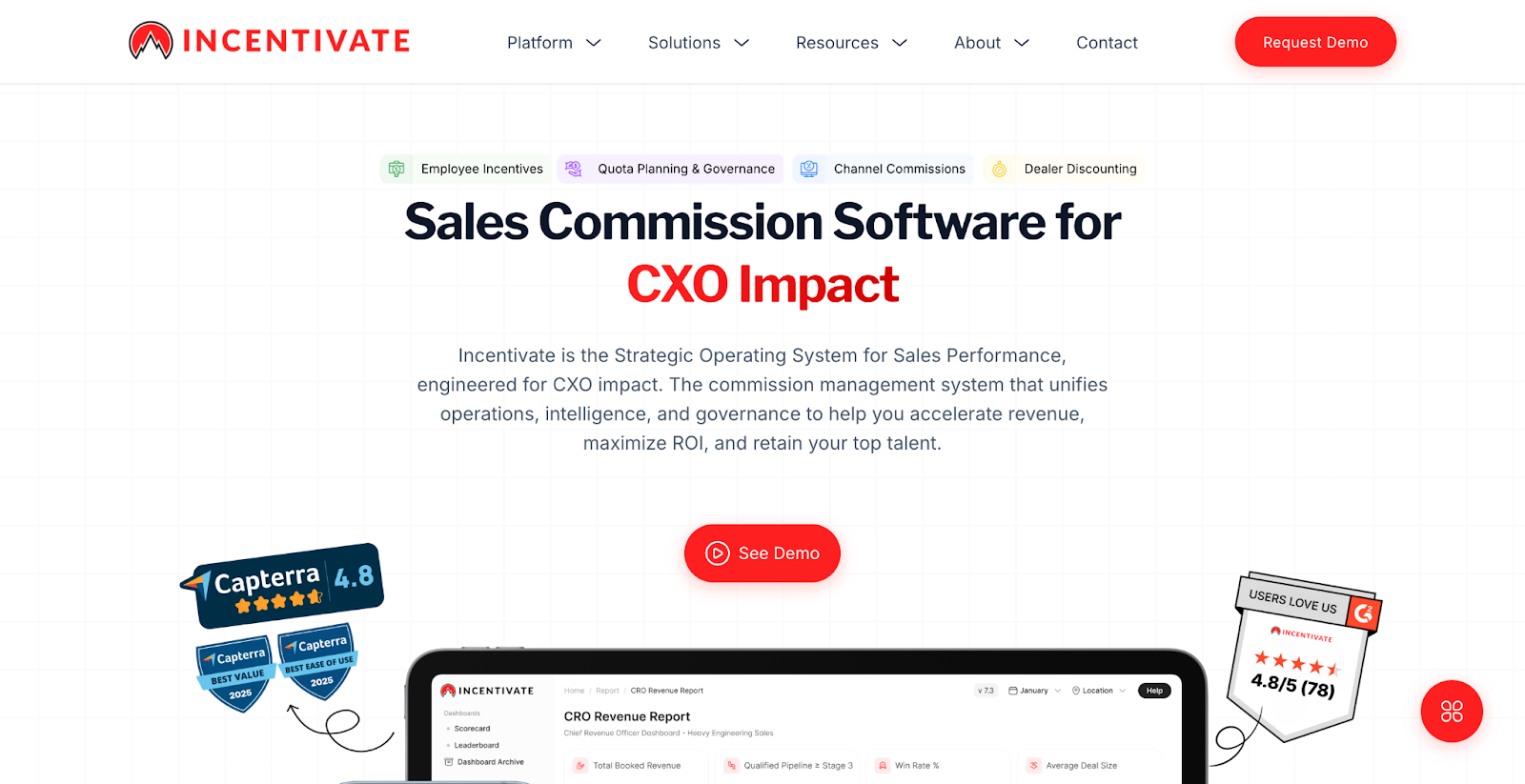
Incentivate enters the market with a strong proposition of "configurable automation." The platform is designed to handle extremely complex enterprise commission structures without sacrificing usability. It positions itself as a robust engine that can manage matrixed sales teams, intricate hierarchy management, and complex credit rules that often bog down older systems.
Key Features and Capabilities:
- Advanced commission calculation engine capable of handling millions of transactions.
- Visual plan modeling to forecast the financial impact of new compensation structures before rolling them out.
- Automated clawbacks, splits, and draw management.
- Strong hierarchy management tools for complex organization structures.
- Robust audit trail and security features for enterprise compliance.
Best Suited For: Large enterprise organizations with vast amounts of data, complex sales hierarchies, and multi-layered commission structures across diverse product lines or regions.
- Pros:
- Scales incredibly well to handle massive transaction volumes.
- Highly configurable without requiring custom code development.
- Very strong workflow automation and approval processes.
- Cons:
- Steeper learning curve due to the sheer depth of features.
- Implementation time can be longer due to the complexity of the environments it usually serves.
3. Quotapath
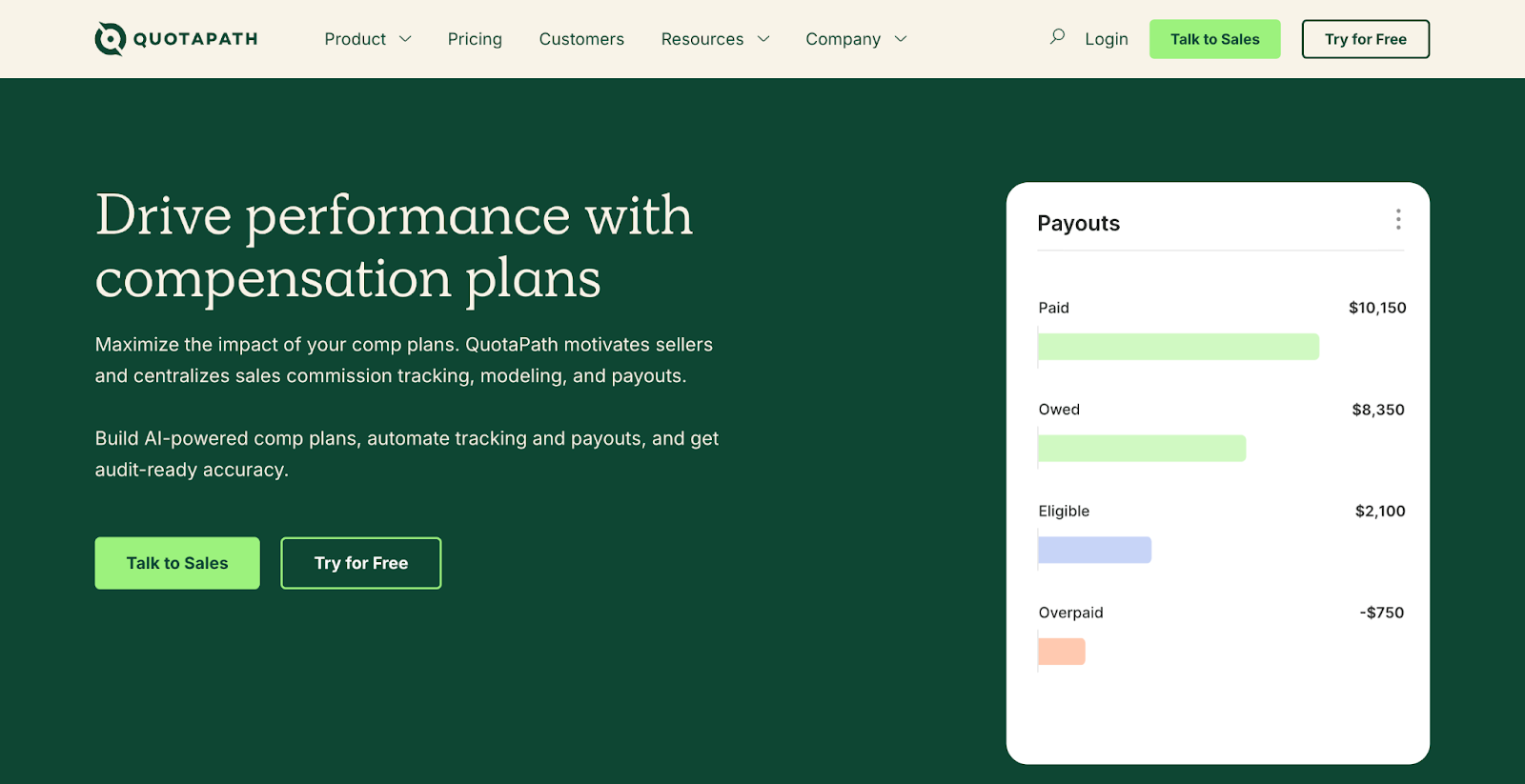
Quotapath is known in the industry for having one of the slickest, most modern user interfaces. They focus heavily on the end-user (the sales rep) just as much as the administrator. Quotapath seeks to gamify the earnings process, allowing reps to see exactly what they need to do to hit their next accelerator, effectively turning the commission dashboard into a motivational tool.
Key Features and Capabilities:
- "Path to Quota" features that allow reps to model potential deals and see forecasted commission before closing.
- Simplified integration setup that connects to CRMs within minutes, not days.
- Collaborative plan designing tools.
- Instant visibility for reps on earnings, payouts, and attainment.
- Clawback and draw tracking and management.
Best Suited For: Early-stage, high-growth, and mid-market tech teams where motivating reps via transparent data is a high priority.
- Pros:
- Excellent UI/UX that drives high adoption rates among sales teams.
- Offers a free version/transparent pricing for smaller teams to start.
- Empowers reps to forecast their own income based on their pipeline.
- Cons:
- May lack the robust auditing and accounting features required by public enterprises.
- Can become complex when handling extreme matrixed sales scenarios.
4. Commissionly
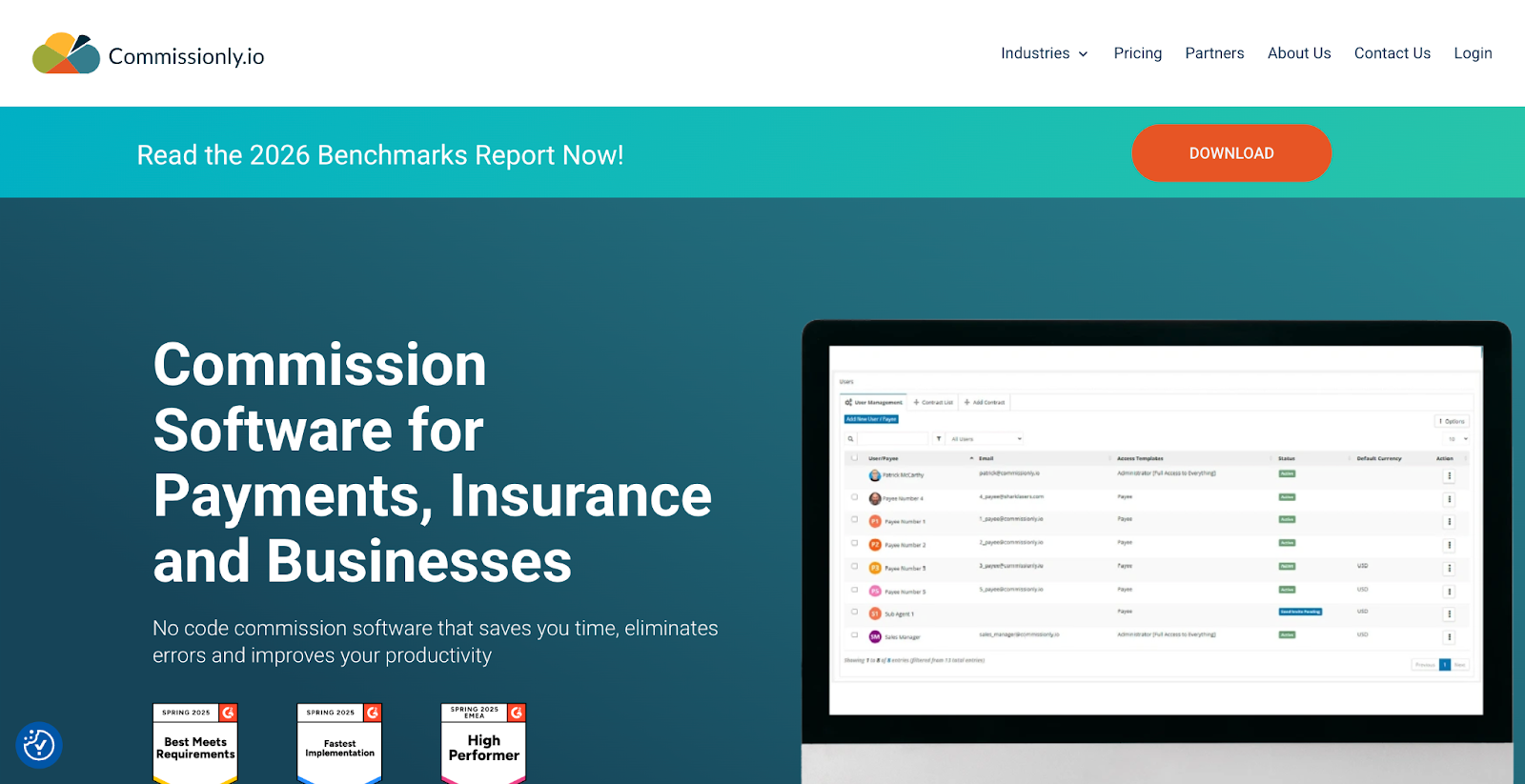
Commissionly targets small to medium-sized businesses that are looking to move away from Excel but don't require the complex feature sets (or high price tags) of enterprise solutions. It prides itself on simplicity, affordability, and getting plans running quickly. It is an ideal first step into the world of sales commission automation.
Key Features and Capabilities:
- Simple integration with CRMs and accounting software (QuickBooks, Xero).
- Easy-to-use template library for common commission structures.
- Prorated goals and target management.
- Rep-facing dashboards with basic visibility.
- Manual data import options for companies not using a full CRM.
Best Suited For: Small businesses (SMBs) across various industries that have straightforward comp plans and need immediate relief from Excel hell at an accessible price.
- Pros:
- One of the most affordable options on the market.
- Quick setup (often live in hours or days).
- User-friendly for non-technical administrators.
- Cons:
- Lacks depth in advanced modeling and compliance features.
- Limited customization options for highly unique plans.
5. QCommission
QCommission is one of the veterans in the sales compensation space. While it might not sport the "new SaaS look" of some other tools on this list, it makes up for it with incredibly robust and deeply established capabilities. It has seen and solved virtually every type of commission scenario across dozens of industries.
Key Features and Capabilities:
- Unmatched flexibility in integrating with a vast list of CRMs, ERPs, and legacy accounting systems.
- Extensive calculation logic covering tiered rates, performance-based rates, multipliers, and bonuses.
- Specific solutions optimized for different industries (retail, manufacturing, insurance).
- Audit trailing and robust reporting capabilities.
- Draw and recovery management.
Best Suited For: Mid-market to larger organizations in traditional industries (finance, insurance, manufacturing, wholesale distribution) that have complex data sources and require a battle-tested solution.
- Pros:
- Proven track record with over two decades of operation.
- Capable of integrating with virtually anything that holds sales data.
- Highly customizable logic for niche industry requirements.
- Cons:
- UI feels outdated compared to modern SaaS alternatives.
- Administration can be complex, often requiring professional services support.
6. Performio
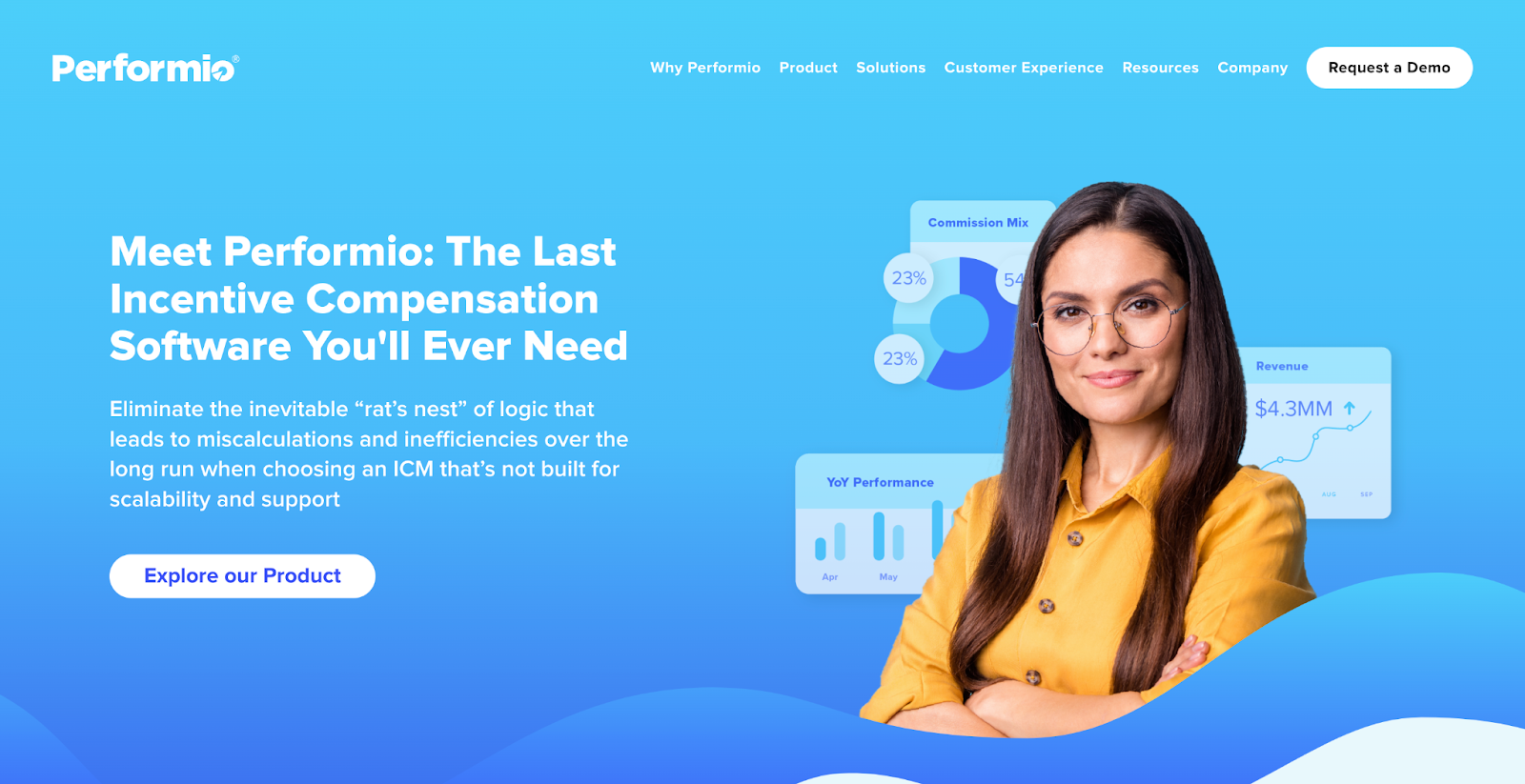
Performio is a robust enterprise-grade sales performance management (SPM) platform. It moves beyond just simple commission calculation into the territory of strategic SPM, offering deeply detailed analytical tools and modeling capability. It is designed to scale with very large, global sales teams where compliance and accuracy are non-negotiable.
Key Features and Capabilities:
- Powerful computation engine designed for massive scalability and speed.
- Robust territory and quota management alongside commission management.
- Advanced compliance capabilities, explicitly designed to handle ASC 606/IFRS 15 requirements.
- In-depth performance analytics and behavioral insights.
- High-level workflow automation for dispute resolution.
Best Suited For: Large, global enterprises that require a comprehensive Sales Performance Management suite (beyond just commissions) with high-level compliance and complex data handling.
- Pros:
- Iron-clad auditing and compliance framework for public companies.
- A single source of truth for territories, quotas, and commissions.
- Strong professional services team to help manage complex implementations.
- Cons:
- One of the most expensive options on the market.
- Implementation can be a major, multi-month project.
7. Qobra
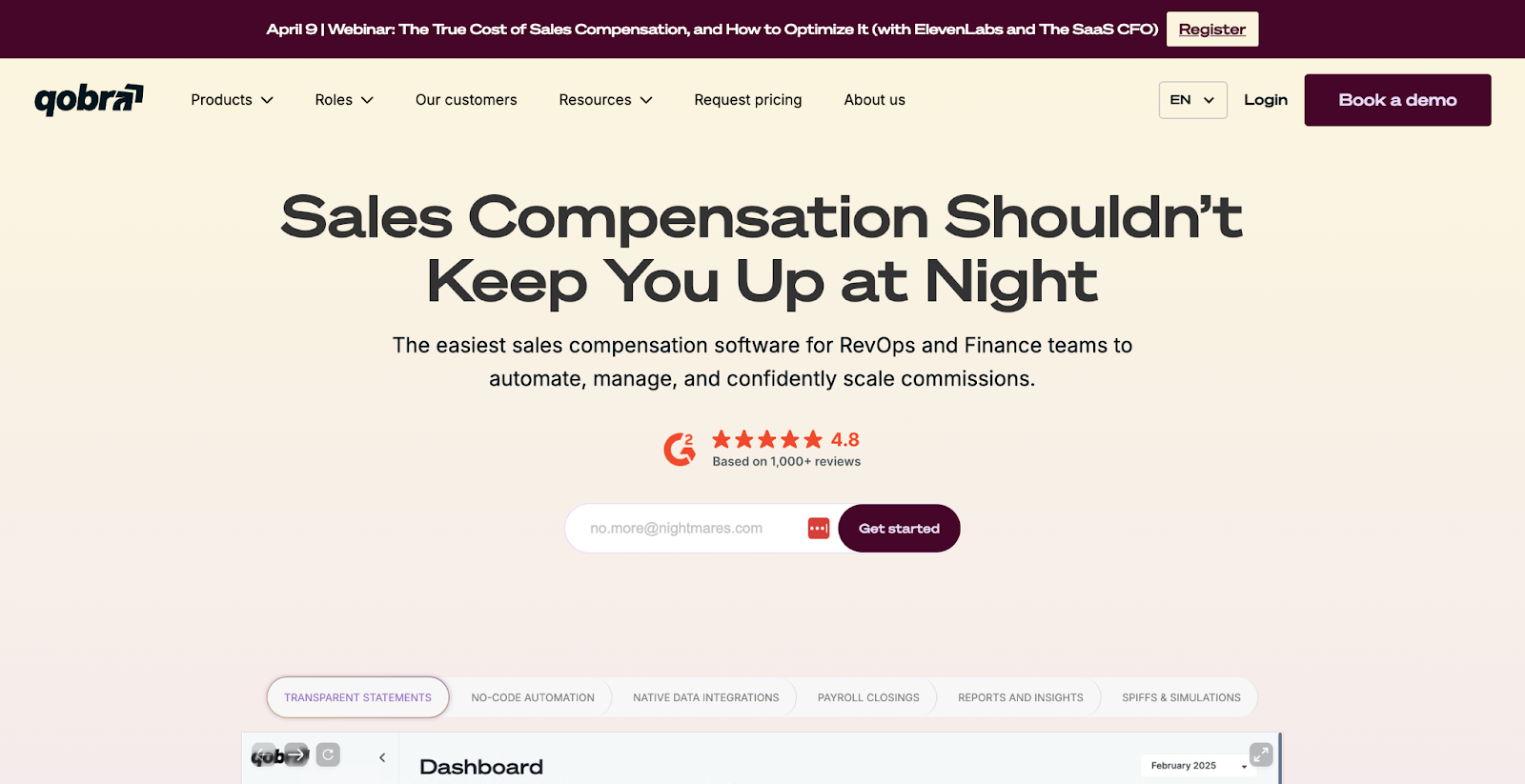
Qobra is a dynamic, modern player that has made significant waves, particularly in the European market. Qobra’s core philosophy is building trust between Finance and Sales. The tool is designed to be exceptionally visually appealing and focuses heavily on providing extreme transparency to the end-user rep, reducing tension during payout cycles.
Key Features and Capabilities:
- Seamless, native integrations with major CRMs (HubSpot, Salesforce, Pipedrive).
- Ultra-intuitive rep dashboards that are simple to read and understand.
- Automated validation processes before generating pay sheets.
- Built-in workflow for reps to easily validate their commissions with one click.
- Agile plan modeling to quickly test how changes in pricing or strategy affect rep pay.
Best Suited For: Modern RevOps teams at hyper-growth tech companies, particularly those operating globally or within Europe, who value transparency and rep motivation.
- Pros:
- Top-tier UI/UX, making adoption effortless for reps.
- Strong focus on compliance in multi-currency, multi-jurisdictional environments.
- Excellent customer support and fast implementation timelines.
- Cons:
- Not as many integrations with legacy ERP systems compared to established players.
- May have limits on extreme computational complexity for traditional, industrial plans.
Implementation Checklist
Switching from spreadsheets to automation requires preparation. Here is your quick checklist for success:
- Clean Up Data: Ensure your CRM data is accurate and structured before integrating. Software cannot fix bad data.
- Document Existing Plans: Have all current plan logic written down in plain English, not just embedded in complex Excel formulas.
- Appoint a "Champion": Designate one person (RevOps, Finance, or Sales Admin) to own the platform.
- Run Parallel Calculations: For the first month or quarter, run the software alongside your manual Excel sheet to ensure calculations match.
- Plan the Rollout: Communicate to the sales team how and when they will get access to their new dashboards to build excitement and buy-in.
Conclusion
Continuing to manage sales commissions on spreadsheets is a massive operational risk that halts scaling and destroys trust within the sales team. The software solutions listed above offer a wide range of capabilities, from simple SMB-focused tools to robust enterprise SPM platforms.
By automating sales compensation, you give your finance team hours back, your sales leadership strategic modeling tools, and most importantly, your sales reps the trust and transparency they need to focus on what they do best: closing deals.
Don’t wait until a massive payout error costs your company thousands of dollars or a top rep leaves due to lack of trust-start your search for an automation tool today.
FAQs
Most solutions use a per-user, per-month pricing model (usually paid annually). Prices can range from $30 to $100+ per rep, per month, depending on the complexity of the platform and the features included (modeling, compliance, analytics).
Enterprise-grade platforms are SOC 2 Type II compliant and offer robust security measures, including single sign-on (SSO) and role-based access control, often making them more secure than sharing sensitive Excel spreadsheets via email.
While these platforms handle the calculation engine and visibility, many RevOps and Finance professionals still use Excel for high-level data manipulation or modeling before porting finalized plan logic over to the software. It removes Excel from the process, not the analyst's toolkit entirely.
Implementation timelines vary based on complexity. For SMB-focused tools like Commissionly or Quotapath, you can often be up and running in 2 to 4 weeks. For enterprise-grade solutions like Performio or Incentivate that require deep ERP integrations and complex historical data migration, the process can take 3 to 6 months.
The "garbage in, garbage out" rule applies here. Most modern platforms like Visdum or Qobra include data cleansing or mapping layers to help handle inconsistencies. However, it is highly recommended to perform a data audit on your CRM (checking for missing deal values, close dates, or owner fields) before the sync to ensure your automated calculations are accurate from day one.
Yes, this is one of the primary reasons companies move away from Excel. Advanced tools automate clawbacks (when a customer churns or defaults) and split commissions (when multiple reps share credit for a deal) based on pre-defined rules. This ensures that the finance team doesn't have to manually track debt or "IOUs" across different pay periods.


RELATED ARTICLES
Lorem ipsum dolor sit amet, consectetuer adipiscing elit, sed diam nonummy nibh euismod tincidunt ut laoreet dolore magna aliquam erat volutpat.