Cold LinkedIn Outreach in 2026: Strategies, Templates, and Proven Playbooks


Cold outreach on LinkedIn has a reputation problem. Most of it is earned. The average cold DM reads like it was assembled from a template, sent to 500 people, and optimized for nothing except volume. Prospects feel it immediately, and they ignore it just as fast.
But the platform itself isn't the problem. LinkedIn still gives you something cold email never can: instant context. Before a prospect reads a single word of your message, they've already seen your face, your title, your mutual connections, and what you've been posting about. That context layer is the whole game. Use it well and cold outreach stops feeling cold. Ignore it and you're just another pitch in a crowded inbox.
This guide covers how to use it well. From building the right foundation before you send anything, to writing messages that get responses, to knowing when automation helps and when it gets you flagged. The tactics here are grounded in what's actually working in 2026, not recycled advice from when LinkedIn was still just a resume site.
What is Cold LinkedIn Outreach?
Definition and how it differs from other forms of cold outreach
Cold LinkedIn outreach is the process of reaching out to potential buyers, partners, or prospects on LinkedIn without any prior interaction or relationship. It's outbound, but hyper-specific to the LinkedIn ecosystem, messages, profile views, connection requests, and InMails.
It’s not email. It’s not cold calling. And it’s not spamming.
Unlike cold email, LinkedIn gives you a built-in context layer. When someone gets your message, they can immediately see your face, title, company, mutual connections, and recent posts. That social context makes a huge difference. You're not just another line in an inbox.
Why LinkedIn is a powerful platform for B2B outreach
B2B decision-makers live on LinkedIn. It’s where they learn, network, share opinions, and keep tabs on their market. Here's the big shift: LinkedIn is no longer just a professional resume hub; it’s a business content platform.
You can engage buyers before you send them a message. Follow their posts. Comment thoughtfully. React to their content. By the time you send a DM, you're not a stranger anymore.
Outreach on LinkedIn feels more conversational than formal. It’s designed for peer-to-peer communication. That gives sellers and marketers an edge. Cold doesn’t have to feel cold.
Benefits of using LinkedIn for prospecting and lead generation
- Warm context even in cold outreach. Your message never lives in isolation.
- Real-time insights into what your prospects care about. Their headlines change. Their posts shift. You adapt.
- Better data. Most users keep their roles and titles up to date. That makes targeting cleaner and ICP-driven.
Plus, you get feedback loops baked in. You can measure connection acceptance rates, engagement on your profile, and message replies, all without needing a full-funnel outbound stack.
And when paired with tools like Clay, you can scale this at levels that weren’t possible just a few years ago. Cold outreach is no longer manual. It’s workflow-driven. Signals in, messages out.
Is Cold LinkedIn Outreach Still Effective in 2026?
Short answer: yes, but the bar is higher than it was even a year ago. The platform is louder, prospects are more guarded, and the tactics that worked in 2022 will get your account flagged today.
What the numbers actually show
Cold LinkedIn outreach still outperforms cold email at the reply stage. Recent benchmark data from Expandi puts the average LinkedIn reply rate around 10.3%, roughly double the cold email average of 5.1%. Higher-performing campaigns push further: direct messages to first-degree connections with personalization land between 25–35%, and InMail averages 10–25%, with top performers reaching 30–40%.
The catch is what separates a 25% reply rate from a 3% one: targeting, timing, and message-market fit. Volume strategies that hammer 500 identical messages into 500 inboxes consistently land at the bottom of those ranges.
How LinkedIn has changed the playing field
The platform's enforcement has tightened. LinkedIn caps most accounts at roughly 100 connection requests per rolling 7-day window, with account-specific adjustments based on acceptance rates, account age, and reported spam signals. Accounts that ignore the cap or send templated bulk messages get throttled, sometimes restricted, sometimes banned outright.
A few specifics worth knowing:
- High pending connection requests (over 500) signal poor targeting and quietly hurt your account health, independent of weekly limits
- Sending all your weekly quota on Monday morning triggers bot detection even when you're under the numerical ceiling
- Profile engagement before a DM (likes, comments, profile visits) measurably lifts reply rates, with one analysis showing combined profile-visit-plus-message sequences hitting reply rates of 11.87% versus baseline cold messages
What separates outreach that works from outreach that gets ignored
Three things, in this order:
- Targeting precision. A narrow ICP outperforms a broad one almost every time, because relevance is the only real shortcut to a reply.
- Signal-based timing. Reaching out within a few days of a trigger event (a job change, a funding announcement, a relevant post) boosts response rates by roughly 32%.
- Message quality. Short, specific, and built around something the prospect actually said or did.
Generic outreach gets ignored because it deserves to. Specific outreach still works because LinkedIn is still where buyers spend their time.
Preparing for Outreach: Foundations for Success
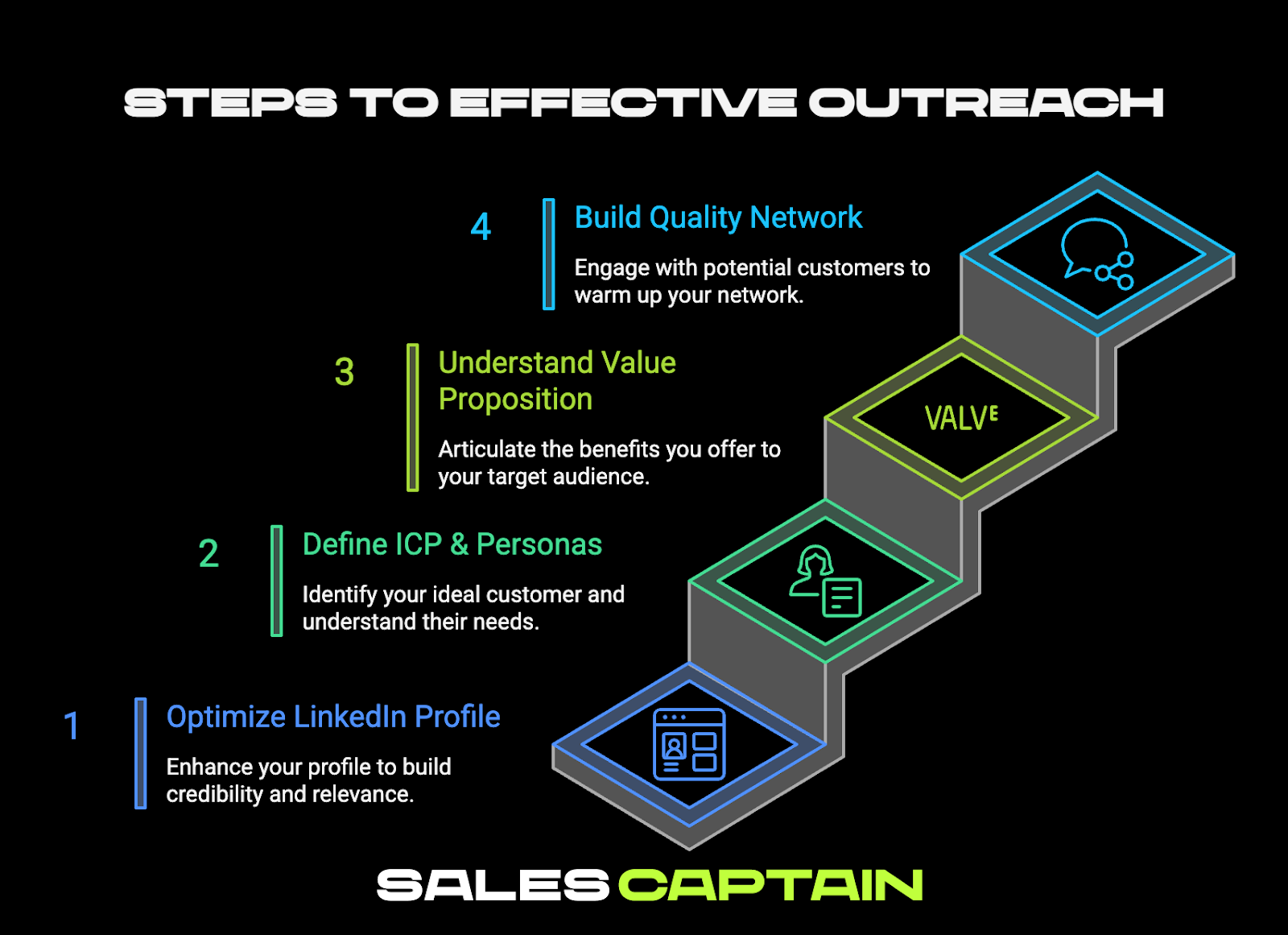
Most cold outreach fails before the first message is ever sent. The targeting is sloppy, the profile reads like a job application, or the value proposition is a paragraph of buzzwords. Fix these four foundations and your reply rate goes up before you change a single line of copy.
Optimize your LinkedIn profile for credibility and conversions
Your profile is the second thing a prospect sees, right after your message. If the message earns the click, the profile has to earn the reply. A bare-bones profile with a job title and a company name signals one thing: this person is here to sell me something.
Treat it like a landing page. The headline should make the prospect's problem the subject, not your job title. Replace "Account Executive at [Company]" with something that names who you help and what changes when you do. The banner image carries weight too. Use it to reinforce positioning, not as decoration. Your About section should open with a sentence about the reader's situation, not your career history.
One signal most people underrate: activity. If your last post or comment was three months ago, the profile reads as inactive, which makes you look less credible. You don't need to be a creator. Two thoughtful comments a week on posts your prospects are reading is enough.
Define your Ideal Customer Profile (ICP) and buyer personas
Generic ICPs produce generic outreach. The ICP needs to be tight enough that a single sentence in your message can signal "I understand your specific situation" to anyone who reads it.
Build the ICP across two layers:
- Company traits: industry, headcount, funding stage, tech stack, geography, revenue range
- Human traits: role, seniority, time in role, what they post about, what tools they evaluate, what objections they raise
The second layer is what makes a message land. Knowing that your target is "VP of Sales at a Series B SaaS company" is table stakes. Knowing they've publicly complained about pipeline forecasting accuracy in the last 60 days is what gets a reply. For a deeper walkthrough on building this out, see our guide to ICP development.
Understand your value proposition and key messaging
Outreach written from the inside-out fails. Buyers don't care about your platform's capabilities; they care about the outcome they're trying to reach and what's currently blocking them.
Translate your offering into two or three outcomes a specific persona actually wants. Not "we help companies scale revenue" but "we help RevOps teams cut forecasting cycles from three weeks to four days." Then test which framing earns replies and double down.
Features belong in demos. Outcomes belong in outreach.
Build a deliberate network before you ever pitch
Cold outreach works better when the prospect has seen you before. A connection you made two months ago who's watched you comment thoughtfully on three posts in their industry is no longer a stranger. They're a familiar face with relevant context.
Add people who match your ICP even when you don't intend to message them right away. Follow the accounts you want to break into. Engage with their content before you ever reach out. This is the slow compounding layer of LinkedIn prospecting that volume-first teams skip entirely, which is exactly why it works.
Building a Targeted LinkedIn B2B Outreach Strategy
Targeting is where most outreach campaigns are won or lost. A great message sent to the wrong person performs worse than a mediocre message sent to the right one. The teams hitting consistent reply rates above 15% have one thing in common: they spend more time deciding who to message than what to say.
Segment prospects by industry, role, and company stage
Broad outreach produces broad results, which usually means bad results. The same message that lands with a Head of Operations at a 50-person SaaS startup will fall flat with a VP of Sales at a 5,000-person enterprise. The pain is different, the language is different, and the budget process is different.
Segment your list across four dimensions:
- Industry: SaaS, fintech, logistics, healthcare — each carries different vocabulary and different objections
- Role and seniority: A director cares about execution; a VP cares about quarterly outcomes; a C-level cares about board-facing metrics
- Company stage: A Series A company is solving for repeatability; a Series C company is solving for efficiency; an enterprise is solving for integration
- Trigger context: Recent funding, leadership changes, new tool adoption, or a public statement about a problem you solve
Then write distinct messaging per segment. Not just swapped variables, but different opening hooks, different proof points, different CTAs. This is the lever that turns a 3% reply rate into a 15% one.
Use LinkedIn Sales Navigator the way it was built to be used
Native LinkedIn search is fine for casual prospecting. Sales Navigator is what you reach for when targeting needs to be precise. The filters that matter most aren't the obvious ones (title, company size). They're the behavioral ones: "Changed jobs in the past 90 days," "Posted on LinkedIn in the past 30 days," "Years in current role." These tell you not just who someone is but where they are in their cycle.
Combine Sales Navigator with enrichment tools to layer in signals the platform doesn't expose: tech stack changes, fundraising events, hiring surges. Tools like Clay are useful here because they pull these signals into a single workflow rather than scattered tabs. For a fuller walkthrough on the tooling side, see our breakdown of LinkedIn outreach automation tools.
Set goals and KPIs before you send the first message
Outreach without measurement is guessing dressed up as activity. Decide upfront what success looks like at each stage of the funnel:
- Connection acceptance rate: 25–35% is a working baseline for cold campaigns
- Reply rate: 10% is average; above 15% means your targeting and messaging are dialed in
- Meeting conversion: 1–3% of total sends turning into booked meetings is solid for B2B
Then track at the segment level, not just the campaign level. One message might pull a 20% reply rate in fintech and 4% in HR tech. That's the kind of insight that compounds, because it tells you where to double down and where to rebuild. For a deeper look at what to measure across the full pipeline, our B2B sales benchmarks guide breaks down the numbers across each stage.
The teams that improve outreach quarter over quarter are the ones treating it like a performance channel, not a hope-driven one.
LinkedIn Outreach Timing: When to Reach Out for Maximum Reply Rates
The best message in the world fails if it lands at the wrong moment. The right message at the right moment often gets replies you weren't expecting. LinkedIn outreach timing is the lever most teams underuse, partly because it requires more thinking than volume does.
Understanding intent signals
Intent signals are the observable events that suggest a prospect is more likely to be receptive right now than they were a week ago. They fall into three rough buckets:
- Personal triggers: A job change, a promotion, a public post about a problem you solve
- Company triggers: A funding round, a product launch, a leadership hire, an expansion announcement
- Behavioral triggers: A profile visit, an engagement with your content, attendance at a relevant event
Each signal carries different weight. A prospect who just changed jobs is in the highest-receptivity window of their tenure. New executives typically reassess vendors, tools, and team structure within their first 90 days, which is why job-change-based outreach consistently outperforms cold outreach to settled executives. Reaching out within a few days of a trigger event has been shown to lift response rates by roughly 32% versus untriggered outreach.
For a deeper look at the signals worth tracking and how to operationalize them, our guide to buying signals breaks down which ones actually predict pipeline.
What's the right sales cadence for cold LinkedIn outreach?
Day of the week and time of day matter more than most teams account for. The patterns are consistent across benchmark reports:
- Tuesday through Thursday outperform Monday and Friday for reply rates
- Morning sends (8–11 AM in the prospect's timezone) tend to land when prospects are most engaged with LinkedIn
- Saturday and Sunday are the worst performing days by a wide margin
These are starting points, not rules. Once you have campaign data, your own segment-level patterns will be more reliable than any benchmark. A VP of Engineering might engage best on Wednesday at 7 AM; a marketing director might respond best on Thursday afternoon. Test, log, refine.
LinkedIn cold message best practices for CEOs and senior executives
Timing matters even more when the prospect is senior. CEOs and VPs check LinkedIn in tighter windows — usually early morning before meetings start or late afternoon after they finish — and ignore anything that looks like volume. Anchor every senior-level message to a recent, specific signal: a podcast they appeared on, a funding announcement, a post they wrote in the last two weeks. The looser the connection between your trigger and your ask, the lower the reply rate.
Stack timing with everything else
Timing alone won't save a weak message. Layered on top of tight targeting and a relevant hook, it's often what separates a 6% reply rate from a 15% one. Treat it as the third variable in your outreach equation, not the last thing to optimize.
Writing Effective Cold LinkedIn Outreach Messages
A great LinkedIn outreach message earns a reply for one reason: it feels like it was written to one person, not blasted to a thousand. Everything else — length, formatting, CTA choice — is secondary to that single signal.
Dan Marzullo, a sales expert who has tested cold sequences across hundreds of campaigns, puts it directly: "Most cold sequences still front-load the ask, which is why reply rates have stayed under 2 percent even as personalization tools have improved." The teams getting 15%+ reply rates aren't using better tools. They're writing differently.
Anatomy of a high-converting cold LinkedIn message
The structure that consistently works follows three beats, in this order:
- Relevance hook — the first line proves you're writing to them specifically, not to a list. Reference a post they wrote, a recent role change, or a public detail about their company.
- Signal or insight — one sentence that gives them a reason to care. This is where you connect their situation to something useful, not where you pitch.
- Low-friction CTA — a question they can answer in two words, or a soft yes/no ask. Heavy CTAs at the top of a cold message kill replies.
Keep the whole message under 400 characters when possible. LinkedIn's own data shows that short messages outperform longer ones by roughly 22%, and most reply-rate winners come in under three sentences.
Personalized LinkedIn outreach that goes beyond first name and job title
"Hi {FirstName}, saw you're the VP of Sales at {CompanyName}" is white noise at this point. Every automated tool does it, and prospects have learned to scroll past it before they finish reading.
Real personalization references something the prospect did, said, or experienced recently:
- A specific point they made in a post (quote a phrase, not a topic)
- A role change or promotion in the last 90 days
- A product launch, fundraise, or hire their company just announced
- A position they took publicly that connects to your value proposition
The bar is whether your opening line could plausibly be sent to anyone else on your list. If it could, it's not personalization. For more on this layer, our deep-dive on cold email personalization walks through the same principles applied to email — the framework transfers directly.
Psychological triggers that move replies
The best outreach messages don't just personalize. They engage a specific cognitive trigger that nudges the prospect to respond. The four that show up most reliably in high-performing campaigns:
- Curiosity gap — open a loop the prospect has to close. "Saw your post on PLG onboarding — there's a counter-pattern from one of our portfolio teams that flipped activation. Worth a look?"
- Social proof of peers — name a specific company in their space you've worked with. "We helped [Specific Company at similar stage] cut their onboarding handoff from 14 days to 4."
- Reciprocity — lead with something useful before you ask for anything. A relevant teardown, a benchmark, a data point.
- Specificity — concrete numbers and names outperform vague claims every time. "Lifted reply rates 3x" beats "improved engagement significantly."
These aren't manipulation tactics. They're the cognitive defaults that make any message more likely to land. Build them in deliberately.
Hooks that grab attention in the first 50 characters
On LinkedIn, the first 50 characters function as a subject line in message previews. They decide whether your message gets opened.
What doesn't work:
- "Quick question."
- "Love what you're doing at [Company]."
- "Thought you'd be interested in..."
- "Hope this finds you well..."
What works:
- A specific reference to something they just did or said
- A pattern interrupt — something they don't expect to see in a cold message
- Clarity over cleverness: "Sourcing BDRs without inflating CAC?" beats "BDR hiring question."
CTAs that don't feel like a sales trap
The heavier the CTA, the lower the reply rate. Asking for 30 minutes from someone who's never heard of you is a near-guaranteed ghost. Soft asks work better:
- "Worth a chat?"
- "Open to ideas?"
- "Want me to send a quick breakdown?"
- "Mind if I share what we've seen?"
The goal of a cold message isn't to book the meeting. It's to earn the second message. For teams running this at scale, our breakdown of cold LinkedIn outreach fundamentals covers the broader system this fits into.
Examples of effective LinkedIn outreach messages
❌ Generic and pitchy:
Hi {FirstName},Hope you're doing well! I wanted to connect because I help companies like {CompanyName} scale revenue through cutting-edge solutions that reduce churn and drive growth. Would love to chat!Best,[Name]
Zero context. All pitch. No reason for the prospect to reply.
✅ Specific and signal-led:
Hey Sarah,Saw your post about scaling CS without bloating headcount — sharp take, especially the bit on onboarding handoff. We helped a few Series B teams (Volt and Roon) operationalize that exact problem without adding reps.Open to swapping notes?~ Alex
Specific opener, named proof, soft CTA. That's the formula.
LinkedIn Connection Requests: Best Practices
Most people send either no note at all or a note that immediately reads as a sales approach. Both outcomes land in the same place: the request gets ignored or declined. The connection note is where you either earn the right to send a message or confirm that you're running volume outreach without much thought for who's on the receiving end.
Writing a connection note that earns the accept
LinkedIn caps connection notes at 300 characters, roughly two short sentences. That constraint is more useful than it seems. It forces a discipline that longer formats let you sidestep: say the one thing that proves you're worth knowing.
The note has a single job: signal relevance. Leave the value proposition, the company overview, and the ask for after they accept. Just give the person one reason to think "this might be worth knowing" before they see your follow-up message.
Strong notes anchor to something specific and recent:
"Saw your post on scaling CS without adding headcount, sharp take. We've solved a similar problem at [Company]. Mind if I connect?"
"You moved from RevOps to founder recently, curious how the GTM thinking shifts. Following your posts."
"You work with mid-market SaaS teams on procurement workflows. We build tooling for that stage. Curious if there's overlap."
Each of these could realistically only be sent to one person. That's the bar. Generic openers like "I'd like to add you to my professional network" (LinkedIn's default text) or "Let's connect and explore synergies" carry zero signal and perform accordingly.
Personalization in a connection note has nothing to do with inserting someone's first name into brackets. It's knowing what they've been thinking about and referencing it in two sentences.
How to increase your LinkedIn connection acceptance rate
The average LinkedIn connection acceptance rate for cold B2B campaigns sits between 25% and 35%. Tighter targeting and account warming push it higher. Justin Rowe, who builds and stress-tests these sequences at scale, has documented 72% acceptance rates when sourcing is precise and profile positioning is dialed in.
Four variables actually move the number.
Profile quality is usually the first thing that goes unaddressed. When someone receives a cold LinkedIn connection request, they click your name. What they see in the next ten seconds determines whether they accept. A headline that names who you help, a recent posting history, and a banner that communicates something specific about your work all lift acceptance rates. A bare-bones profile with just a job title and a company logo does the opposite.
ICP precision matters more than most campaigns account for. Sending requests outside your target persona pulls your acceptance rate down over time and quietly sends a spam signal to LinkedIn's algorithm. High rates of ignored or declined requests restrict your account's reach. Narrower targeting cleans up both numbers.
Warming before the request doesn't have to be elaborate. A relevant comment on a post they wrote in the week before you send the request shifts your name from "stranger" to "person I've seen." That 30-second action matters at the accept/decline decision point.
Timing and pacing round out the list. Weekday mornings outperform late afternoons, Fridays, and weekends by a meaningful margin. If you're scheduling through an automation tool, stagger sends throughout the day rather than clustering them at the same time every morning, which triggers bot detection regardless of whether you're under LinkedIn's weekly cap of 100 requests. Our guide to automating LinkedIn outreach covers how to structure sequences without running into those restrictions.
What to avoid in your initial connection request
Pitching in the note is the most consistent way to tank your acceptance rate. "I help companies like yours achieve results with [solution]..." signals that the connection request is just a vehicle for what follows. Most professionals at the director level and above will decline rather than accept a sequence they can already see coming.
Note length is a close second. 300 characters is a ceiling, not a target. A note that gets cut off mid-sentence reads like a form letter. Two specific sentences consistently outperform four vague ones.
Sending nothing, in cold LinkedIn outreach specifically, is not neutral. A blank request reads as high-volume automation. A two-sentence contextual note typically moves acceptance rates by 10 to 15 percentage points compared to sending nothing. The note doesn't have to be clever. It has to be real.
Follow-Up Strategy That Converts
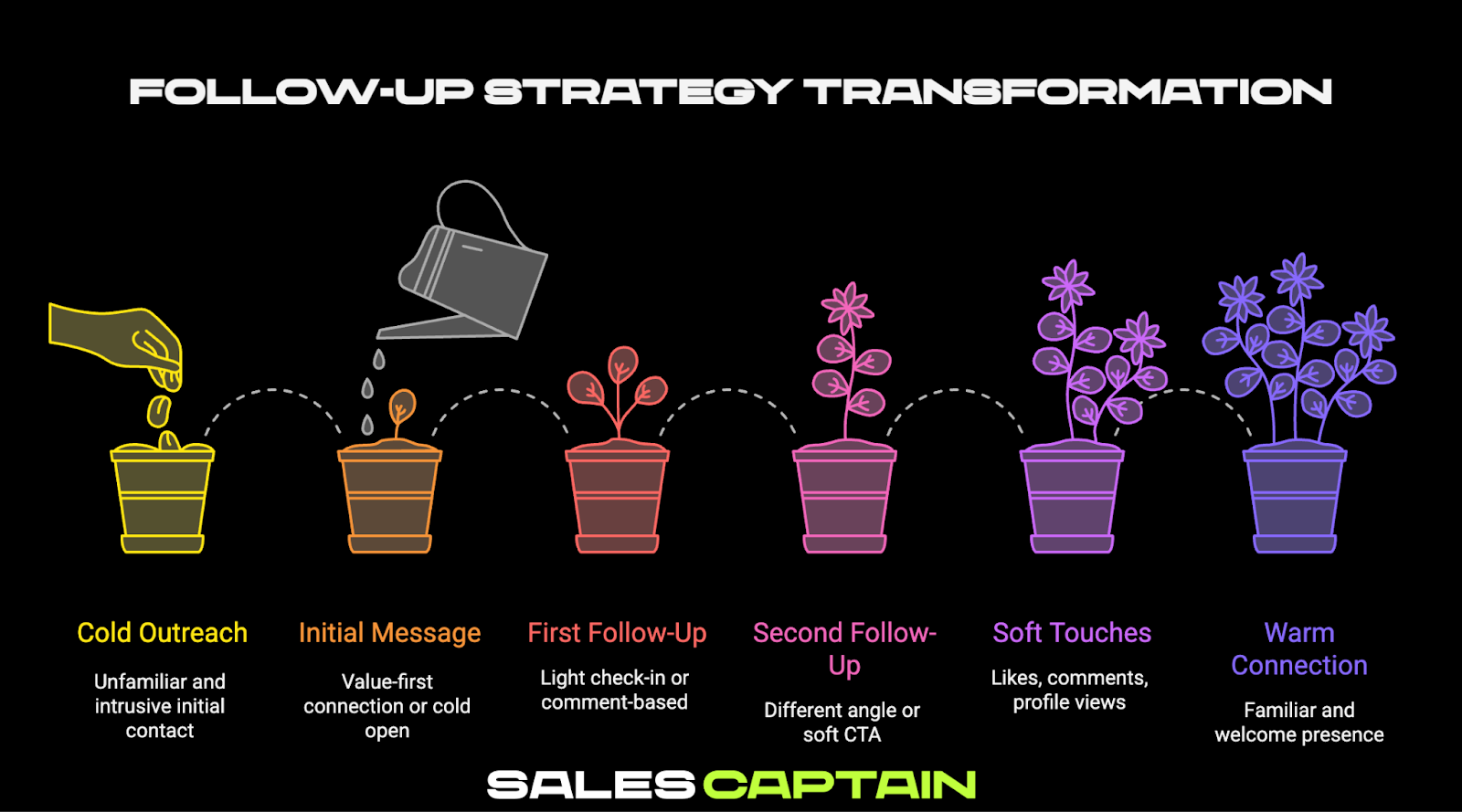
Most cold LinkedIn outreach doesn't fail at the first message. It fails at the second one, or because there is no second one. A single message with no follow-up leaves most of your reply rate on the table. The sequence after the opening is where campaigns either compound or stall.
Follow-up cadence: spacing your LinkedIn touches
The rhythm that outperforms aggressive back-to-back sends:
Day 0: Initial message after they accept the connection.
Days 3 to 4: First follow-up. A different angle, not a resend. Reference something that's happened since your first message, a post they wrote, a company update, a trigger you noticed.
Days 7 to 10: Second follow-up with a new hook. This is where the insight-based nudge works well: share a relevant proof point from your work or your network that connects to a problem they've been visible about.
Day 14 or later: Soft close or exit message that leaves the door open.
Between each direct message, soft touches (post engagement, profile views) keep your name visible without adding more to the thread.
What kills follow-up sequences is not sending too many. It is sending the same thing repeatedly. Each touch should introduce something new: a different framing, a relevant proof point, a question triggered by their recent activity. A follow-up that is a near-copy of the original signals automation, and experienced prospects recognize it immediately.
How many follow-ups are too many?
Three direct messages is the ceiling for cold LinkedIn outreach. Beyond that, you're in territory that damages the exchange and can flag your account's standing with LinkedIn's algorithm, which tracks high ignore-and-decline rates at the account level.
Structure the three touches like this: the first message leads with a hook and a low-friction ask. The second brings a new piece of context or a relevant proof point. The third closes the loop clearly and gracefully.
The exit message is often the one teams rush or skip. It matters because how you leave the conversation determines whether the prospect comes back to you in three months when the timing has shifted. A clean exit looks like: "Sounds like the timing isn't right, no pressure at all. If the situation changes, happy to pick this up then." That message performs better than a fourth follow-up, and it's the one they remember when they're ready.
Follow-up message templates that get responses
Three formats that produce replies when the targeting is right.
The insight-based nudge works when a company trigger has happened since your initial message:
"Saw [Company] just expanded the team, exciting growth. That stage can make [problem] more visible fast. Want me to share a quick teardown on how [Client] handled it?"
Use this one when you have a new signal, hiring, funding, a product launch, to justify the follow-up. The trigger makes the message feel timely rather than automated.
The curiosity angle works when they've been active on LinkedIn and you can reference something they've said:
"Had a thought after your last post, might be off, but it could cut [problem] in half. Want two lines on it?"
The open loop is the mechanism here. It works because it's low-stakes and specific. They just have to say yes or no to two lines, not agree to a 30-minute call.
The graceful exit is for the final message:
"I'll close the loop here unless it's still relevant. No pressure either way, just thought [specific insight] was worth flagging."
Confidence, not desperation. Prospects who weren't ready earlier often respond to this one.
Soft touches: staying visible between messages
Between direct messages, post engagement and profile activity serve a practical purpose beyond just keeping your name visible. When your follow-up lands, the prospect's first instinct is to recall who you are. If they've seen your name in their notifications twice in the past week, the message gets more of their attention than it would from a complete stranger.
The touches that work: leaving a specific comment on a post they wrote (not "great insight," but something that adds to the conversation), reacting to a company update, viewing their profile. These take under a minute each and shift the dynamic from cold outreach to something that at least resembles familiarity.
One thing to avoid: engaging with every piece of content they post in a tight window before your follow-up. Three interactions in 48 hours reads as monitoring rather than genuine interest. One relevant comment in the week before a follow-up is the right level.
When to bring email and phone into the sequence
LinkedIn is usually where B2B outreach sequences start, but staying there exclusively limits your reach. Once you've sent three LinkedIn touches without a reply, shifting channels is more effective than continuing to add to the same thread. Research from Callbox found that multi-touch outreach sequences combining LinkedIn with email and phone increase response rates by roughly 40% compared to single-channel campaigns.
A practical model for combining LinkedIn outreach with email for mid-market prospects:
LinkedIn connection and first message in the first few days, a LinkedIn follow-up around day five to seven, then a cold email referencing the LinkedIn context, with an optional phone call or voice note for high-priority accounts where you have a direct number.
The LinkedIn-to-email handoff is where most teams fumble. The email should acknowledge the LinkedIn outreach explicitly rather than pretending it didn't happen. Something like "I reached out on LinkedIn last week about [X], wanted to try a different channel" is honest, breaks the pattern of a generic cold email, and tends to generate replies from prospects who saw your LinkedIn messages but didn't respond there. For the full sequencing logic across channels, our guide to multichannel outbound campaigns covers the structure end-to-end. For the email side specifically, our cold email follow-up guide breaks down how to write the handoff messages.
Leveraging LinkedIn Features to Increase Outreach Success
The tactics covered earlier are about what to send. This section is about how the platform's own features change what happens when a prospect receives it. Context built before a message lands is part of the message.
Voice notes, video messages, and InMail
Most cold LinkedIn outreach arrives in the same format: a text DM, roughly the same length, roughly the same structure. Format fatigue is real. The formats that break the pattern consistently earn more attention than the message alone would.
Voice notes, available on LinkedIn's mobile app, are the lowest-effort format disruption available. A 30-to-45-second voice note after a connection accepts lands differently because almost nobody sends them. Keep it under a minute, reference something specific about the person or their situation in the first five seconds, and save the actual ask for the follow-up text message. The voice note warms the exchange; it shouldn't carry the pitch.
Video messages require more effort but suit high-value targets well. A 30-to-60-second recorded message that references the prospect's company, a recent post, or a specific challenge their org is dealing with outperforms a text DM for cold-to-warm conversion on enterprise accounts. Keep the production deliberately scrappy. Polished video reads as a marketing asset; a quick Loom-style recording reads as a person making a specific effort, which is the signal you want.
InMail is the right format when a prospect is outside your network and a connection request is unlikely to land or would take too long. It functions like a DM but reaches people without requiring a prior connection. InMail response rates average between 10% and 25%, with well-targeted messages from credible senders reaching 30-40%. The common mistake is treating the additional character limit as permission to write more. The same rules apply as any cold message: lead with relevance, keep it short, and don't pitch in the opening line.
Engaging with prospect content before messaging
When your message arrives, one of the first things a prospect does is check whether they recognize your name. Engagement before outreach is the simplest way to ensure they do.
Use Sales Navigator lead lists to track when your ICP accounts are posting. A post from a target is an opening: it tells you what they're thinking about right now, gives you a specific hook for your message, and lets you leave a comment that signals genuine attention before any outreach begins.
The comments that work add something to the conversation: a specific observation, a related data point, a question that shows you understood what they wrote. The comments that don't work: "Great post!" or "Really valuable insight, thanks for sharing." The latter is worse than saying nothing because it signals to both the prospect and LinkedIn's algorithm that you're running a volume engagement play.
A practical weekly rhythm: pick five to ten high-priority targets. Follow their activity. Leave one substantive comment when they post something relevant to the problem you solve. Then send the connection request or DM. By that point the outreach is no longer cold in any meaningful sense.
Content creation and thought leadership in outreach
Before a prospect replies to your message, they look at your profile. Before your profile, many check whether you've posted anything recently. An account with no recent activity reads as either abandoned or purely transactional, and both work against you at the moment a prospect is deciding whether to respond.
You don't need to become a LinkedIn creator. Two well-placed posts or comments per week on topics your ICP is actively thinking about is enough to signal that you're a real practitioner in the space. That credibility layer is what separates a profile that earns replies from one that raises doubts.
What to post: observations from work you're actually doing, perspectives on problems your buyers are solving, and takes that would be genuinely useful to your specific ICP. What to avoid: generic motivational content, trend roundups without a point of view, anything that reads like a brand announcement. The goal is to look like someone doing the work, not someone marketing the work.
This is the core logic of social selling: the content you produce is a pre-qualification layer that either confirms or undermines the credibility your messages claim. When the content is consistent and ICP-specific, prospects occasionally reach out before you ever message them. That outcome is slow to build but it does happen, and it's the most efficient form of outbound because the prospect arrives warm. Our piece on inbound-led outbound walks through how to build this into a systematic motion rather than leaving it to chance.
Tools and Automation for Scalable Yet Personalized Outreach
Running cold LinkedIn outreach manually at any meaningful volume is not sustainable. The teams hitting consistent reply rates across hundreds of active conversations are running systems, not individual efforts. The right automation stack covers delivery, timing, and data enrichment. The human layer stays responsible for the quality of what gets sent.
Top LinkedIn automation tools
The tools that matter most are the ones that fit cleanly into your targeting and messaging workflow without introducing risk or friction.
Clay is the starting point for teams doing signal-based outreach at scale. It pulls intent data from across the web, enriches prospect records with job changes, hiring signals, and tech stack information, and connects to LinkedIn workflows through integrations. The reason it has become the infrastructure layer for most serious outbound teams is that it handles the research that would otherwise take hours of manual work per week. Our breakdown of how to use Clay covers the setup end to end.
Expandi is a LinkedIn-native automation tool built for connection request scheduling, profile visits, and message sequencing. It's affordable and straightforward, which makes it a good fit for teams doing moderate volume without a complex tech stack. It operates within LinkedIn's rate limits when configured correctly.
Waalaxy suits earlier-stage teams or those running lower-volume campaigns who want automation without a heavy operational setup. The UI is simpler than most alternatives and the onboarding curve is short.
SalesLoft and similar sales engagement platforms become the right choice once you're running outreach across channels at scale, with LinkedIn as one node in a broader sequence that includes email, phone, and CRM sync. These platforms provide sequence management and cross-channel reporting that point solutions don't.
Choose based on your current volume and workflow complexity, not features you might need in a year.
Balancing personalization with automation
The failure mode with automation isn't using it. It's using it to send the same message faster. Automation that replaces judgment produces generic outreach at scale: more people receiving messages that feel like they weren't written for them, faster.
The right division of labor is this: automation handles delivery, timing, and scheduling. Data enrichment handles the research layer, pulling in signals like recent job changes, funding announcements, or tech stack additions. The messaging layer stays human-edited, even when it's templatized.
In practice, this means moving beyond {{FirstName}} and {{Company}} as your personalization variables. With enrichment tools, you can pull in {{recent_post_topic}}, {{hiring_signal}}, or {{recent_funding_event}} as dynamic fields built from real data. The message looks personalized because the personalization is real rather than cosmetic.
Maintaining brand voice at scale requires a different kind of discipline. Write a handful of message variants with distinct tones and test them against each other. Templates drift over time when they're edited piecemeal across campaigns. Reviewing your full sequence against your original brand voice every few weeks catches drift before it compounds.
A useful test before automating any sequence: read three messages from it out loud as if you were receiving them. If any of them would make you think "this was sent to 500 people," your personalization layer isn't doing its job yet.
Risks of automation: avoiding spam and account restrictions
LinkedIn actively monitors for automation signals and penalizes accounts that trigger them. The behaviors that draw flags:
Sending connection requests in high daily bursts rather than spread throughout the day. Fifty requests sent between 9 and 10 AM looks like a bot regardless of whether you're under the weekly 100-request cap. LinkedIn's detection is behavioral, not just numerical.
Templated messages with no variation across recipients. The platform detects message-level similarity at scale. If the same sentences appear in outreach to hundreds of people in a short window, the account gets flagged.
High rates of ignored or declined connection requests. These signal poor targeting and reduce your account's reach through a separate mechanism from the weekly limits. Poor targeting is an account health problem, not just a reply rate problem.
Browser-injection automation tools that interact with LinkedIn outside of official API channels. These are faster to set up but carry significantly higher restriction risk than tools built on LinkedIn's API.
The practical safeguard: stagger activity throughout the day, build real variance into your message templates, and monitor accept and reply rates weekly. A sudden drop in acceptance rate is usually the first signal that account health is degrading before any restriction actually lands.
Integrating CRM and outreach workflows
Syncing LinkedIn activity to your CRM isn't just record-keeping. It's the mechanism that lets you answer segment-level questions: which personas accept but don't reply, which messages generate replies but no meetings, which accounts are producing pipeline at the right rate.
Without consistent CRM sync, these answers require manual logging that rarely happens reliably. With it, you build segment-level data over weeks and make decisions based on pattern rather than instinct.
The integration model most teams use: LinkedIn activity feeds into an enrichment layer like Clay, which routes records to the CRM with updated stage data, which then triggers next-step workflows based on status. The specific CRM matters less than having clean stage definitions and the discipline to log consistently. For a fuller look at how to build this stack, our outbound tech stack guide covers the architecture.
Measuring and Optimizing Outreach Campaigns
The teams that improve outreach quarter over quarter share one habit: they treat it as a performance channel with defined metrics, not a volume activity measured only by meetings booked. Without segment-level data, you're optimizing based on instinct, and instinct usually fixes the wrong variable.
Key metrics to track
Three tiers, measured at the segment level rather than the campaign level.
Connection acceptance rate sits between 25% and 35% for well-run cold B2B campaigns. Below 20% consistently points to poor ICP targeting, a weak profile, or both. Above 40% usually reflects tight targeting combined with some degree of prior engagement.
Reply rate runs around 10% as a baseline for cold LinkedIn outreach. Above 15% indicates that targeting and messaging are calibrated. Breaking this down by segment is where the useful data lives. A message pulling 20% reply rate in fintech and 4% in HR tells you far more than a blended 12% across both.
Meeting conversion rate sits at 1-3% of total sends becoming booked meetings for most B2B campaigns. For tightly targeted senior executive outreach, 2-5% is achievable. If reply rates are strong but meeting conversion is low, the issue is usually the CTA or the discovery call framing, not the outreach itself.
If you're running LinkedIn as part of a multi-channel sequence, track cost per booked meeting by channel. LinkedIn typically costs more per touch than email but books at a higher rate. Knowing the channel-level economics tells you where to weight the effort. For a detailed breakdown of the benchmarks across each pipeline stage, our B2B sales benchmarks guide covers the numbers by segment.
A/B testing your outreach
LinkedIn doesn't give you built-in split testing, which means the one-variable-per-test rule is not optional. If you change the hook, the CTA, and the message length at the same time and your reply rate shifts, you don't know what drove it.
What's worth testing, in rough order of impact: first-line hooks (the single highest-leverage variable in most campaigns), CTA phrasing and weight (soft ask vs. medium ask), message length (under 200 characters vs. 300-400 characters), and follow-up angle.
Run a minimum of 100 sends per variation before drawing any conclusions. LinkedIn reply rates have enough natural variance that smaller samples produce misleading signals. A 20% reply rate on 30 sends can look like a winner and be noise. Log every version with the date, the specific variable you changed, the send volume, and the outcome. Without that record, you will run the same tests more than once without realizing it.
When and how to pivot
A reply rate that isn't moving after 200-300 sends is a signal, not a coincidence. Before changing your message, run through three questions.
Is the segment right? A strong message sent to the wrong persona will cap out around 3-5% regardless of quality. Check whether the people accepting your connections actually match your ICP or whether targeting drift has crept in.
Is the message the issue? If you're getting profile views after acceptance but no replies, the copy is the problem. If you're not getting views at all after a connection accepts, the issue is in the message's opening line or your profile's credibility signal.
Is something external at play? Budget freeze cycles, major industry events, or a public controversy in the prospect's sector can suppress reply rates for weeks. Check for external factors before assuming the copy needs to be rebuilt.
Change one input at a time, run it for at least two weeks or 100 sends, document the result, then move to the next variable. LinkedIn outreach optimization is incremental by nature. The teams that compound their results aren't finding breakthrough messages — they're eliminating what doesn't work faster than everyone else.
Cold LinkedIn Outreach for Different Use Cases
The mechanics of cold LinkedIn outreach stay consistent across use cases: tight targeting, specific hooks, low-friction asks. What changes is the intent behind the message, the tone it needs to carry, and what a successful reply actually looks like. B2B pipeline language sent to a potential co-marketing partner signals you haven't thought about their world. Discovery framing sent to a sales prospect undercuts the urgency. Each use case has its own register.
B2B lead generation
B2B lead generation is the most common use case and where LinkedIn consistently outperforms cold email at the reply stage. The platform's context layer does work that email can't: a prospect sees your face, title, mutual connections, and recent posts before they read a word of your message. That passive credibility check either builds or erodes the case for engaging before the pitch even begins.
The approach that compounds over time is signal-based. Identify trigger events — role changes, funding rounds, team expansion, new tool adoption — and build your message around what the signal implies about the prospect's current situation. "Saw you added three CS managers in the last 60 days" is a different opener than "I'd love to tell you about our customer success platform," even if the offer behind both is the same.
For senior executive targets, including CEOs and C-suite contacts, the specificity bar rises sharply. These prospects receive high volumes of cold outreach and have learned to distinguish quickly between a message that required real research and one written for a list. The LinkedIn cold messages that earn replies from CEOs are almost always anchored to something the executive said or did recently: a post they wrote, a funding announcement, a position they took at a conference. Generic value proposition language fails at this level more reliably than at any other. Enterprise deals do close through LinkedIn founder outreach, but the path almost always starts with a message that demonstrates the sender understood the prospect's specific situation before writing a word.
For a deeper look at the full B2B lead gen motion on LinkedIn, see our guide to LinkedIn for B2B lead generation.
Recruiting and talent sourcing
Recruiting outreach on LinkedIn operates on the same mechanical principles as sales outreach, with one meaningful difference: the person you're messaging hasn't expressed any interest in moving. Your message arrives in the context of someone who may be entirely satisfied where they are, which means it can't lead with the role.
The signals that make recruiting outreach land: a career that's been plateauing (two or more years in a role with no visible movement), a public post suggesting frustration or unfinished work at the current company, or a skill set that's visibly outgrowing what the person's current title suggests they're using. These signals tell you both that the person might be receptive and that you have something specific to say.
The tone shifts accordingly. Lead with recognition of where the person is and how the opportunity connects to that trajectory, not with the job description or the compensation details. Recruiter outreach that opens with the specific capability the prospect has been publicly building, then connects it to a role that's a natural next step, outperforms a cold "exciting opportunity" message at every seniority level.
What kills response rates in recruiting: attaching a job description in the first message, leading with compensation before establishing relevance, or messaging on behalf of a company that's recently had a public layoff without acknowledging it. Experienced candidates have seen these patterns and disengage before finishing the first sentence.
Partnership and affiliate outreach
The best way to approach partners through LinkedIn outreach is to establish motion alignment before suggesting any collaboration. Most partnership messages fail because they propose working together before the sender has demonstrated they've thought seriously about what the other party actually does and who they serve.
A message that works:
"You work with early-stage SaaS founders on financial modeling. We build GTM infrastructure for that same cohort, usually right after they close their seed. Wondering whether there's a natural handoff point worth a conversation."
That message earns a reply because it identifies a specific overlap without requiring the other person to commit to anything. The first message in partnership outreach should demonstrate that you understand their work well enough to make a conversation worthwhile, nothing more.
Affiliate outreach follows similar logic but with a commercial element that should be named early rather than buried. Burying the revenue angle reads as evasive. Naming it briefly and directly reads as confident and respectful of the other person's time, which is the register that converts with experienced affiliates who receive partnership pitches regularly.
Product validation and customer discovery
Early-stage founders use LinkedIn cold outreach for customer discovery more than any other non-sales application, and it remains one of the most underused approaches on the platform. The barrier to getting honest feedback from potential users is lower than most founders expect when the message is framed correctly.
The framing that gets responses: lead with the problem you're investigating, not the solution you've built. The goal isn't to confirm that your idea is good. It's to understand whether the problem is real for this specific person and how they're currently dealing with it.
A message structured for discovery:
"Building a lightweight transcription layer for remote sales teams, specifically for surfacing objection patterns across calls without requiring full recording reviews. Curious whether that's a problem you've actually run into, or whether I'm solving the wrong version of it."
That message works because it invites honest pushback. The prospect isn't being asked to validate a hypothesis. They're being asked whether the hypothesis even applies to them, which is a much lower-stakes question and produces more useful answers.
A few practical constraints: keep the ask to one question, avoid leading questions that point toward the answer you want, and be transparent that you're in early validation. Most people are willing to give ten minutes to a founder who is clearly trying to get something right rather than close a sale.
Compliance and Etiquette in Cold LinkedIn Outreach
Ethical LinkedIn outreach has become a sharper topic in 2026 than most sales practitioners expected. For most B2B professionals, the primary question is no longer about tone or follow-up frequency. It's about provenance: where did the contact data come from before the message was sent? That question is driving a significant shift in how teams think about which outreach channels are defensible and which carry real compliance risk.
LinkedIn's policies and limits
LinkedIn enforces its terms of service through algorithmic and behavioral monitoring, not manual review. The practical limits in 2026:
Most accounts operate under a cap of 100 connection requests per rolling 7-day window. Individual thresholds adjust based on acceptance rate history, account age, and reported spam signals. Accounts with strong targeting records sometimes operate above this; accounts with poor acceptance rates get throttled below it without a direct notification.
Daily invite limits run around 20 requests for most accounts, though this is less precisely enforced than the weekly cap. Clustering all your weekly requests into short morning windows triggers bot detection regardless of whether you're under the numerical ceiling. LinkedIn's detection is behavioral, not just numerical.
The behaviors that get accounts flagged or restricted: sending identical or near-identical messages to large numbers of recipients in a short window; high rates of ignored or declined connection requests; using browser-injection automation tools that interact with LinkedIn outside authorized API channels; and rapid profile visits or engagement patterns that don't match human browsing behavior.
Restrictions start quietly. Reduced reach, delayed inbox visibility, and lower connection acceptance rates are the early signals, well before any explicit warning appears. Monitoring your acceptance rate weekly is the most reliable early warning system.
Reaching out on LinkedIn without private email
The dominant concern in ethical LinkedIn outreach right now centers on contact data, not messaging style. Specifically: is it acceptable to use scraped email addresses or private contact information acquired from third-party sources alongside LinkedIn outreach? And what does ethical outreach look like when you're doing it entirely through LinkedIn's own messaging system, without using private email data at all?
On the first question, the answer is clear under GDPR and comparable frameworks. LinkedIn's User Agreement explicitly prohibits scraping profile data without authorization. Using personal email addresses acquired through scraping or third-party data brokers, without a documented lawful basis and a legitimate interest that isn't overridden by the individual's privacy rights, creates real compliance exposure for companies selling to EU and UK markets. LinkedIn's legal team has pursued enforcement against large-scale scrapers, and the regulatory environment around this has tightened, not loosened, since GDPR came into force.
On the second question, reaching out on LinkedIn without private email data is both more defensible legally and, in practice, better received. When you message someone through LinkedIn's DM or connection request system, you're using data the person made available on a professional networking platform, through the channel they opted into, for professional communication. They joined LinkedIn. They built a profile. They are reachable through the channel they chose. That is a meaningfully different situation from acquiring their personal email address through a data broker and adding them to a sequence they never knew existed.
LinkedIn-native outreach does not require private email data to function. Keeping outreach within the platform sidesteps the primary GDPR risk, because you're not processing personal data that the individual didn't intend for professional use. The best practices for reaching out on LinkedIn without emails, which is what the most ethically defensible outreach looks like, are simply the practices that use the platform the way it was designed: connection requests to relevant contacts, DMs after acceptance, InMail where appropriate.
For teams that do combine LinkedIn with cold email, the email side requires more careful handling. Use publicly listed professional addresses rather than personal inboxes acquired through scraping, document your legitimate interest basis by segment, and honor opt-out requests immediately.
GDPR, CAN-SPAM, and practical compliance
For B2B cold outreach specifically, GDPR's legitimate interests basis is the most commonly used justification for initial contact. Legitimate interest requires that your reason for reaching out is proportionate to any privacy impact on the individual, that the contact would reasonably recognize the purpose as legitimate, and that their rights don't override your interests in contacting them. Cold outreach to business email addresses about relevant professional topics generally meets this standard. Cold outreach to personal email addresses acquired through scraping generally does not.
Practices that create compliance risk regardless of jurisdiction:
Fabricating mutual connections or prior context. "We met at [Event]" when you didn't is deception, not personalization. This falls under the FTC's framework for deceptive commercial communication and under GDPR's accuracy principle for personal data processing.
Continuing to message someone after they've asked you to stop. Under GDPR, an explicit opt-out must be honored immediately and logged. Under CAN-SPAM, the requirement is within 10 business days for commercial email; the practical standard should be immediate across all channels.
Using enrichment tools that pull real-time personal data from LinkedIn profiles without user consent. LinkedIn's terms explicitly prohibit this, and the regulatory trend across the EU and UK is toward stricter enforcement of this kind of data acquisition.
One practical step worth taking before you scale: document your legitimate interest basis for each prospect segment in writing. Doing it before a complaint arrives is substantially easier than reconstructing it after one.
Ethical LinkedIn outreach guidelines: respect, transparency, and opt-outs
The ethical LinkedIn outreach guidelines that matter most in practice are less about regulatory compliance and more about the standard that separates outreach that feels professional from outreach that feels predatory.
Don't misrepresent your intent. A connection request that says "just looking to connect" followed immediately by a sales pitch misrepresents the reason for the connection. If you're reaching out for professional outreach purposes, name it briefly in the note. Most professionals respond better to directness than to manufactured casualness.
Make it easy to disengage. A message that gives the prospect a clear and graceful way to say "not interested" produces less friction than one that leaves them with no option except ignoring you or reporting you. "If this isn't relevant, just let me know and I'll leave you alone" reflects genuine respect for the other person's time and performs better in practice. People are more likely to reply to a message that acknowledges the possibility of "no."
Observe the three-touch ceiling for cold outreach. Three direct messages with spacing and new content each time is the outside limit for contacting someone who hasn't responded. Beyond that, the outreach becomes unwanted contact, which is a different category of thing.
Honor opt-outs immediately and log them. Someone who asks to be left alone and receives a fourth message will remember the company name for the wrong reason, and may report the account. Across channels, LinkedIn included, a logged opt-out should close the prospect from all further automated or manual outreach until they re-engage.
Cold LinkedIn Outreach Mistakes to Avoid
Over-automation and sounding robotic
The problem with automation is not using it. It is using it as a substitute for judgment. A personalization layer that swaps in first names and company names while sending the same underlying message to 500 people is not personalization. It is the appearance of personalization, which most experienced prospects recognize and dismiss inside the first two sentences.
The test: read your sequence out loud. If a message could be sent to anyone on your list with only a name change, it is not doing what you think. Variance in message content, not just in personalization tokens, is what separates a sequence averaging 12% reply rates from one averaging 3%. The automation layer handles delivery logistics. The writing layer stays human-edited and reflects real research, not template-generated copy wrapped in dynamic fields.
Ignoring profile optimization before outreach
The profile is the second thing a prospect checks after your message. If the message earns a click, the profile has to earn a reply. A bare-bones profile with a generic headline and no recent activity signals one thing regardless of message quality: this person is here primarily to sell.
The specific things that undermine credibility when a prospect clicks your name: a headline that leads with your job title rather than who you help, a stock-photo banner that carries no positioning, and an activity section showing nothing posted or commented on in the last few months. That combination tells the prospect they're looking at a transactional account.
Fix the profile before running any sequence at scale. A strong profile is part of the outreach system, not a separate personal branding exercise done at some other time.
Generic messaging with no personalization
The most common version of this mistake is false efficiency: writing one message that feels vaguely relevant to everyone and sending it at volume. "I help companies like yours drive growth" belongs in this category. So does "Thought you might find this interesting" with no explanation of why. So does "Quick question" with no question in the body.
Real personalization references something the prospect did, said, or is visibly working through right now. It cannot be replicated by swapping variables. If your first line could be sent to 200 people with only a name change, it is a template with a thin wrapper around it, not genuine outreach. The reply rates on tightly personalized sequences run 3-5x higher than volume campaigns from the same send counts. The research time is the investment.
Following up too aggressively or too passively
Most prospects who don't reply to a cold message are not doing so out of hostility. The timing was off, the message didn't land, or they were genuinely busy when it arrived. That warrants follow-up. It does not warrant escalating emotional pressure.
The follow-ups that hurt: "Just following up on my previous message" (adds no value), "Trying one last time to get your attention" (signals the sender is invested in the outcome rather than the prospect's situation), and passive-aggressive closes that frame the prospect's silence as a character flaw. These generate spam reports, not replies.
The follow-ups that work add something new: a proof point, a question triggered by a post they just published, a resource tied to something they've been publicly working through. Three touches with spacing and new content each time is the ceiling. After that, a clear exit message acknowledging the timing and leaving the door open is the only move worth making.
Cold Messaging Templates and Scripts
Templates are starting points, not finished messages. A template sent without adaptation to the specific prospect will feel automated even when it isn't. The templates below are frameworks: take the structure and the logic, replace the bracketed fields with real research, and edit the tone to sound like you.
Connection request templates
The constraint is 300 characters, roughly two short sentences. Each of these should only be sendable to one specific person.
Context-based: "Saw your post on PLG onboarding, we're solving something similar at our end. Mind if I connect?"
Shared trajectory: "You moved from RevOps to founder recently, curious how the GTM thinking shifts. Would love to follow your posts."
Role-based overlap: "You work with eCommerce teams scaling operations, we build tooling for exactly that stage. Curious if there's overlap. OK to connect?"
Skip the default "I'd like to add you to my professional network." It reads as automation and performs like it.
Initial cold message templates
Once connected, keep the first message brief, specific, and close with something the prospect can answer in two words.
ICP hook with proof: "You lead data at a fast-growth SaaS org. Most teams at your stage run into activation visibility problems. We've built workflows that surface them quickly. Worth a look?"
Insight-forward open: "If usage-based billing is on your radar, wanted to share what we've seen working across three fintech teams post-Series B. Worth a skim?"
Soft co-learning approach: "Saw you're working on procurement friction in mid-market. Our last client got a four-week cycle down to five days. Might be worth a quick exchange."
Follow-up message templates
Follow up with something new, not a resend.
Results-anchored nudge (use when a relevant trigger has happened since your first message): "Quick follow-up: helped a team in your space cut onboarding handoff time by 40% last quarter. Happy to explain how if there's any interest."
Curiosity-based (use when they've been active on LinkedIn and you can reference it): "Had a thought after your last post, might be off, but it could cut [pain] in half. Want two lines on it?"
Graceful exit (final message): "I'll close the loop here unless it's still relevant. No pressure either way, just figured [specific insight] was worth flagging."
Templates by audience type
The message structure stays consistent across personas. What changes is the register, the proof points, and what counts as a relevant signal for that audience.
CEOs and senior executives. LinkedIn cold messages for CEOs work when they anchor to something the executive said or did recently, not to a general statement about what your company does. The signal justifies the outreach. The ask stays small.
"Saw you just closed a new partner motion. Most orgs hit resource strain right at that stage. We've helped [Companies X and Y] operationalize through it. Worth a quick conversation?"
Founders. Peer register, not vendor register. Skip the formal intro. Get to a specific result that maps to a problem they've made visible.
"Running into early acquisition plateaus with low CAC channels? We put together a playbook that pulled 22 opps in 30 days for a team in your space. Want me to send the brief?"
Recruiters. High volume of inbound. Get specific fast. Reference the talent segment they work with and offer something immediately actionable.
"You hire GTM talent in SaaS. A founder we work with has three off-market BDRs pre-vetted and ready. Interested in introductions?"
RevOps professionals. Detail-oriented and skeptical of vague claims. Lead with a specific problem they're likely managing right now and tie your offer to a measurable outcome.
"You're probably managing pipeline visibility across at least four tools right now. We shipped a native Data Studio connector that eliminates three of them. Want a walkthrough?"
These are decision-maker outreach templates calibrated to the specific ways each persona evaluates an unsolicited message. Adapt the signal, keep the structure.
Case Studies and Real-World Examples
A reply rate number without context is nearly useless. Anyone can report 28%. The useful version of a LinkedIn outreach case study explains what the targeting logic was, how the sequence was structured, where it broke, and what the data looked like when it was fixed. The examples below follow that structure, with company details anonymized.
LinkedIn cold messaging campaigns that generated high response rates
A Series B SaaS company targeting revenue operations leaders ran a LinkedIn cold messaging campaign built around a single trigger: companies where the RevOps lead had recently posted about billing model complexity, or where job postings signaled an active transition to usage-based pricing. The enrichment layer flagged these accounts automatically. No prospect entered the sequence without a named, visible signal connecting them to the offer.
Sequence structure:
- Day 0: Connection request referencing the specific billing signal ("Saw you're in the middle of a UBB transition at [Company], we've been through a few of those recently")
- Day 4: First message with a short breakdown of how a comparable team handled the same transition without a six-month implementation cycle, no pitch, just a functional comparison
- Day 9: Follow-up with an industry data point on how long UBB transitions typically block RevOps throughput, tied to a soft ask
- Day 14: Exit message with a one-link resource offer
Reply rate across 200 sends: approximately 26%. Of replies, around 30% converted to discovery calls. The result wasn't driven by message length or CTA phrasing. Trigger specificity was the variable. Every prospect had a visible, named reason to believe the message was about their current situation, not a general description of their job function.
For the targeting infrastructure behind this kind of sequence, our guide to SaaS lead generation covers the workflow in detail.
Lessons from a failed outreach campaign
A demand generation agency attempted to scale founder-to-founder LinkedIn outreach by using AI-generated messages customized with company details. The targeting was reasonable: Series A and B SaaS founders who had recently closed rounds. The volume was aggressive: roughly 100 sends per week across five sender accounts.
The failure had three identifiable components.
The messages read as AI-generated despite accurate personalization. They referenced the company's recent fundraise and drew a connection to the agency's offering, but the writing pattern was detectable to founders who receive high volumes of outreach. Several replied to say so. The result was a reply rate, but not the right kind.
The sequence was too compressed. Five touches in eight days is the cadence pattern most associated with automation tools rather than genuine interest. Founders who recognized the pattern muted the thread rather than engaging with it.
Profile warmup was skipped entirely. No engagement with prospect content, no comments, no profile visits before the sequence launched. The first interaction these founders had with the senders was a cold DM, which started every conversation from zero familiarity.
The rebuild: human-written messages with AI-assisted research rather than AI-generated copy, sequence cut from five touches to three with five-to-seven-day spacing, one week of content engagement before the first DM. Reply rate on the rebuilt version: around 11%, with no sarcastic or negative replies in the sample.
Industry-specific outreach strategies that worked
SaaS. Trigger-based outreach tied to decision-maker role changes consistently outperforms static ICP lists in SaaS. A CRO or VP of Sales joining a new company enters a high-receptivity window that typically lasts 60 to 90 days, during which they reassess tools, vendors, and team structure. A sequence launched within two weeks of a role change, with messaging that acknowledges the transition and speaks to what typically needs to be rebuilt at that stage, reliably produces reply rates above 20% in well-targeted campaigns. The key is speed: outreach at day five after a role change outperforms outreach at day 30 by a significant margin.
Healthcare. LinkedIn outreach in B2B healthcare works best when it's role-specific and avoids clinical language that practitioners associate with vendor mass mailings. Outreach to practice managers and operations leads that references a visible operational signal, hiring for front-desk staff, expanding to a new location, switching EMR platforms, produces meaningfully better results than category-generic "we help healthcare organizations" messaging. The compliance layer also matters: healthcare contacts are more attuned to privacy concerns than most B2B personas, which makes the ethical LinkedIn outreach principles from the compliance section above directly relevant to conversion rates, not just legal risk. Our piece on cold email strategies for B2B healthcare covers the compliance and messaging considerations specific to this vertical.
eCommerce and retail. Segmentation by platform (Shopify versus Magento versus custom build) and revenue stage tends to be the sharpest targeting variable in eCommerce outreach. An operator on Shopify at $5M ARR is solving different operational problems than one on a custom stack at $50M, and a message that names the platform and connects to a problem known to affect operators at that scale lands differently than a generic pitch. The opening hook that has worked consistently in this segment: a genuine question about where margins or inventory costs are moving in their category, rather than a value proposition statement. It gets a response because it sounds like research, not outreach.
FAQs
The safe daily limit depends on your activity level, profile age, and connection acceptance rate, but here’s the practical range:
- Connection requests: Stay under 20 per day unless your account is well-warmed and gets high acceptance (>50%). Going over can get you flagged.
- Messages to 1st-degree connections: There’s a soft cap around 80–100/day. But if you're blasting templated content, expect throttling fast.
- InMails (paid): Limited by your subscription tier. But again, quality governs longevity more than volume.
Treat LinkedIn’s system like an immune system. Irregular, unnatural behavior triggers defense mechanisms. Spread your seeds. Rotate formats. Don't automate for volume if your profile doesn’t back it up.
One more thing: always track your bounce and response rates. High bounce = serious risk.
Not technically, but yes if you're serious.
The native LinkedIn search is basic. You’ll spend hours combing irrelevant profiles. Sales Navigator gives you filters that matter, team size, recent job changes, posted content, geography, and seniority.
It turns raw scraping into segmentation.
If outbound is part of your motion and you're doing more than 5 DMs/week, it’s worth every dollar. Especially when layered with real workflows and trigger-based outreach.
Sales Navigator isn’t the outreach engine. It's the targeting core. Treat it like your upstream GTM filter.
There’s no golden time for everyone, but there are winning patterns.
Across most B2B segments:
- Best days: Tuesday and Wednesday (people are in the flow, inbox cleared)
- Second-best: Monday late morning or Thursday mid-morning
- Avoid: Friday after 1 PM and any time on weekends
Time of day also matters:
- 7:30–9:00 AM local time performs well (before meetings)
- Lunch break window (11:30–1:00) works across many roles
- Late afternoon (4–5 PM) can hit execs doing end-of-day catch-up
But here’s the real unlock: signal-based timing. Tools like Clay can trigger messages based on events instead of arbitrary calendars, job changes, new posts, and funding rounds.
Time on a clock matters. But timing in sequence matters way more.
InMail is LinkedIn’s premium messaging format. You can send it to prospects you're not connected with. Messages (DMs) are only for your existing connections.
Quick breakdown:
- InMail = cold-message non-connections (limited sends/month depending on plan)
- Message = warm follow-up to someone who accepted your connection
InMails have a reputation problem: most users ignore them. Why? Because they’re often misused as pitch spam.
If you use InMail:
- Keep them short, specific, and context-heavy
- Don’t copy-paste your cold email into it
DMs, on the other hand, arrive after they’ve accepted you. That’s a higher-trust channel.
Smart outbound systems optimize for connection + DM flow, not InMail spray. Especially in tech markets.
Both. But the right templates are modular, not static.
Here’s the balance:
- Templates give you repeatable structure (CTA, proof, length, tone)
- Personalization adds context (recent post, shared challenge, role trigger)
Use dynamic fields that trigger real relevance: [RecentPostTopic], [NewRole], [TeamChange], [FundingEvent].
The worst messages are templated and lazy. The best campaigns use infrastructure that feels handcrafted.
You don’t need to write every message from scratch. You need to make every message feel intentional. That’s modern outbound.
RELATED ARTICLES
Check out more articles on our blog!


RELATED ARTICLES
Lorem ipsum dolor sit amet, consectetuer adipiscing elit, sed diam nonummy nibh euismod tincidunt ut laoreet dolore magna aliquam erat volutpat.